
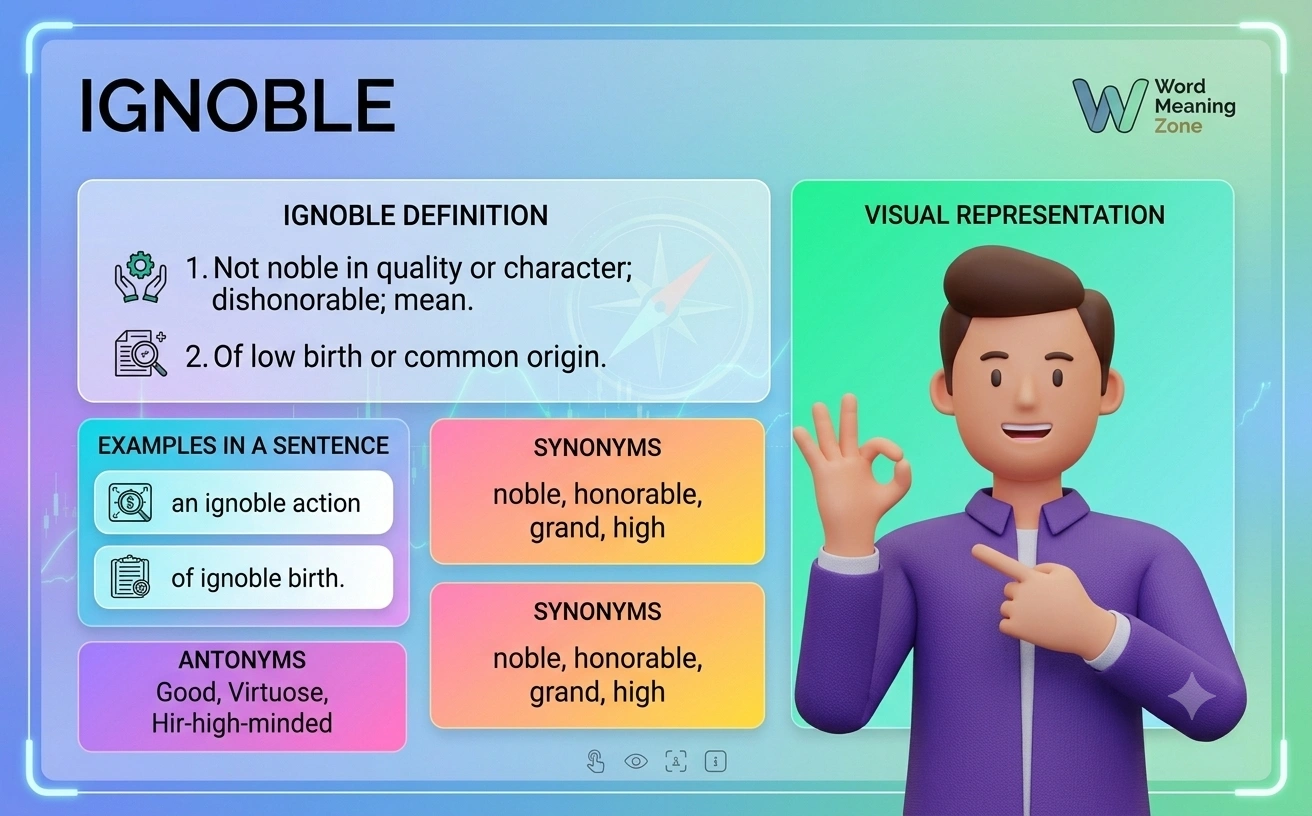
If you’ve come across the word “ignoble” in a book, news article, or conversation and paused to ask “what does this actually mean?” — you’re in the right place. This guide gives you the complete ignoble definition, how to pronounce it correctly, its French roots, synonyms, antonyms, and real example sentences so you can start using it confidently today.
Quick Answer: Ignoble Definition in One Line
Ignoble (adjective) means not honorable in character or purpose; base, shameful, or dishonorable.
It describes an action, motive, feeling, or person that lacks moral dignity — the opposite of noble, admirable, or upright.
“It was an ignoble act to abandon his team right before the deadline.”
Full Dictionary Definition of Ignoble
Word: Ignoble Part of speech: Adjective Pronunciation: ig-NOH-buhl (IPA: /ɪɡˈnoʊbəl/)
Definition:
- Not honorable in character or purpose; shameful or dishonorable (e.g., an ignoble betrayal).
- Of humble origin or low social rank (a now less common, more historical usage).
- Lacking dignity or excellence; mean-spirited or petty in nature.
In modern everyday use, meaning #1 is by far the most common. When someone calls a motive, act, or defeat “ignoble,” they mean it was shameful, disgraceful, or beneath basic standards of honor.
Read More: Asynchronous Class Meaning: What It Really Means (With Examples)
What Is the Definition of the Word “Ignoble”? (Explained Simply)
People often search specifically for “what is the definition of the word ignoble” or “what is the definition of ignoble” because the word sounds formal and unfamiliar. Here’s the simplest way to remember it:
- Noble = honorable, admirable, dignified
- Ig-noble = the opposite — dishonorable, shameful, low
Think of the prefix “ig-” (a form of “in-“) as a negation, much like “il-” in “illegal” or “im-” in “impossible.” So ignoble literally means “not noble.”
Ignoble Definition Simple
If you want the ignoble definition simple version, without dictionary language, here it is:
Ignoble = shameful, low, or dishonorable behavior or purpose.
Use it when you want to describe something that a decent, honorable person wouldn’t do — lying to win, betraying a friend for personal gain, or quitting in a cowardly way are all “ignoble” acts.
Ignoble Definition and Stressed Syllable
Getting the pronunciation right matters, especially if you plan to use “ignoble” in speech or a presentation. Here’s the breakdown:
- Syllables: ig-no-ble (3 syllables)
- Stressed syllable: The stress falls on the second syllable — “NO.”
- Phonetic spelling: ig-NOH-buhl
- IPA: /ɪɡˈnoʊ.bəl/
A common mistake is stressing the first syllable (“IG-no-ble”), which sounds incorrect to native English speakers. Practice it as ig-NOH-buhl, matching the stress pattern of the word “noble” itself (NOH-buhl) with “ig” added before it.
Read More: Palayon Meaning in Filipino: 5 Facts to Know (2026)
Ignoble Définition en Français (Ignoble Definition Francais)
For French speakers or bilingual learners searching for “ignoble définition” or “ignoble definition francais,” here’s the connection:
Interestingly, “ignoble” is also a real French word, and its meaning is very close to the English version — but slightly stronger in everyday French usage.
Ignoble (French adjective):
- Meaning: Vile, despicable, disgusting, or morally repugnant.
- Used to describe behavior, conditions, or people that are deeply shameful or repulsive — often more emotionally intense than its English counterpart.
- Example: “Son comportement envers ses employés était ignoble.” (His behavior toward his employees was ignoble/despicable.)
Key difference: In French, “ignoble” can also describe something physically disgusting (like a smell or a dirty place), not just moral character — a nuance that’s less common in English.
Both the English and French words come from the same Latin root, “ignobilis” (meaning “not well-known” or “of low birth”), which evolved over centuries into today’s meaning of moral disgrace.
Word Origin and Etymology
- Latin root: ignobilis — a combination of in- (“not”) + gnobilis/nobilis (“known, famous, noble”).
- Originally, the Latin term referred to someone of low or unknown birth/rank rather than someone who behaved badly.
- Over time, especially by the 16th–17th century in English, the meaning shifted from “low social status” to “morally low” or “dishonorable” — the primary meaning used today.
Synonyms of Ignoble
Use these words interchangeably with “ignoble” depending on context:
- Dishonorable
- Shameful
- Disgraceful
- Base
- Despicable
- Contemptible
- Vile
- Mean-spirited
- Degrading
- Unworthy
Antonyms of Ignoble
The opposite of ignoble includes:
- Noble
- Honorable
- Dignified
- Admirable
- Virtuous
- Respectable
How to Use “Ignoble” in a Sentence
Here are several example sentences showing different contexts:
- “Cheating on the exam was an ignoble way to secure top marks.”
- “The king was remembered not for his victories, but for his ignoble treatment of his own people.”
- “There’s something ignoble about mocking someone who can’t defend themselves.”
- “He suffered an ignoble defeat, losing the match after refusing to follow the rules.”
- “Her ignoble motives were finally exposed when the truth came out.”
Notice how “ignoble” is almost always paired with actions, motives, defeats, or behaviors — rarely with neutral objects.
Read More: Nefarious Meaning: Full Definition, Origin, Synonyms & Uses (2026)
Related Word Forms
- Ignobly (adverb): In a shameful or dishonorable manner. “He ignobly fled the scene instead of helping.”
- Ignobility / Ignobleness (noun): The state or quality of being ignoble; dishonorable character. “The ignobility of his scheme shocked everyone.”
Ignoble vs. Similar Words: Common Confusions
| Word | Meaning | Difference from Ignoble |
|---|---|---|
| Ignorant | Lacking knowledge or awareness | Not related to morality — about knowledge, not honor |
| Ignoble | Dishonorable, shameful | About moral character and behavior |
| Noble | Honorable, admirable | Direct opposite of ignoble |
| Ignominious | Deserving or causing public disgrace | Very close in meaning, but usually used for outcomes (an “ignominious defeat”) rather than character traits |
FAQs About Ignoble Definition
What is the definition of ignoble?
Ignoble means not honorable in character or purpose; shameful, base, or dishonorable.
What is the definition of the word ignoble in one sentence?
It’s an adjective describing actions, motives, or people that lack honor, dignity, or moral decency.
Is “ignoble” a formal or informal word?
It’s a formal, literary word most often found in writing, speeches, and journalism rather than casual conversation.
What is the ignoble definition simple version for kids or beginners?
Ignoble simply means “not noble” — behaving in a way that isn’t honest, fair, or admirable.
How do I pronounce ignoble correctly, and which syllable is stressed?
Say it as ig-NOH-buhl, with the stress on the second syllable (“NOH”) — the same stress pattern as the word “noble.”
What does “ignoble” mean in French (ignoble définition)?
In French, “ignoble” means vile, despicable, or morally repugnant — it can describe both behavior and physical conditions, and generally carries a stronger, more disgusted tone than the English word.
I searched “Ignoble Definition trackid=sp-006” — why does this appear?
That text is simply a tracking parameter automatically added by some mobile search apps (like the Google Search app) to the end of a search query — it has no effect on the meaning of the word. The actual definition of “ignoble” remains exactly as explained above, regardless of that tag in the URL.
What’s the opposite of ignoble?
The opposite is “noble,” meaning honorable, dignified, or admirable in character.
Final Takeaway
Ignoble is a powerful, formal adjective used to describe dishonorable, shameful, or base behavior — the direct opposite of “noble.” Whether you’re writing an essay, preparing for a vocabulary test, or just expanding your English vocabulary, remembering the simple formula “ignoble = not noble” will help the meaning stick for good.
Looking to expand your vocabulary further? Explore more word meanings, definitions, and grammar guides on WordMeaningZone.
