
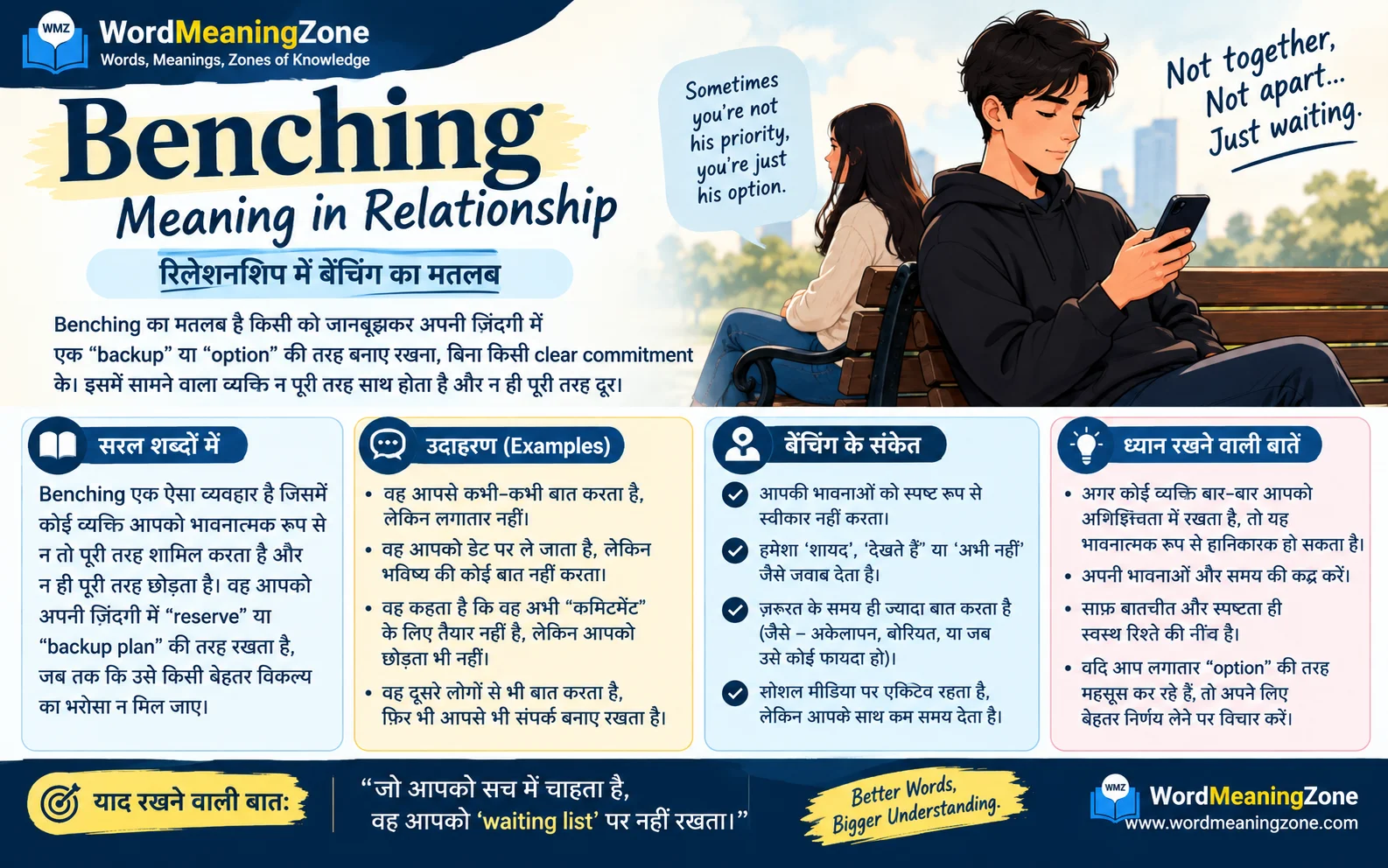
Benching meaning in relationship refers to a dating pattern where someone keeps you interested and available — through occasional texts, likes, or half-hearted plans — without ever committing to a real relationship or fully letting you go. You’re not their priority, but you’re not cut off either. You’re simply “on the bench,” waiting to be called into the game if and when they decide you’re needed.
It’s one of the more confusing modern dating behaviors, because it doesn’t feel like outright rejection. It feels like almost something. That ambiguity is exactly what makes it hurt.
Where the Term “Benching” Actually Comes From
Most articles skip this, but it matters: the word comes directly from sports. In basketball, football, or cricket, a benched player isn’t removed from the team — they’re just not playing right now. The coach keeps them around as a backup option, ready to sub in if a starting player gets injured or underperforms.
Apply that to dating, and it’s an exact match. A person who “benches” you isn’t dumping you. They’re keeping you as a reserve option while they pursue someone else (their “starting player”), or while they enjoy being single without commitment. You get called off the bench only when it’s convenient for them — a slow weekend, a breakup with someone else, or simple boredom.
Understanding this sports origin is useful because it reframes the behavior correctly: benching isn’t really about you. It’s about the bencher managing their own options.
Benching vs. Ghosting vs. Breadcrumbing vs. Zombieing
People often use these terms interchangeably, but they describe different behaviors:
| Term | What Happens | Contact Pattern |
|---|---|---|
| Benching | You’re kept as a backup option, not fully dropped | Sporadic but consistent enough to stay on your radar |
| Ghosting | The person disappears completely | Zero contact, no explanation |
| Breadcrumbing | Small, flirty “crumbs” of attention with no real intention to date | Random likes, occasional flirty texts, no plans made |
| Zombieing | Someone ghosts, then reappears later as if nothing happened | Silence, then a sudden resurrection |
The key difference: benching almost always involves some level of real interaction — the person still messages you, still occasionally sees you, and may even call you their “situationship.” Breadcrumbing, by contrast, is usually thinner and less personal. Ghosting and zombieing involve disappearance; benching involves controlled presence.
What Is “Back Benching” in a Relationship?
This phrase trips a lot of people up because “back bencher” is a familiar school term for students who sit at the back of the class and stay uninvolved. In a relationship context, “back benching” isn’t a separate, officially defined concept — it’s a colloquial variation people use to describe the same core idea as benching: being placed at the back, out of active consideration, while someone else takes the “front seat” in the person’s attention.
If you’ve searched this exact phrase, know that it’s asking the same question as “benching meaning in relationship” — you’re wondering if you’re a genuine priority or a background option. The advice and signs below apply equally.
Also Read: Supercalifragilisticexpialidocious Meaning
Signs You’re Being Benched
- They reply inconsistently — fast one day, silent for four days the next, with no real pattern
- Plans get suggested but rarely confirmed (“we should hang out sometime” never becomes an actual date)
- They resurface right after their more “active” relationship or dating prospect falls through
- Your relationship has no defined label, and any attempt to discuss “what we are” gets deflected
- They’re active on social media and clearly not busy, yet still slow to respond to you
- You always seem to be the one initiating contact after gaps in conversation
- They keep just enough warmth in the conversation (compliments, occasional flirting) to stop you from walking away entirely
Why Do People Bench Others?
This is where most content on this keyword stays shallow. Here’s a deeper look at the actual motivations behind benching:
1. Option-hoarding as a scarcity response. Some people bench others not because they’re cruel, but because they’re anxious about scarcity — they fear that if they let go of every “maybe,” they’ll end up with nothing. Keeping you on the bench is a hedge against loneliness, not necessarily a plan to use you.
2. Avoidant attachment style. People with an avoidant attachment pattern often struggle with full intimacy. Benching lets them keep a connection at arm’s length — close enough to feel wanted, far enough to avoid vulnerability.
3. Ego maintenance, not romance. For some benchers, the goal isn’t a future relationship with you at all — it’s the reassurance of knowing someone is still interested. Your attention is the reward; commitment was never the plan.
4. Situational convenience. Not all benching is calculated. Sometimes it’s simply someone dating multiple people casually and being honest with themselves that you’re not (yet) their top choice — but they haven’t told you that directly.
The “Bench Rotation” Pattern
A pattern worth naming explicitly, since it rarely gets discussed: many people don’t bench just one person — they rotate between two or three “bench players” at once, spreading light attention across all of them so no single connection fully dies. If you notice the timing of their attention to you lining up suspiciously with gaps in their other relationships or dating app activity, you’re likely one node in this rotation rather than a unique case.
How to Respond If You’re Being Benched
- Name it plainly. Ask directly: “Are we exclusive, or are you seeing other people too?” Vague situations survive on vagueness — a direct question often forces clarity.
- Stop initiating for two weeks. If the relationship only survives because you keep restarting it, that’s information in itself.
- Decide your minimum standard before you’re offered “the game.” Know in advance what commitment level you actually want, so a sudden burst of attention doesn’t talk you out of your own needs.
- Don’t compete for a starting spot you were never offered. Trying harder rarely converts a bench player into a priority — it usually just extends the bench.
Also Read: Fidelity Meaning in Hindi
Is Benching Toxic, or Just Human Nature?
It’s worth resisting the urge to villainize every bencher. Keeping options open during early, undefined dating is common and not inherently malicious — most people do some version of it before committing. It becomes genuinely harmful when it’s prolonged, one-sided, and undisclosed — when someone deliberately maintains your hope without ever intending to invest, purely to keep you available on standby. The line isn’t the behavior itself; it’s the dishonesty and duration.
Benching Meaning in Relationship — Regional Language Equivalents
Since this term is searched widely across India, here’s what the concept translates to conceptually in different languages (there’s no single official translated term, but this is how the idea is commonly expressed):
| Language | How the Concept Is Understood |
|---|---|
| Benching Meaning in Relationship in Hindi | किसी को “ऑप्शन” या “बैकअप” के तौर पर रखना — बिना पूरी तरह कमिटमेंट दिए उम्मीद बनाए रखना |
| Benching Meaning in Relationship in Tamil | ஒருவரை முழுமையாக ஏற்காமல், ஒரு “பேக்-அப்” ஆப்ஷனாக வைத்திருப்பது |
| Benching Meaning in Relationship in Telugu | పూర్తిగా కమిట్ కాకుండా ఒకరిని “బ్యాకప్ ఆప్షన్”గా ఉంచుకోవడం |
| Benching Meaning in Relationship in Malayalam | പൂർണ്ണമായി പ്രതിബദ്ധത കാണിക്കാതെ ഒരാളെ “ബാക്കപ്പ് ഓപ്ഷൻ” ആയി നിലനിർത്തുക |
| Benching Meaning in Relationship in Bengali | সম্পূর্ণ প্রতিশ্রুতি না দিয়ে কাউকে “বিকল্প” হিসেবে রেখে দেওয়া |
| Benching Meaning in Relationship in Marathi | पूर्णपणे वचनबद्ध न होता एखाद्याला “पर्याय” म्हणून ठेवणे |
In each case, the core idea stays identical across languages: someone is kept as a reserve option rather than treated as a true priority.
FAQs About Benching Meaning in Relationship
What is Benching Meaning in Relationship?
It means being kept as a backup or low-priority option by someone who stays in occasional contact but avoids full commitment or clearly defining the relationship.
What is Benching Meaning in Relationship, in one line?
Being kept interested just enough that you don’t walk away, without ever being made a real priority.
Is benching the same as being ghosted?
No. Ghosting is total disappearance; benching involves continued, if inconsistent, contact.
How long does benching usually last?
There’s no fixed timeline — it can last weeks or drag on for months, often ending only when the bencher’s “starting option” changes or when the benched person stops responding.
Can benching turn into a real relationship?
Occasionally, yes — if circumstances change and the bencher decides to commit. But it’s not something to wait around for; it should come from a direct conversation, not hope.
