
If you’ve stumbled across the word “quixotic” in a novel, a news article, or a conversation and thought, “what does that even mean?” — you’re not alone. It’s one of those words that sounds fancy but has a surprisingly simple meaning once you break it down.
Note: Every definition, example, and pronunciation guide in this article is pulled directly from trusted sources like Oxford and Merriam-Webster — not an AI-generated guess. You’re getting the real, verified answer.
Let’s get straight into it.
What Is the Quixotic Definition? (Quick Answer)
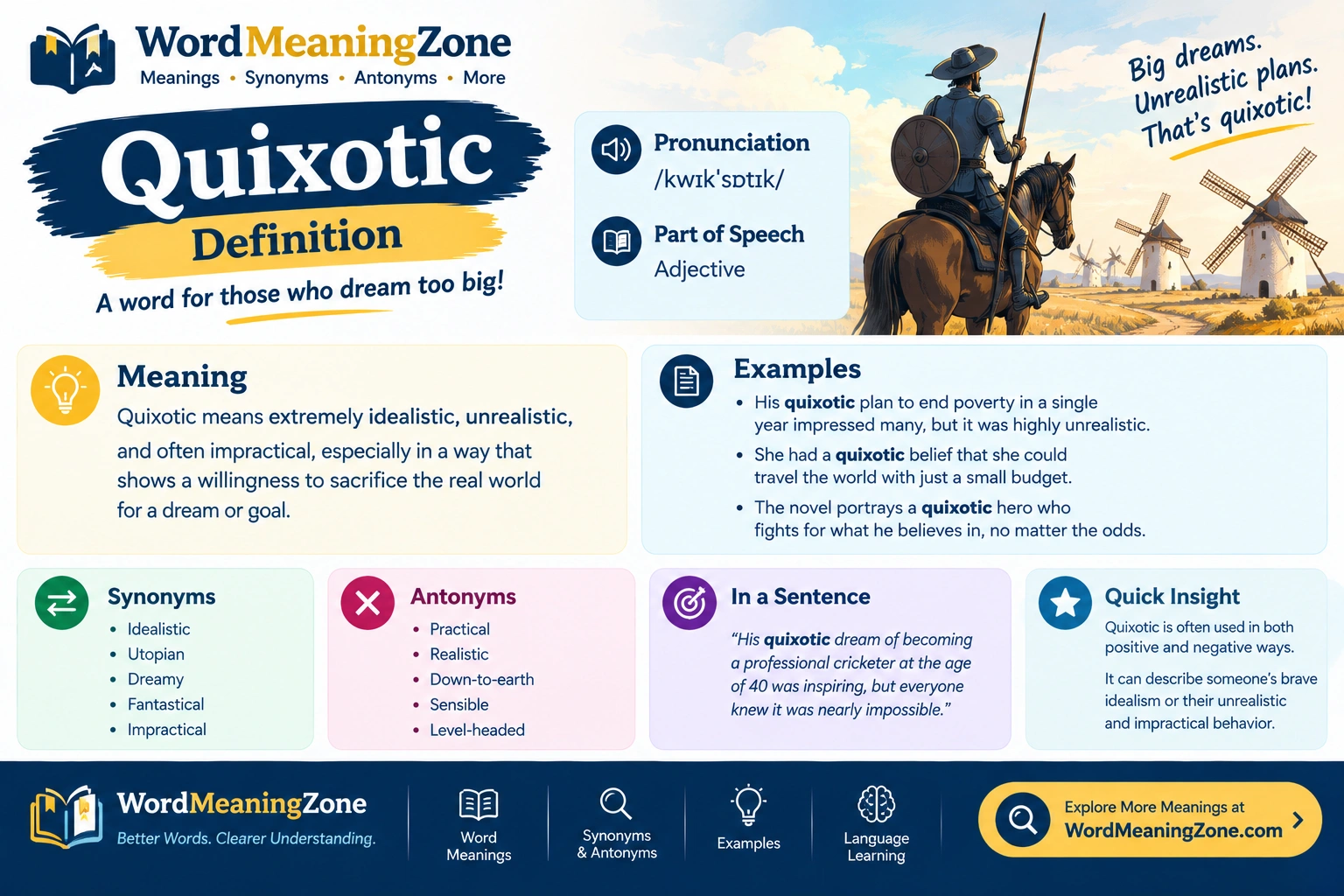
Quixotic (adjective) describes ideas, plans, or people that are extremely idealistic, unrealistic, and impractical — usually because they’re driven by noble or romantic intentions rather than common sense.
In plain English: if someone has a quixotic plan, they’re chasing a dream that sounds admirable but probably won’t work out in the real world.
Pronunciation: kwik-SOT-ik
Quixotic Definition Simple (For Everyday Use)
If dictionary language still feels a bit complicated, here’s the simplest way to understand it:
Quixotic = hopeful, romantic, or idealistic in a way that isn’t practical.
Think of someone who wants to single-handedly end world hunger by next week, or a person who quits a stable job to chase a wildly ambitious dream with no real plan. Their intentions are good — even admirable — but the plan itself isn’t grounded in reality. That’s quixotic.
Read More: Asynchronous Class Meaning: What It Really Means (With Examples)
Quixotic Definition Meaning (In Detail)
The word carries two closely related shades of meaning:
- Foolishly impractical, especially in the pursuit of ideals — used for goals, plans, or actions that are unrealistic despite being well-intentioned.
- Extravagantly chivalrous or romantic — used to describe someone who acts with old-fashioned, noble idealism, like a “knight in shining armor” chasing a cause that can’t realistically succeed.
A quixotic person isn’t lazy or foolish in general — they’re often passionate, imaginative, and driven by strong ideals. The issue is that their goals tend to ignore practical limitations like time, money, logistics, or plain reality.
Quixotic Definition Pronunciation
Getting the pronunciation right matters, especially since the spelling doesn’t give many clues.
- Phonetic spelling: kwik-SOT-ik / kwik-SAH-tik
- IPA (US): /kwɪkˈsɑːtɪk/
- IPA (UK): /kwɪkˈsɒtɪk/
- Syllables: quix-ot-ic (3 syllables)
- Stress: on the second syllable (“SOT”)
A quick way to remember it: it rhymes loosely with “exotic” — just swap the first syllable for “kwix.”
Quixotic Definition – Oxford Dictionary
According to Oxford’s learner and general dictionaries, quixotic describes ideas or plans that show imagination and idealism but are usually not practical. Oxford also directly ties the word to its origin — the character Don Quixote, whose adventures come from chasing goals that are essentially impossible to achieve.
Oxford’s framing highlights the same theme most dictionaries agree on: imaginative, well-meaning, but not grounded in reality.
Merriam-Webster Quixotic Definition
Merriam-Webster defines quixotic as foolishly impractical, especially in the pursuit of ideals, and notes it can specifically describe actions marked by rash, lofty, romantic notions or extravagantly chivalrous behavior that’s essentially doomed to fail. Merriam-Webster also lists a secondary, less common sense: capricious or unpredictable.
Merriam-Webster’s own Simple Definition puts it more casually: being hopeful or romantic in a way that isn’t practical — a version that’s especially useful if you want an easy, no-frills explanation of the word.
Read More: Palayon Meaning in Filipino: 5 Facts to Know (2026)
Where Does the Word Quixotic Come From? (Origin & Etymology)
Quixotic comes from Don Quixote, the title character of Miguel de Cervantes’ classic 1605 Spanish novel El ingenioso hidalgo don Quijote de la Mancha (“The Ingenious Hidalgo Don Quixote of La Mancha”).
In the story, Don Quixote is an aging man so obsessed with tales of chivalry that he sets out on grand, noble quests — including his most famous blunder: mistaking windmills for giant enemies and charging at them with a lance. His adventures are heroic in spirit but completely disconnected from reality.
The adjective “quixotic” has been used in English since at least the early 1700s to describe people or ideas that share Don Quixote’s blend of admirable idealism and impractical execution — which is why “tilting at windmills” is still used today as a related expression for chasing an unwinnable fight.
Quixotic Definition Synonyms
Looking for a different way to say “quixotic”? Here are some of the closest synonyms, along with their subtle differences:
| Synonym | Slight Difference |
|---|---|
| Idealistic | Focuses on high ideals, without the “doomed to fail” tone |
| Unrealistic | More general; lacks the romantic/noble connotation |
| Impractical | Focuses purely on practicality, not idealism |
| Romantic | Emphasizes emotion and imagination over realism |
| Visionary | Can be positive; stresses imagination over impracticality |
| Fanciful | Suggests pure imagination, less about “noble goals” |
| Chimerical | More formal/literary; implies something imaginary or unattainable |
| Utopian | Specifically about idealized, perfect (and unrealistic) societies or plans |
| Starry-eyed | Informal; suggests naive optimism |
Quixotic Definition Antonyms: practical, realistic, pragmatic, sensible, down-to-earth.
Read More: Nefarious Meaning: Full Definition, Origin, Synonyms & Uses (2026)
Quixotic Definition and Examples
Seeing the word in context makes it much easier to use correctly. Here are some example sentences:
- “Her quixotic plan to build a school in a war zone with no funding impressed everyone, even though it never got off the ground.”
- “Critics called the senator’s campaign promises quixotic, arguing they sounded great but were financially impossible.”
- “He had a quixotic notion that he could repair their broken friendship with a single letter.”
- “Starting a bookstore in the age of e-commerce might be considered a quixotic venture, but he opened one anyway.”
- “The startup’s mission was undeniably quixotic — to eliminate world poverty within a decade using a mobile app.”
Notice the pattern: the intentions are admirable, but success is unlikely.
Waxing Quixotic Definition: What Does This Phrase Mean?
You may have also come across the phrase “waxing quixotic.” This combines two ideas:
- “Wax” here doesn’t mean the substance — it’s an older usage meaning “to become” or “to speak in a certain manner” (as in “wax poetic” or “wax nostalgic”).
- “Quixotic” carries its usual meaning of idealistic and unrealistic.
So, “waxing quixotic” means to talk or write about something in an idealistic, romantically unrealistic, or overly hopeful way — often at length and with obvious passion, even if the topic isn’t grounded in reality.
Example: “After a few drinks, he started waxing quixotic about quitting his job to sail around the world.”
Quixotic Definition: Quick Recap Table
| Feature | Details |
|---|---|
| Word | Quixotic |
| Part of Speech | Adjective |
| Simple Meaning | Idealistic and impractical |
| Pronunciation | kwik-SOT-ik |
| Origin | Don Quixote (Cervantes, 1605) |
| Synonyms | Idealistic, unrealistic, utopian, visionary |
| Antonyms | Practical, realistic, pragmatic |
| Related Phrase | Waxing quixotic |
Frequently Asked Questions About Quixotic Definition
What is the Quixotic Definition?
Quixotic means extremely idealistic, unrealistic, and impractical — usually describing plans or people driven by noble intentions rather than practicality.
Is quixotic a positive or negative word?
It’s mostly neutral-to-negative, since it points out that something isn’t realistic. However, it can carry a slightly admiring tone too, since it usually implies the person’s intentions are noble or romantic, even if impractical.
How do you use quixotic in a sentence?
Use it to describe a plan, idea, or person that is admirably idealistic but unlikely to succeed — for example, “Their quixotic dream of ending traffic congestion overnight was inspiring, if unrealistic.”
What’s the difference between quixotic and idealistic?
Idealistic simply means holding high standards or ideals. Quixotic goes a step further, implying those ideals are chased in a way that’s impractical or doomed to fail.
Where does the word quixotic come from?
It comes from the character Don Quixote, from Miguel de Cervantes’ 1605 novel, who famously chased noble but unrealistic quests, including his mistaken attack on windmills.
What is a simple synonym for quixotic?
“Unrealistic” or “idealistic” are the simplest one-word replacements, though neither captures the romantic, noble undertone that “quixotic” carries.
Final Thoughts On Quixotic Definition
“Quixotic” is a rich, slightly old-fashioned word for describing big dreams that outpace reality. Whether you’re using it to describe a business plan, a political promise, or a personal goal, it captures that specific mix of admirable idealism and impracticality — something a simple word like “unrealistic” just can’t fully express.
Next time you come across a bold, romantic, but unlikely-to-succeed idea, you’ll know exactly the word to reach for.
