
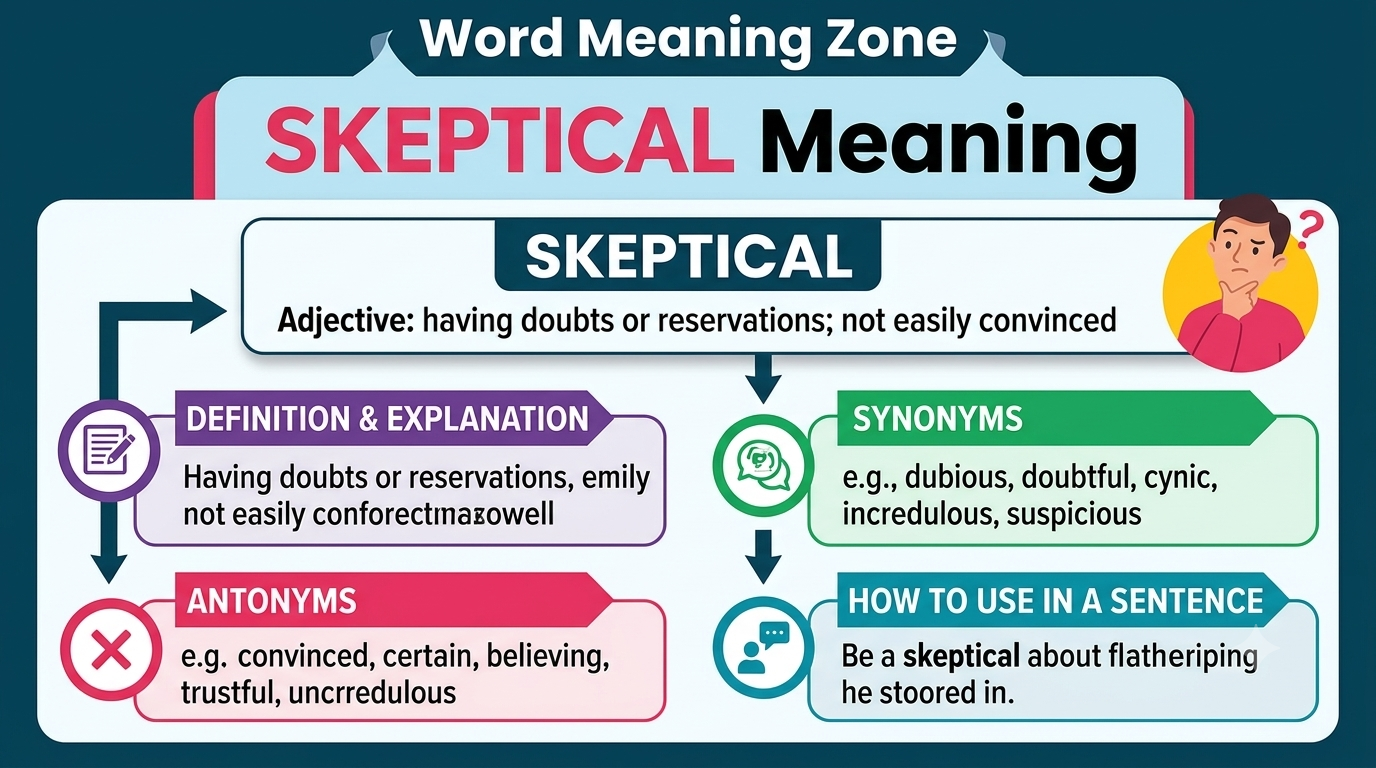
Skeptical means having doubts or reservations about something — not readily accepting a claim, idea, or statement as true without proof or evidence. It’s an adjective used to describe a person’s attitude of questioning rather than blind belief.
Example: “She remained skeptical about the salesman’s promises.”
Now let’s go deeper — because there’s a lot more to this word than a one-line dictionary entry.
Skeptical Meaning in English (Full Definition)
As an adjective, skeptical describes:
- A questioning or doubting attitude — not easily convinced by claims, arguments, or promises without solid proof.
- A philosophical stance — relating to skepticism, the school of thought that questions whether certain knowledge is truly possible.
- A cautious, evidence-first mindset — someone who withholds judgment until they see facts.
Part of speech: Adjective
Pronunciation: /ˈskɛp.tɪ.kəl/ (SKEP-tih-kuhl)
Related forms:
- Noun → skepticism (the state or quality of being skeptical)
- Adverb → skeptically (e.g., “He looked at me skeptically”)
- Person → skeptic (someone who habitually doubts)
Also Read: Quixotic Definition
The Origin of “Skeptical” — A Fact Almost No One Mentions
Most word-meaning pages stop at the definition. But here’s something genuinely interesting: “skeptical” shares its root with the word “telescope.”
The word traces back to the Greek skeptikos (“thoughtful, inquiring”), from skeptesthai (“to look at, consider, examine”). This in turn connects to the ancient root spek-, the same root that gave English words like inspect, suspect, spectacle — and yes, telescope and microscope.
In other words, at its linguistic core, being skeptical isn’t about negativity — it literally means “to look closely.” A skeptical person isn’t someone who refuses to believe; they’re someone who insists on examining something before accepting it. That’s a subtle but important distinction most definitions completely miss.
Skeptical Meaning With Example (Everyday Usage)
Here’s how the word is actually used in real sentences:
- “I’m skeptical that this diet plan will work in just a week.”
- “The scientists remained skeptical of the unverified results.”
- “He gave a skeptical smile when I told him I’d won the lottery.”
- “Investors are growing skeptical about the company’s growth claims.”
- “She’s naturally skeptical, so don’t expect her to agree right away.”
Notice the pattern: skeptical is almost always followed by “of” or “about” — this is the natural grammatical pairing to remember.
Being Skeptical Meaning (What It Says About a Person)
Being skeptical means approaching claims, people, or situations with a “prove it to me” mindset rather than accepting things at face value. A skeptical person:
- Asks for evidence before forming an opinion
- Questions motives behind claims (especially too-good-to-be-true offers)
- Doesn’t dismiss ideas outright — they just need convincing
- Values logic and verification over assumption
Importantly, being skeptical is generally seen as a rational, healthy trait — it protects people from scams, misinformation, and manipulation. It’s different from simply being negative, which brings us to the next point.
Also Read: What Does “Ignoble” Mean?
Cynical and Skeptical Meaning — The Difference Almost Nobody Explains Correctly
This is one of the most confused word pairs in English, and most sites treat them as synonyms. They aren’t.
| Skeptical | Cynical | |
|---|---|---|
| Core attitude | “Show me proof” | “It’s probably fake/selfish anyway” |
| Open to persuasion? | Yes, with evidence | Often no, regardless of evidence |
| Underlying belief | People/facts can be trustworthy, but need verification | People/facts are usually dishonest or self-serving |
| Example | “I’m skeptical of this offer until I see the contract.” | “All salesmen lie, so I won’t even look at the contract.” |
In short: a skeptic questions; a cynic has already decided the answer is negative. Skepticism is a method; cynicism is a mindset.
Feeling Skeptical Meaning
When someone says they’re “feeling skeptical,” they mean they currently have an internal sense of doubt or hesitation about a specific situation — it’s the emotional experience of skepticism rather than a permanent personality trait.
Example: “I’m feeling skeptical about this job offer — the salary seems too high for the role.”
This is often temporary and tied to a specific trigger (an unusual claim, a red flag, a gut feeling), unlike being a “skeptic,” which describes an ongoing personality trait.
What Does “Skeptical About Love” Mean?
A common search is around skeptical love or being skeptical in relationships. This doesn’t mean disliking love — it describes a guarded emotional state, usually caused by past heartbreak, betrayal, or disappointment, where a person hesitates to fully trust romantic feelings or a partner’s intentions. Someone who is “skeptical about love” isn’t against love itself; they simply need more reassurance and consistency before they let their guard down.
Overly Skeptical Meaning — When Doubt Becomes a Problem
While skepticism is generally healthy, overly skeptical describes a point where doubt becomes excessive or counterproductive — questioning even well-supported facts, refusing to trust reliable sources, or being unable to accept anything without extreme, often unreasonable, levels of proof.
Signs someone is overly skeptical:
- Rejecting expert consensus without valid reasoning
- Assuming bad intent even with clear evidence otherwise
- Struggling to make decisions because “nothing feels certain enough”
The healthy version of skepticism updates its opinion when good evidence appears. The overly skeptical version keeps moving the goalposts.
Also Read: Esoteric Meaning
Sceptical or Skeptical Meaning — Which Spelling Is Correct?
Both are correct — the meaning is identical. The difference is purely regional:
- Skeptical → American English (used in the US, and increasingly online/globally)
- Sceptical → British English (used in the UK, Australia, India’s formal/academic writing, and most Commonwealth countries)
If you’re writing for an American audience, use “skeptical.” If you’re writing in British-style English, “sceptical” is the standard form. Neither is “more correct” — it’s simply a spelling convention, similar to “color” vs “colour.”
Skeptical Meaning Synonyms and Antonyms
Synonyms: doubtful, doubting, disbelieving, distrustful, questioning, unconvinced, dubious, incredulous, wary, suspicious, unbelieving
Antonyms: trusting, convinced, credulous, certain, confident, believing
Skeptical Meaning in Different Languages (With Examples)
Here’s how “skeptical” translates across major languages — useful for readers searching in their native tongue.
Skeptical Meaning in Hindi (With Example)
Hindi: संशयशील (sanshayasheel) / संशयवादी (sanshayvaadi) / अविश्वासपूर्ण (avishwaspurn)
Example: “मुझे इस योजना पर संशय है।” (I am skeptical about this plan.)
Skeptical Meaning in Tamil
Tamil: சந்தேகம் கொண்ட (sandhegam konda) — meaning “one who holds doubt”
Skeptical Meaning in Telugu
Telugu: సంశయాత్మక (samshayatmaka) / అనుమానాస్పద (anumanaspada)
Skeptical Meaning in Malayalam
Malayalam: സംശയാലുവായ (samshayaluvaya)
Skeptical Meaning in Kannada
Kannada: ಸಂಶಯಾತ್ಮಕ (samshayatmaka)
Skeptical Meaning in Marathi
Marathi: संशयी (sanshayi) / शंकेखोर (shankekhor)
Skeptical Meaning in Bengali
Bengali: সংশয়ী (sanshoyi) / সন্দিহান (sandihan)
Skeptical Meaning in Punjabi
Punjabi: ਸ਼ੱਕੀ (shakki) / ਸੰਦੇਹਵਾਦੀ (sandehvadi)
Skeptical Meaning in Gujarati
Gujarati: શંકાશીલ (shankashil)
Skeptical Meaning in Farsi
Farsi: شکاک (shakkāk)
Note: Regional dialects and formal/informal usage can slightly change the preferred word in each language — these are the most widely accepted translations.
Also Read: Internalized Synonym
Frequently Asked Questions
What is the meaning of skeptical?
It means having doubts or not being easily convinced about the truth of a claim, statement, or situation without proof.
What is the meaning of being skeptical?
It describes an attitude of questioning and requiring evidence before accepting something as true, rather than believing it automatically.
What is the meaning of skeptical person?
A skeptical person is someone who habitually questions claims, ideas, or promises and prefers evidence and logic over blind trust.
What is the meaning of the word skeptical?
It comes from Greek “skeptikos,” meaning “thoughtful or inquiring,” and describes a doubting, evidence-seeking attitude.
What is the meaning of skeptical in Hindi?
In Hindi, skeptical is translated as संशयशील (sanshayasheel) or संशयवादी (sanshayvaadi), meaning “doubtful” or “one who questions.”
What is the meaning of skeptical in English?
In English, it simply means doubtful, questioning, or not easily persuaded — used as an adjective before or after a noun (“a skeptical mind,” “she was skeptical”).
What is the meaning of skeptical love?
It refers to being cautious or guarded in matters of the heart — hesitating to fully trust love or a partner’s intentions, usually due to past experiences.
