
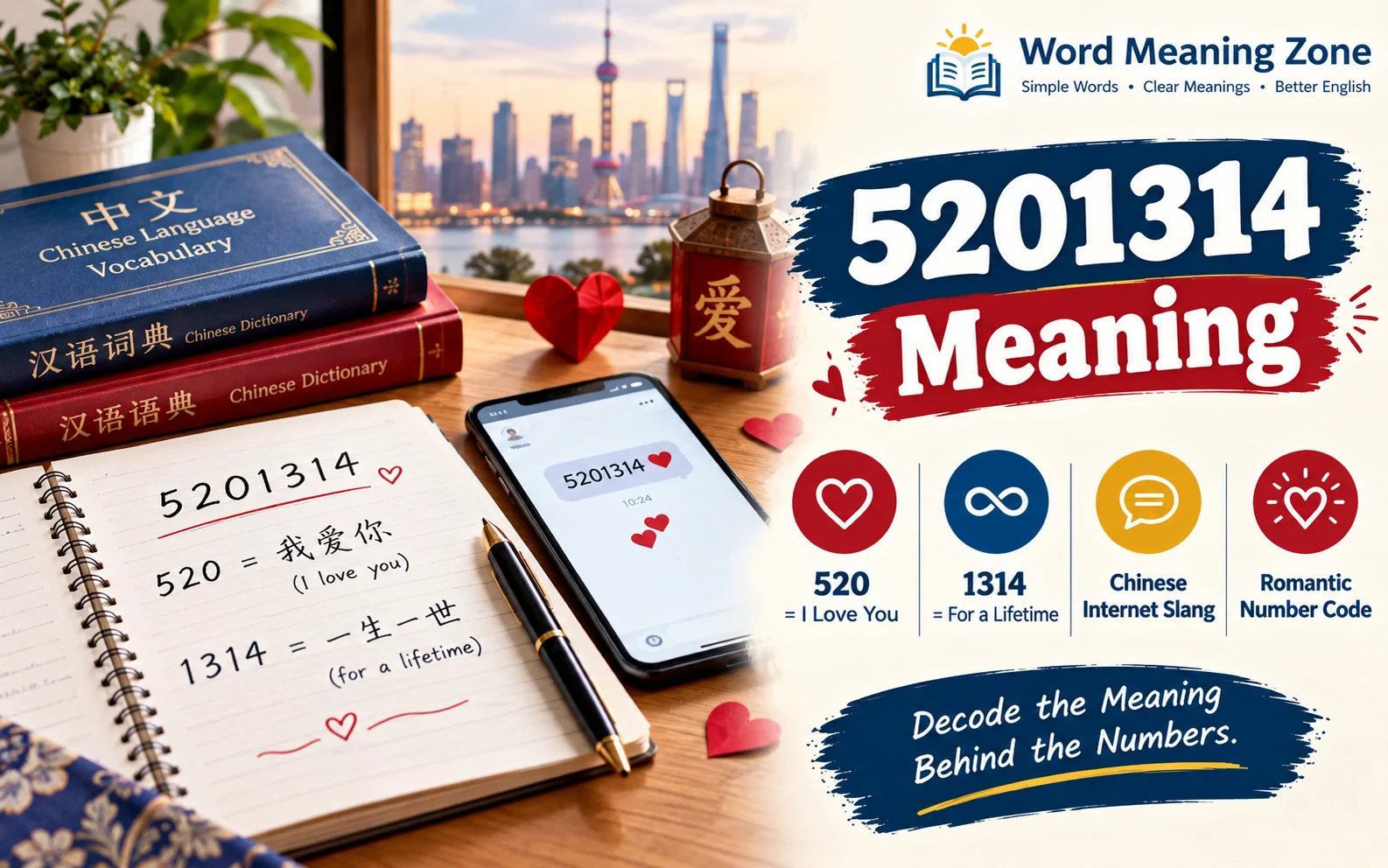
5201314 is Chinese internet slang that reads phonetically as “I love you for a lifetime” — it fuses 520 (which sounds like 我爱你 / wǒ ài nǐ, “I love you”) with 1314 (which sounds like 一生一世 / yī shēng yī shì, “for one life, one world” — i.e., forever).
If you’ve ever seen 5201314 tattooed on someone’s wrist, stamped on a wedding invitation, or dropped into a WeChat chat right after “I miss you already,” and wondered what 5201314 Meaning, then you’ve stumbled onto one of the internet’s oldest and most durable love codes. I’ve spent years picking apart internet slang and numeric codes for content projects, and 5201314 is one of the rare ones that’s survived over two decades of meme culture without losing its meaning. That’s worth understanding properly — not just as a translation, but as a piece of digital culture with real staying power in 2026.
What Does 5201314 Mean? (The Short Version)
Break it into two chunks:
| Number | Pinyin | Sounds Like | Meaning |
|---|---|---|---|
| 520 | wǔ èr líng | 我爱你 (wǒ ài nǐ) | “I love you” |
| 1314 | yī sān yī sì | 一生一世 (yī shēng yī shì) | “For a lifetime” |
| 5201314 | wǔ èr líng yī sān yī sì | 我爱你一生一世 | “I love you for a lifetime” |
Neither 520 nor 1314 is a word in Mandarin — they’re numbers that happen to sound like romantic phrases when you say them out loud fast. This is called a homophonic pun, and it’s one of the most common tricks in Chinese internet slang, going back to the earliest days of Chinese SMS and ICQ chat in the late 1990s.
Here’s the thing most explainer articles miss: this isn’t a one-off gimmick. It’s part of an entire system of number-based love language that Chinese speakers still use daily in 2026 — and that’s why 5201314 has outlasted a hundred forgettable memes.
Also Read: 52013 Meaning in Hindi: 7 अंकों की लव स्टोरी
Why Do Numbers Sound Like Words in Chinese? (The Real Mechanism)
Mandarin has a limited number of syllable sounds compared to English, so it’s naturally packed with homophones — words that sound alike but mean different things. Numbers are no exception.
- 5 (wǔ) is close enough to 我 (wǒ), “I/me”
- 2 (èr) is close enough to 爱 (ài), “love”
- 0 (líng) is close enough to 你 (nǐ), “you”
- 1 (yī), said twice with 3 (sān) and 4 (sì) in between, echoes 一生一世, “one life, one world”
None of these are exact matches — it’s approximate, playful pronunciation, the same instinct that gives English speakers “GR8” for “great” or “CU” for “see you.” The difference is that in Chinese, this wordplay became a cultural institution rather than a passing texting shortcut.
Expert insight: the reason 520-based slang took off specifically (and not, say, 630 or 410) comes down to tone and rhythm. Mandarin is a tonal language, so a number sequence has to match not just the consonant-vowel sound but roughly the tonal contour of the phrase it’s mimicking. 520 and 我爱你 both have a similar rising-falling cadence when spoken quickly — that’s why it “clicks” instantly to native speakers and 250 (èr bǎi wǔ, which actually means “idiot” in slang) absolutely does not.
Case Study: How 520 Became an Actual Public Holiday (Sort Of)
This is the part that separates 5201314 from a random meme: it created its own day.
Because 520 sounds like “I love you,” May 20th (5/20) has become an unofficial, internet-born Valentine’s Day in China — and the data on it is remarkable:
- In Harbin, 2,736 couples registered marriages on a single 520 day — seven times the average for a normal weekday, according to city marriage registry data reported by China Daily.
- Shenzhen’s civil affairs bureau recorded 1,851 marriage registrations on May 20, 2024 — a five-year high for the city, beating the 1,810 registrations from May 20 the prior year, per Shenzhen Daily.
- In Tianjin, registrations jumped from 847 couples on 520 in one year to 1,214 the next, according to chinadaily.com.cn.
- In 2026, marriage registration offices across major Chinese cities reported overwhelming demand for May 20 and May 21, with couples rushing to register on dates that sound like “I love you” in Mandarin. All 15 marriage registration offices in Guangzhou were fully booked for May 20 as of May 8, and in Nanjing, more than 1,400 couples had secured appointments for the date by late April.
Why this matters for you: this isn’t a dead or fading trend — the 2026 reporting shows it’s still growing, with cities adding extra staff and expanded weekend hours specifically to handle the 520 rush. A numeric love code that reliably moves government office scheduling for two decades running is a genuinely rare piece of internet culture longevity, and it’s why 5201314 still shows up constantly in gifts, tattoos, and captions rather than fading into “does anyone even use this anymore” territory.
5201314 Meaning Across Languages
Because people search for this phrase from every corner of the internet, here’s what “I love you for a lifetime” (the underlying meaning of 5201314) looks like translated into major Indian languages. Note: the number itself doesn’t change — 5201314 is always read in Mandarin. What changes is how you’d express the same sentiment if you wanted to say it in your own language.
| Language | Translation of “I love you for a lifetime” |
|---|---|
| 5201314 Meaning in Hindi | मैं तुमसे जीवन भर प्यार करता/करती हूँ |
| 5201314 Meaning in Tamil | நான் உன்னை வாழ்நாள் முழுவதும் காதலிக்கிறேன் |
| 5201314 Meaning in Telugu | నేను నిన్ను జీవితాంతం ప్రేమిస్తున్నాను |
| 5201314 Meaning in Bengali | আমি তোমাকে সারাজীবন ভালোবাসি |
| 5201314 Meaning in Marathi | मी तुझ्यावर आयुष्यभर प्रेम करतो/करते |
| 5201314 Meaning in Kannada | ನಾನು ನಿನ್ನನ್ನು ಜೀವನಪೂರ್ತಿ ಪ್ರೀತಿಸುತ್ತೇನೆ |
| 5201314 Meaning in Malayalam | ഞാൻ നിന്നെ ജീവിതകാലം മുഴുവൻ സ്നേഹിക്കുന്നു |
| 5201314 Meaning in English | “I love you for a lifetime” / “I will love you forever” |
Author’s tip: if you’re sending 5201314 to someone who doesn’t know Mandarin numeric slang, always pair it with the translation the first time. The number by itself, dropped with zero context, just looks like a phone number or a random string — the romance is entirely in the decoding, and you lose the effect if the other person can’t do that decoding themselves.
Also Read: Benching Meaning in Relationship
5201314 Meaning in Chat: How It’s Actually Used in 2026
Numeric love slang isn’t stuck in 2005-era SMS. In 2026 it shows up in:
- WeChat and Xiaohongshu (RedNote) captions — often stacked with emojis: 💕5201314💕
- Wedding invitations and hongbao (红包) amounts — couples deliberately gift or request ¥520 or ¥1314 as a symbolic figure, not just a round number
- Anniversary and proposal messages, frequently sent at exactly 5:20 or 13:14 on the clock for extra symbolism
- Product pricing and marketing — Chinese e-commerce listings around May 20 will price romantic gift bundles at ¥520 or ¥1314 specifically because of the pun
- Tattoos and jewelry engravings — 5201314 is one of the most requested numeric tattoos among Chinese-speaking couples globally, precisely because it compresses a full sentence into seven digits
This is the pattern I’d point to as the clearest sign of a slang term’s staying power: it has migrated from speech to pricing strategy and product design. That’s a much higher bar than “people still text it sometimes.”
5201314 vs. Other Chinese Love Numbers: Quick Comparison
| Code | Pinyin | Meaning |
|---|---|---|
| 520 | wǔ èr líng | I love you |
| 530 | wǔ sān líng | I miss you |
| 1314 | yī sān yī sì | Forever / for a lifetime |
| 5201314 | wǔ èr líng yī sān yī sì | I love you for a lifetime |
| 9420 | jiǔ sì èr líng | Just love you |
| 1314520 | yī sān yī sì wǔ èr líng | I love you forever (reversed order) |
| 250 | èr bǎi wǔ | Idiot / stupid (⚠️ not romantic — common mix-up) |
The 250 entry is there deliberately: it’s the single most common mistake people make with this slang, and it’s an easy way to accidentally insult someone instead of complimenting them.
A Simple Framework for Decoding Any Chinese Number Slang
Here’s a repeatable method I use whenever I run into a new numeric code and want to figure out if it’s genuine slang or just a random number:
The S.O.U.N.D. Check:
- Say it out loud, fast, in Mandarin pinyin — not English.
- Omit the individual digit names; blend them into one continuous sound.
- Understand tone matters — a rising tone reading might reveal a totally different match than a flat one.
- Narrow to short phrases (2–4 characters) — most love-number slang maps to compact phrases, not full sentences.
- Double-check against a known reference list before trusting a translation you found once online.
Run 5201314 through this and you land exactly on 我爱你一生一世 — which is why this code, unlike most improvised internet numerology, is considered “correct” and standardized rather than a personal guess.
Common Mistakes People Make With 5201314
- Confusing 520 with 250 — one is love, the other is an insult. Double-check before sending.
- Assuming it works in Cantonese — the phonetic match is specific to Mandarin pronunciation; in Cantonese the numbers don’t sound like the same phrase.
- Treating it as a universal “cute number” — outside Chinese-speaking and Chinese-diaspora contexts, it needs an explanation to land.
- Using it in formal or professional writing — it’s romantic slang, not a formal phrase; keep it in personal messages, gifts, and captions.
- Forgetting the reversed version — 1314520 means the exact same thing as 5201314, just in reverse order; both are valid and both are searched heavily online.
How to Use 5201314 (Checklist)
Confirm the recipient will recognize or want an explanation of Chinese number slang
Pair the number with a short translation the first time you use it
Use it in casual/romantic contexts: captions, texts, cards, gifts — not business communication
Consider timing it around May 20th for maximum cultural resonance
Double-check you’re not typing 250 by mistake
If gifting money or a hongbao, consider ¥520 or ¥1314 as the amount for symbolic weight
Key Takeaways
- 5201314 phonetically spells out 我爱你一生一世 — “I love you for a lifetime” — by combining 520 (“I love you”) and 1314 (“forever”).
- The code has real-world weight: May 20th has become an unofficial Chinese Valentine’s Day, driving measurable spikes in marriage registrations year after year, including in 2026.
- It works only in Mandarin pronunciation, not Cantonese or other dialects.
- The reversed form, 1314520, carries the identical meaning.
- Watch out for 250, a similar-looking number that means “idiot,” not love.
Also Read: Sugar Mommy Meaning in Hindi
Short Summary
5201314 is Chinese numeric slang for “I love you for a lifetime,” built by stringing together two homophonic love codes: 520 (I love you) and 1314 (forever). Rooted in 1990s Chinese texting culture, it’s still thriving in 2026 — shaping marriage registration rushes on May 20th, wedding gift amounts, tattoos, and romantic captions across Chinese-speaking communities worldwide.
FAQs
1. What is the meaning of 5201314?
5201314 means “I love you for a lifetime.” It combines 520 (which sounds like “I love you” in Mandarin) and 1314 (which sounds like “for a lifetime” or “forever”).
2. What is 5201314 meaning in Hindi love context?
In Hindi, the sentiment behind 5201314 translates to “मैं तुमसे जीवन भर प्यार करता/करती हूँ” — “I will love you for my whole life.”
3. Is 5201314 used only in China, or globally?
It originated in Mandarin-speaking internet culture in China but is now used across Chinese-speaking communities worldwide, including in Taiwan, Singapore, Malaysia, and Chinese diaspora communities.
4. What is the difference between 520 and 5201314?
520 alone means “I love you.” 5201314 extends that into “I love you for a lifetime” by adding the “forever” component (1314).
5. What is 5201314 meaning in Tamil?
The underlying meaning translates to “நான் உன்னை வாழ்நாள் முழுவதும் காதலிக்கிறேன்” — “I will love you for my whole life” — since the number itself is always read in Mandarin, not Tamil.
