
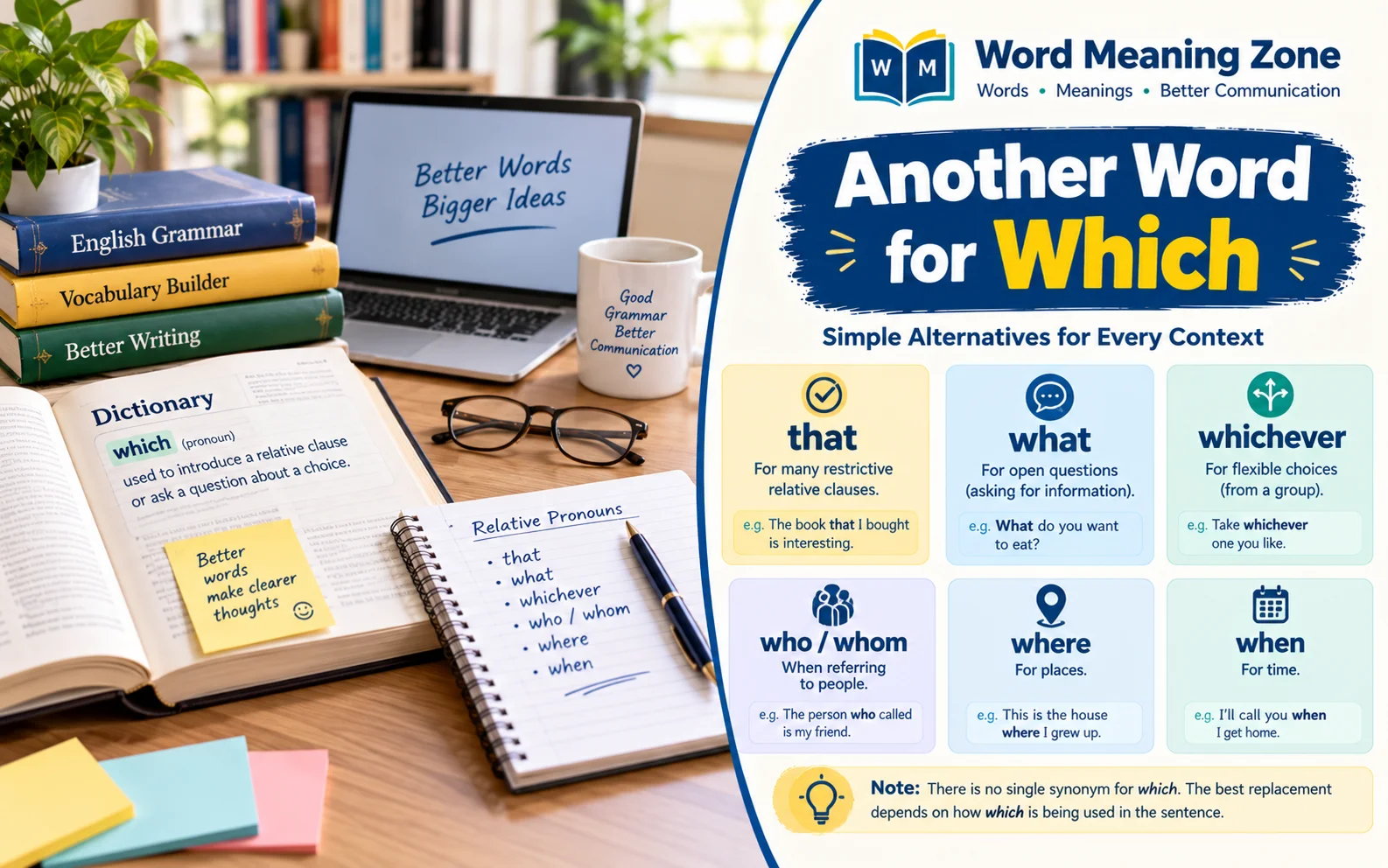
Another word for which is “that,” “who,” “whose,” or “where.” To start a sentence, use “This,” “As a result,” or “Therefore.”
“Which” is the word that sneaks into your writing when you’re not looking. One “which” is fine. Four in a single sentence turns your paragraph into a rickety train: each clause is coupled to the last, and nobody can tell where it’s heading.
This guide gives you the full swap list with examples. It also gives you a repeatable test for choosing the right replacement, so you’re not guessing every time.
What Is Another Word for Which?
The answer depends on what “which” is doing in your sentence. It plays three roles:
| Role | What it does | Example | Best swap |
|---|---|---|---|
| Relative pronoun | Links a clause to a noun | “The app, which I love, is free.” | that, who, where, or nothing |
| Interrogative | Asks a question | “Which one do you want?” | what, who (or keep it) |
| Determiner | Points to something already mentioned | “…after which we left.” | after that, then |
Another Word for Which: The Full List With Examples
1. Relative Pronoun Swaps
Another word for which is often “that” or “who,” depending on what you’re describing.
| Alternative | Use it for | Example |
|---|---|---|
| that | Essential clauses about things | “The laptop that I bought is fast.” |
| who | People (subject) | “My editor, who hates filler, cut this line.” |
| whom | People (object) | “The author whom I trust wrote it.” |
| whose | Possession | “A word whose meaning keeps shifting.” |
| where | Places or situations | “The café where we met closed.” |
| when | Time | “The year when everything changed.” |
| (nothing) | Dropping the pronoun | “The tool I use daily is free.” |
2. Another Word for in Which
“In which” sounds stiff in casual writing. Here’s what to use instead:
| Alternative | Tone | Example |
|---|---|---|
| where | Casual, clear | “A situation where speed matters.” |
| whereby | Formal, describes a method | “A system whereby users vote.” |
| wherein | Very formal or legal | “A clause wherein the buyer agrees.” |
| during which → when | Timing | “The week when sales doubled.” |
| in what | Questions | “In what way did it change?” |
Why it works: “where” is shorter, and shorter relative words keep the reader moving. Use “whereby” only when you’re describing how something works. Use “where” only for real places or situations. “A book where…” is a mistake.
3. Another Word for Which to Start a Sentence
You can’t open a sentence with a relative “which” and keep it grammatical. Use a pronoun or transition instead.
This is also the answer to another transition word for which:
| Alternative | Best for | Example |
|---|---|---|
| This | Referring to the previous idea | “This explains the delay.” |
| That | Same, slightly more distant | “That changed everything.” |
| As a result | Cause and effect | “As a result, sales doubled.” |
| Consequently | Formal cause and effect | “Consequently, we paused.” |
| Therefore / Thus / Hence | Logical conclusions | “Therefore, we chose B.” |
| For this reason | Explaining motive | “For this reason, we stayed.” |
| Because of this | Plain-English cause | “Because of this, prices fell.” |
4. Another Word for Which + Verb Phrases
Most “which” clauses attach a verb right behind it. That’s where the real upgrade is: replace the pair with a single stronger verb.
| Phrase | Stronger swaps | Example |
|---|---|---|
| which led to / which led | resulting in, causing, triggering, prompting, sparking | “A price cut, triggering a rush.” |
| which leads to | resulting in, producing, paving the way for, driving | “Clear titles, driving more clicks.” |
| which shows | demonstrating, revealing, indicating, illustrating | “A 40% jump, revealing real demand.” |
| which helps | aiding, supporting, enabling, assisting | “A checklist enabling faster edits.” |
| which has | featuring, containing, including, boasting | “A tool featuring three modes.” |
| which will | set to, poised to, expected to, going to | “An update set to launch.” |
| which also | plus, as well as, and also, while also | “Fast and also cheap.” |
| which means | meaning, so, in other words, that is | “Prices rose, meaning budgets shrank.” |
Whats another word for which led to? “Resulting in” is the safest all-purpose choice, and “triggering” is punchier.
Also Read: Intriguing Synonym
Another Word for Which in an Essay (With Example)
Essays reward precision. Here’s how the swaps look in academic writing.
Before: “This is a study in which participants read aloud, which suggests memory improves.”
After: “This is a study whereby participants read aloud, suggesting memory improves.”
Another word for which in an essay example, step by step:
-
“in which” → “whereby” (formal method)
-
“, which suggests” → “, suggesting” (verb upgrade)
Another word for in which in an essay
use “wherein” for formal structure (“an agreement wherein…”) and “whereby” for process (“a method whereby…”).
A few terms keep the rest of this guide simple:
- Antecedent: the noun the clause points back to (“the app, which…”).
- Restrictive clause: essential information. Remove it and the sentence changes meaning (“The app that crashed is mine”).
- Non-restrictive clause: bonus information, set off with commas (“My app, which crashed, is free”).
Why it matters: “which” is one of the most common words in the language. According to the Oxford English Corpus, the 100 most common lemmas account for 50% of the corpus, and “which” lands at roughly 48th on that list. Everyone reaches for it by default, so your writing sounds like everyone else’s unless you vary it.
US vs UK: major US style guides such as AP and Chicago reserve “which” for non-restrictive clauses and use “that” for restrictive ones. British usage is looser, and “which” often appears in both. Follow whichever standard your reader expects.
Quick Answers to “Which” Quiz Questions
Some searches use “which” as a quiz question, not a grammar problem. Here are the answers:
| Question | Answer | Why |
|---|---|---|
| Formal balance is another word for which type of balance? | Symmetrical balance | Equal visual weight on both sides of a central axis |
| Smurgling is another word for which cat activity? | Kneading | Cats rhythmically press their paws into laps, blankets, or clothes, also called “making biscuits” |
| Which of the following is another word for armpit? | Axilla | The anatomical term |
| Which of these is another word for currency? | Money (also legal tender) | The system of exchange a country uses |
| Which of the following is another word for telos? | Purpose or ultimate goal | From Greek, meaning “end” or “aim” kinship |
Why Shorter Sentences Win
Swapping “which” often shortens sentences, and shorter sentences are easier to read.
- Plain English Campaign recommends an average sentence length of 15 to 20 words.
- A widely cited American Press Institute readability study found that readers understand roughly 90% of information in 14-word sentences. Comprehension falls below 10% at 43 words or more.
- The Oxford English Corpus shows the 1,000 most common lemmas cover about 75% of English text, which is why plain, familiar words keep your writing accessible.
Also Read: Another Word for It
Common Mistakes When Replacing “Which”
- Using “which” for people. “The man which called” should be “The man who called.”
- Ignoring the comma rule. Essential clause → “that,” no comma. Bonus clause → “which,” comma.
- Stacking clauses. Three or more “which” in one sentence is a rewrite signal.
- Vague reference. “He quit, which surprised everyone” works. “The report covers sales, which is useful” leaves “which” unclear. Use “a fact that” or restructure.
- Using “where” for non-places. “A book where…” should be “A book in which” or “A book that.”
- Over-correcting to “whom.” Use it only for objects: “to whom,” “with whom.”
- Forcing a swap. Some “which” clauses are fine. The goal is clarity, not zero “which.”
Conclusion
Finding another word for which is mostly about knowing what the word was doing in the first place. Match the antecedent, check the comma, and compress “which + verb” into one stronger word. Your sentences get shorter and clearer, and they sound human-written.
Next time you edit, search for “which,” run the five steps, and keep only the ones that earn their place.
Key Takeaways
- “That,” “who,” “whose,” “where,” and “when” cover most relative-pronoun swaps.
- “Whereby” and “wherein” replace “in which” in formal writing.
- “This,” “As a result,” and “Therefore” replace “which” at the start of a sentence.
- Stronger verbs (resulting in, revealing, enabling) beat “which + verb” pairs.
- The WHICH test helps you decide which “which” to keep.
Summary
“Which” is a useful word that gets overused. Swapping it for “that,” “who,” “where,” or a stronger verb makes your writing clearer, shorter, and more confident. Apply the five-step WHICH test, keep at most one “which” per paragraph, and your edits will be fast and consistent.
Also Read: Other Word for Because
FAQs
1. What is another word for which?
Another word for which is “that” (for essential clauses), “who” or “whose” (for people), or “where” and “when” (for places and times). If the clause isn’t essential, you can often drop the pronoun entirely.
2. What’s another word for which to start a sentence?
Use “This,” “That,” “As a result,” “Therefore,” or “Because of this.” These carry the previous idea forward without breaking grammar.
3. Is “that” another word for which?
Often, yes, but only in restrictive clauses. “The laptop that I bought” works, while “My laptop, that I bought” does not. If a comma is needed, keep “which.”
4. What is another word for which led to?
“Resulting in,” “causing,” “triggering,” “prompting,” and “sparking” all work. “Resulting in” is the safest, and “triggering” is more energetic.
5. Can I use another word for which in an essay without sounding stiff?
Yes. Use “whereby” or “wherein” for “in which,” and replace “which shows” with “demonstrating” or “revealing.” Keep the tone formal, but still cut filler.
