
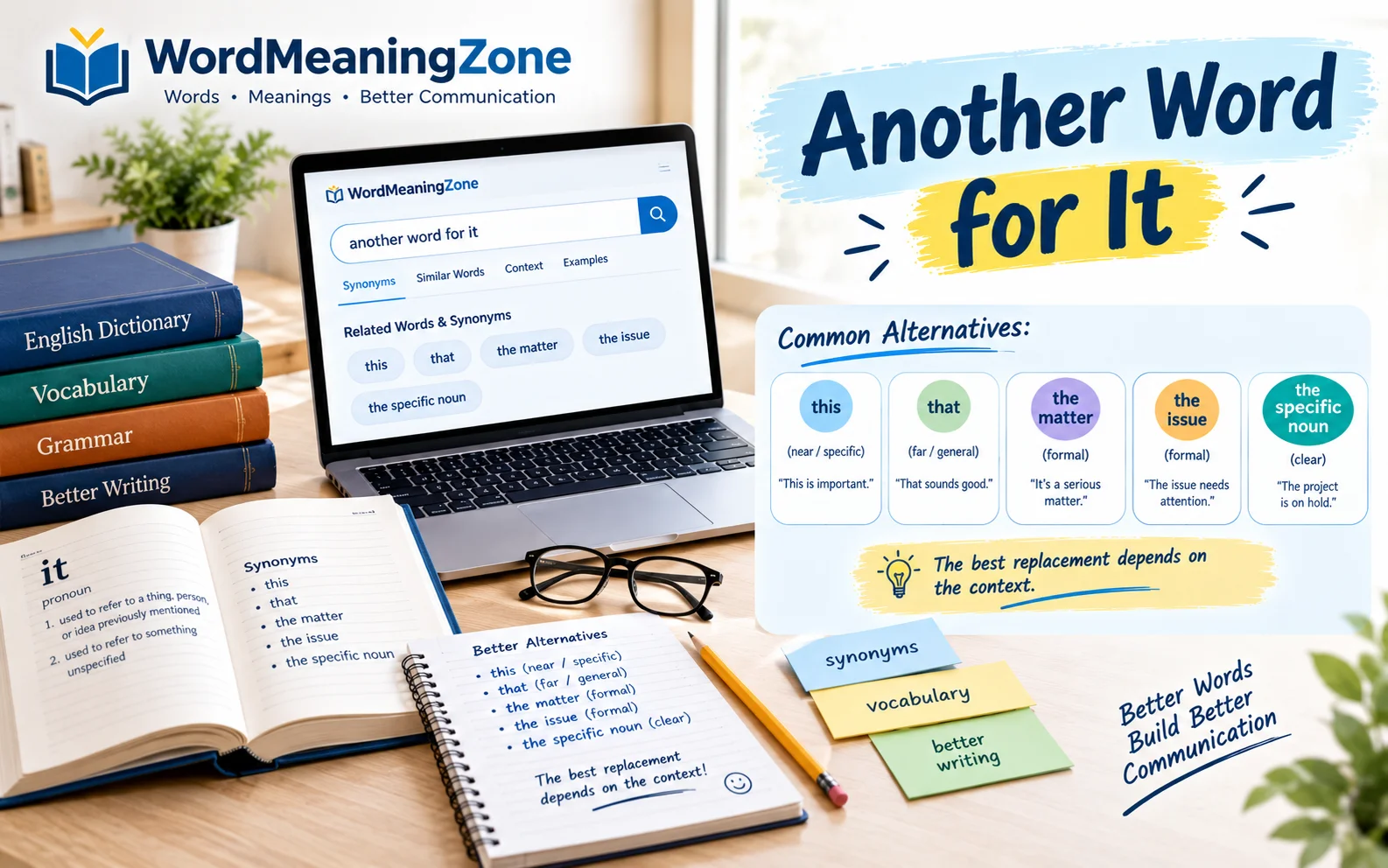
Another word for it depends on what “it” is doing: as a pronoun, swap it for this, that, the matter, the issue or a precise noun; as part of a phrase like “it shows” or “it states,” swap in demonstrates, illustrates, reveals or notes.
Picture this. You are 1,200 words into an essay at 11 p.m., and you scroll back up. “It shows… it also says… it is important because it…” The word it has quietly taken over your document, like a houseguest who refuses to leave.
You open a thesaurus and type “it.” Nothing useful comes back. That is because it is not a normal word. It is a stand-in, and the right replacement changes with the job. This guide gives you another word for it for every job: pronouns, essay verbs, email phrases, and slang. You also get a simple framework to pick the right one in seconds.
What Is Another Word for It? (Quick Answer Table)
Short on time? Start here.
| What “it” is doing | Best alternatives | Example |
|---|---|---|
| Pointing to a thing already mentioned | this, that, the item, the product | “The report is late. The document needs edits.” |
| Starting a sentence (“It is clear that…”) | clearly, evidently, notably | “Clearly, sales dipped.” |
| Following “it shows / it states” | demonstrates, notes, asserts | “The study demonstrates a link.” |
| Inside “worth it” | worthwhile, valuable, rewarding | “The trip was rewarding.” |
| Inside “love it” | adore, cherish, relish | “I adore this design.” |
| Inside “to whom it may concern” | Dear Hiring Manager, Dear Team | “Dear Hiring Manager,“ |
Why “It” Is So Hard to Replace (Definitions You Need)
Before the word lists, three terms. They explain why some swaps work and others fall flat.
- Pronoun: a word that stands in for a noun. It is a pronoun.
- Antecedent: the noun that it points back to. In “The laptop crashed, so I replaced it,” the antecedent is laptop.
- Pronoun ambiguity: when a reader cannot tell what it refers to. This is the real reason to hunt for another word for it.
Here is the expert-level insight most thesaurus pages miss. You are not really replacing a word. You are replacing a lookup. Every time a reader meets it, their brain must scan backwards to find the antecedent. Swap it for a concrete noun, and that mental scan disappears.
That is also why this matters beyond style. Nielsen Norman Group’s eye-tracking research found that people read only around 28% of the words on a typical web page. Readers skim. Vague pronouns slow them down and make skimming harder.
Also Read: Other Word for Because
Another Word for It as a Pronoun
When it refers to something you already named, you have three options: a demonstrative, a noun phrase, or a repeated key noun.
Demonstrative and Referring Words
This
“We tested the new layout. This raised sign-ups by 12%.”
That
“The deadline moved. That changes everything.”
Such
“Delays are common, and such setbacks can be managed.”
The latter / the former
“Email and chat both work, but the latter is faster.”
One
“I need a charger, and this one is broken.”
Noun Replacements
The matter
“The board will review the matter on Monday.”
The issue
“The issue is a pricing gap, not demand.”
The situation
“The situation improved after the update.”
The topic
“The topic deserves a longer look.”
The idea
“The idea works because it is simple.”
The concept
“The concept originated in 19th-century linguistics.”
The point
“The point is to save time.”
The case
“In this case, the data is clear.”
The thing
“The thing about deadlines is they never move.”
The item / the product
“The item ships in two days.”
The subject
“The subject came up twice.”
The object
“The object was placed on the shelf.”
The aspect
“Cost is the aspect that matters most.”
Author’s note: My rule of thumb after years of editing web copy: if a sentence has two possible antecedents, never use it. Name the thing. Clarity beats elegance every time.
Also Read: Other Word for Important
Another Word for It Shows, States, and Says (Essay Verbs)
This is the most searched group, and the one where students lose the most marks. “It shows” and “it states” are not wrong. They are just flat. A stronger verb tells the reader what kind of work the evidence is doing.
Another Word for It Shows (and It Shows in an Essay)
Demonstrates
“The graph demonstrates a steady decline.”
Illustrates
“The case study illustrates the risk.”
Reveals
“The survey reveals a gap in awareness.”
Indicates
“The trend indicates growing demand.”
Suggests
“The pattern suggests a seasonal effect.”
Signals
“The drop signals a change in habits.”
Confirms
“The second trial confirms the result.”
Exemplifies
“This policy exemplifies cautious reform.”
Reflects
“The data reflects shifting attitudes.”
Another Word for It States and It States in an Essay
Notes
“The author notes that costs doubled.”
Asserts
“She asserts that the law is outdated.”
Argues
“The report argues for earlier screening.”
Claims
“The company claims a 20% gain.”
Maintains
“He maintains the figures are accurate.”
Declares
“The charter declares equal access.”
Specifies
The contract specifies a 30-day window.”
Points out
“The editor points out a flaw.”
Another Word for It Says and It Says in an Essay
- Explains
- Describes
- Remarks
- Observes
- Mentions
- Adds
Example: “The author observes that readers skim.”
Another Word for It Highlights, Helps, and Also
Highlights
underscores, emphasizes, spotlights, stresses. (“The chart underscores the shift.”)
Helps
assists, supports, enables, facilitates. (“The tool enables faster edits.”)
Also
additionally, moreover, furthermore, likewise, besides, in addition. (“Moreover, costs fell.”)
Another Word for in the Text It States (What Is Another Word for in the Text It States?)
Teachers love the phrase “in the text it states.” You can say it better with a named source and a stronger verb:
- “The passage notes…”
- “According to the author…”
- “The writer asserts…”
- “The source explains…”
- “Paragraph two reveals…”
Same idea, but now the reader knows who is speaking.
Also Read: Other Words for And
Another Word for It Is Important (and Other Opening Phrases)
“It is important” is the empty calories of academic writing. Try these:
It is crucial
“It is crucial to back up your files.”
Vital
“Sleep is vital for memory.”
Essential
“Accuracy is essential.”
Key
“Timing is key.”
Significant
“This is a significant finding.”
Critical
“Early testing is critical.”
Better still, drop the opener entirely. “It is important to note that costs rose” becomes “Costs rose.” Shorter, sharper, done.
Another Word for Worth It, Love It, and Got It
Now the casual stuff. These phrases show up in reviews, chats, and everyday writing.
Another Word for Worth It
Worthwhile
“The extra hour was worthwhile.”
Valuable
“A valuable upgrade.”
Rewarding
“A rewarding climb.”
Beneficial
“A beneficial habit.”
Profitable
“A profitable move.”
Useful
“Genuinely useful advice.”
Fruitful
“A fruitful meeting.”
Well spent
“Money well spent.”
Another Word for Love It
- Adore
- cherish
- treasure
- relish
- enjoy
Informal: “I’m crazy about this,” “I’m hooked on it,” “Obsessed.”
Example: “I adore the new interface.”
Another Word for Got It, Thanks
- Understood, thanks.
- Noted, thank you.
- Message received.
- Much obliged.
- Appreciate the heads-up.
- Makes sense, thank you.
- Perfect, thanks for clarifying.
Pick the tone first. “Noted” is crisp and professional. “Much obliged” is warm and a bit old-school.
Also Read: Another Word for Equitable
Another Word for Know It All
- Smart aleck
- Wiseacre
- Smarty-pants
- Show-off
- Pedant (someone obsessed with small rules)
- Armchair expert
- Sciolist (formal, someone with only superficial knowledge)
Another Word for It in Emails and Letters
Another Word for To Whom It May Concern
This phrase feels dated. Hiring managers and recruiters often read it as “I did not bother to find a name.” Try:
- Dear Hiring Manager,
- Dear [Name], (best option, always)
- Dear Admissions Committee,
- Dear [Company] Team,
- Hello [Department] Team,
- Greetings, (fine when a name truly is not available)
Another Word for It Was a Pleasure to Meet You
- It was great meeting you.
- Lovely to meet you.
- I enjoyed our conversation.
- Thank you for your time today.
- Delighted to have met you.
- Great connecting with you.
Is There Another Word for It? The SWAP Framework
People often ask: “Is there another word for it?” The honest answer: yes, but not one word. There is a method. Here is the SWAP Framework, which I use to edit almost every draft.
| Step | Question to ask | Quick action |
|---|---|---|
| S – Spot | Which “it” is this? Pronoun, verb phrase, or fixed phrase? | Highlight every “it” |
| W – Weigh | Is the antecedent clear in one glance? | If not, name the noun |
| A – Adapt | What tone fits: essay, email, chat? | Match the register |
| P – Prove | Read it aloud. Does it flow? | Keep or revert |
A Copy-Paste Workflow (5 Minutes)
- Paste your draft into a document and search for “it.”
- Count the hits. Anything above 1 per 100 words deserves a look.
- Mark each “it” with S, W, A, or P using the table above.
- Replace only the ones that confuse, not all of them. Over-editing sounds robotic.
- Read the final version aloud once.
Before and After: A Mini Case Study
Here is a realistic example of how a short paragraph transforms.
Before (7 uses of “it”):
The new policy was introduced in March. It was meant to cut waiting times. It shows promise, and it also states that clinics must report weekly. It is important because it affects funding.
After (1 use of “it”):
The new policy, introduced in March, aims to cut waiting times. The pilot data demonstrates early promise, and the guidelines require weekly clinic reports. This reporting rule is crucial because funding depends on it.
What changed, and why it works:
- “It shows” became “the pilot data demonstrates.” The reader now knows what is showing.
- “It states” became “the guidelines require.” A stronger verb, plus a named source.
- “It is important” became “this reporting rule is crucial.” The vague opener is gone.
- Result: 7 uses of “it” dropped to 1, and the paragraph shrank by about 10%.
The Strength Ladder: Choosing the Right Verb
Not every verb carries the same weight. Use this when you pick another word for it states or shows in an essay.
| Strength | Verbs | Use when |
|---|---|---|
| Soft | suggests, implies, hints | Evidence is partial |
| Medium | indicates, notes, reflects | Evidence is solid |
| Strong | demonstrates, proves, confirms | Evidence is conclusive |
Why this matters: “proves” in a paper with weak data is an overclaim. A careful academic reader will notice. Matching verb strength to evidence strength is a quiet sign of credibility.
Common Mistakes When Replacing “It”
- Swapping blindly. Not every “it” needs to go. “It is raining” is perfectly fine. The pronoun there is a dummy subject with no antecedent.
- Using “this” with no noun. “This is a problem” can be as vague as “it.” Write “This delay is a problem.”
- Overusing fancy verbs. Three “underscores” in one paragraph reads like thesaurus abuse.
- Mixing tones. “Much obliged” in a casual text, or “smarty-pants” in a cover letter.
- Ignoring meaning. Proves and suggests are not interchangeable. Check the definition.
- Forgetting the reader. In 2026, with so much AI-drafted text online, repetitive filler like “additionally” and “it is important to note” stands out. Plain, specific wording reads as human.
Facts and Benchmarks Worth Knowing
- Vocabulary size: A study by Brysbaert and colleagues (2016, Frontiers in Psychology) estimated that an average 20-year-old native English speaker knows about 42,000 word families. You already own plenty of alternatives. You just need to retrieve them.
- Dictionary scale: The Oxford English Dictionary describes more than 600,000 words, so English rarely runs out of options.
- Thesaurus history: Peter Mark Roget first published his Thesaurus in 1852, organizing words into roughly 1,000 categories of meaning, not alphabetically. That “meaning first” approach is exactly what the SWAP Framework borrows.
- Skim reading: Nielsen Norman Group research suggests readers take in only about 28% of words on a typical page, so precise nouns and verbs carry more weight.
- Readability benchmark: Under the Flesch Reading Ease scale, a score of 60 to 70 is considered plain English. Clearer references (fewer vague “it” words) tend to nudge scores up.
Quick Checklist Before You Hit Publish
Every “it” has one clear antecedent
No more than one “it” per sentence
Essay verbs match evidence strength
Email greetings use a real name where possible
Tone matches the audience
Final read-aloud done
Conclusion: Find Another Word for It, Then Move On
The best another word for it is rarely one magic synonym. It is a clearer noun, a sharper verb, or a smarter greeting. Use SWAP to decide, pick from the lists above, and keep the “its” that are doing honest work.
Do that, and your writing stops sounding like a draft and starts sounding like you.
Key Takeaways
- Another word for it depends on context: pronoun, verb phrase, or fixed phrase.
- Replace vague “it” with a named noun to remove reader lookup effort.
- Use demonstrates, illustrates, reveals for “it shows,” and notes, asserts, argues for “it states.”
- Retire “to whom it may concern” in favor of a name or role.
- Use the SWAP Framework (Spot, Weigh, Adapt, Prove) for every edit.
- Match verb strength to evidence strength.
Summary
“It” is the most overused small word in English writing, and replacing it is a matter of precision, not decoration. This guide covered 75+ alternatives across pronouns, essay verbs, email openers, and casual phrases, with examples for each. You also got the SWAP Framework, a before-and-after rewrite, the verb strength ladder, and a pre-publish checklist.
FAQs About Another Word for It
1. What is another word for it in an essay?
It depends on the role. For “it shows,” use demonstrates, illustrates, or reveals. For “it states,” use notes, asserts, or argues. When “it” is a pronoun, name the noun: the study, the author, this finding.
2. Is there another word for it when I mean “this thing”?
Yes. Try the item, the object, the matter, the issue, or a specific noun. The more specific, the better. “The invoice” beats “it” every time.
3. What’s another word for it is important?
Use crucial, vital, essential, key, significant, or critical. Or drop the opener entirely and state the point directly.
4. What is another word for it that sounds more formal?
Formal options include the aforementioned, the latter, such, said (legal), and the subject in question. Use them sparingly, because too many formal words make writing stiff.
5. Is there another word for it in “to whom it may concern”?
Yes. Replace the whole phrase with Dear Hiring Manager, Dear [Name], Dear Admissions Committee, or Dear [Company] Team. A real name is always the strongest option.
