
Last Update: 1 August 2026
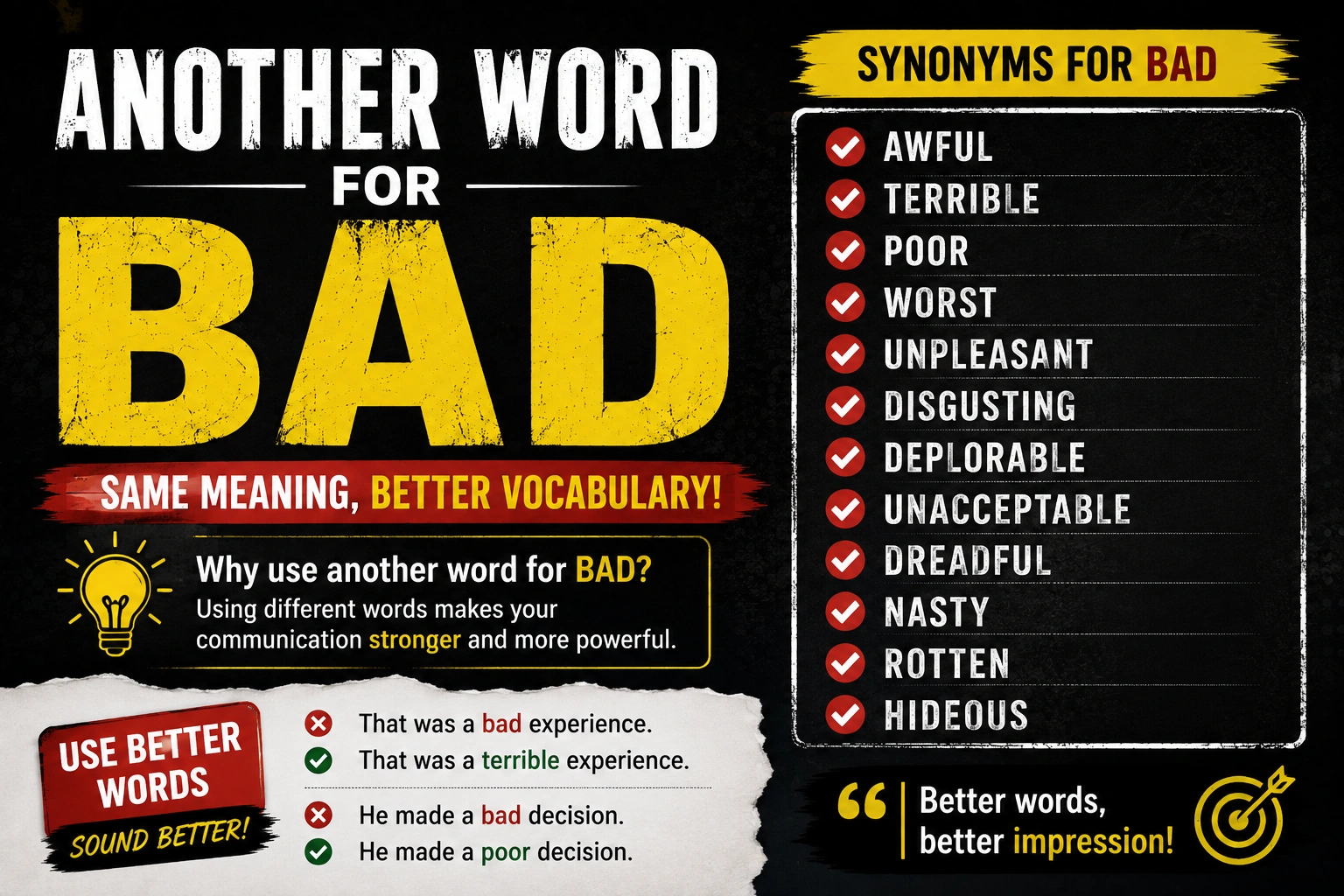
Another word for bad can be poor, terrible, awful, harmful, unpleasant, inferior, unethical, defective, or unsuccessful—but the right synonym depends on the context.
If you’re searching for another word for bad, this guide will help you choose a more precise alternative instead of simply replacing bad with terrible. You’ll learn the best synonyms for different situations, how their meanings differ, which words sound stronger or more professional, and which alternatives work best in writing, conversation, school, business, and formal communication.
What Is Another Word for Bad?
The best synonym for bad depends on what “bad” means in the sentence.
For example:
- Bad quality → poor, inferior, substandard
- Bad behavior → inappropriate, unacceptable, unethical
- Bad weather → severe, unpleasant, harsh
- Bad result → unsuccessful, disappointing, ineffective
- Bad person → immoral, unethical, wicked
- Bad health → poor, unhealthy, serious
- Bad condition → poor, damaged, deteriorated
- Bad smell → unpleasant, foul, offensive
- Bad decision → unwise, misguided, poor
- Bad situation → difficult, serious, unfavorable, dire
There is no single perfect replacement for bad. Major dictionaries list the word across several senses, including poor quality, moral wrongdoing, unpleasantness, harmfulness, incorrectness, illness, and seriousness.
Common synonyms for “bad” include poor, awful, terrible, horrible, unpleasant, harmful, inferior, defective, inadequate, undesirable, unacceptable, immoral, unethical, unsuccessful, and disappointing. The best alternative depends on context. Use precise words such as “harmful” for damage, “unethical” for conduct, and “poor” for quality rather than using “bad” everywhere.
Quick List: 50 Synonyms for Bad
Here are some of the most useful alternatives:
- Poor
- Awful
- Terrible
- Horrible
- Dreadful
- Unpleasant
- Inferior
- Substandard
- Defective
- Faulty
- Inadequate
- Unsatisfactory
- Unsuitable
- Unacceptable
- Harmful
- Damaging
- Dangerous
- Unhealthy
- Unsuccessful
- Ineffective
- Disappointing
- Unsatisfactory
- Unfortunate
- Unfavorable
- Adverse
- Severe
- Serious
- Dire
- Grim
- Atrocious
- Abysmal
- Appalling
- Deplorable
- Shameful
- Immoral
- Unethical
- Wrong
- Wicked
- Corrupt
- Offensive
- Foul
- Nasty
- Miserable
- Wretched
- Lousy
- Crummy
- Subpar
- Deficient
- Flawed
- Misguided
The Cambridge Thesaurus also groups alternatives according to specific meanings rather than treating every synonym as interchangeable. Its entries include words such as poor, dire, grim, awful, and terrible for unpleasant situations, while inferior, substandard, faulty, and defective fit low quality more naturally.
Another Word for Bad Depending on Meaning
This is where synonym choice becomes useful.
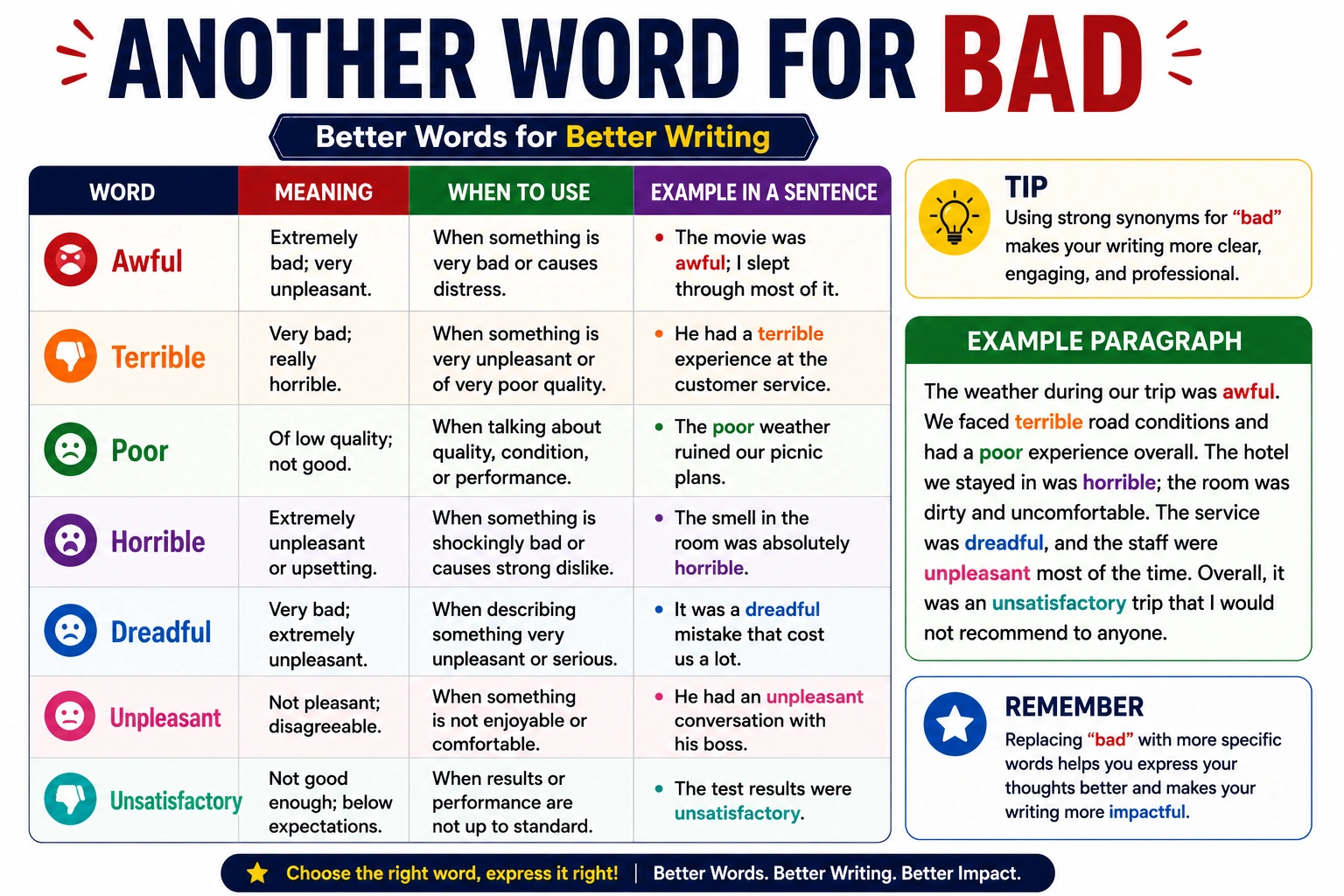
Simply writing terrible every time you see bad can make your writing repetitive and sometimes inaccurate. A synonym should preserve the original meaning while adding precision.
| Meaning of “bad” | Best alternatives | Example |
|---|---|---|
| Low quality | poor, inferior, substandard | The product is substandard. |
| Very unpleasant | awful, horrible, terrible | It was a horrible experience. |
| Harmful | damaging, harmful, injurious | Smoking is harmful to health. |
| Morally wrong | immoral, unethical, wicked | The decision was unethical. |
| Unsuccessful | ineffective, unsuccessful, futile | The strategy was ineffective. |
| Incorrect | wrong, inaccurate, faulty | The calculation is incorrect. |
| Serious | severe, serious, dire | The patient suffered a severe injury. |
| Unhealthy | unhealthy, poor | He is in poor health. |
| Damaged | defective, faulty, broken | The machine is defective. |
| Unpleasant smell | foul, offensive, unpleasant | There was a foul odor. |
| Difficult situation | difficult, unfavorable, grim | The situation looks grim. |
| Poor decision | unwise, misguided, ill-advised | It was an ill-advised decision. |
Another Word for Bad Quality
When bad describes the quality of something, poor is usually the safest replacement.
Other useful choices include:
- Inferior
- Substandard
- Defective
- Faulty
- Flawed
- Inadequate
- Unsatisfactory
- Subpar
- Deficient
- Unreliable
- Low-quality
- Second-rate
Examples
Basic:
The product is bad.
More precise:
The product is poor in quality.
Stronger:
The product is substandard.
Technical:
The product is defective.
These words aren’t identical.
Poor generally indicates that something falls below the expected standard. Defective suggests a specific fault or malfunction. Substandard explicitly means below an accepted standard.
Merriam-Webster defines bad in one sense as failing to reach an acceptable standard and lists alternatives including poor, unacceptable, deficient, flawed, and substandard.
Another Word for Bad Person
When describing someone’s character or conduct, the right synonym depends on what makes the person “bad.”
Possible alternatives include:
- Immoral
- Unethical
- Wicked
- Cruel
- Dishonest
- Corrupt
- Malicious
- Vicious
- Deceitful
- Dishonorable
- Untrustworthy
- Abusive
- Harmful
- Misguided
Example
Instead of:
He is a bad person.
You could write:
He is dishonest.
if lying is the issue.
Or:
His behavior was cruel.
if he deliberately caused suffering.
Or:
His conduct was unethical.
if he violated professional or moral standards.
This distinction matters because calling someone simply bad makes a broad judgment without explaining the actual problem.
Another Word for Bad Behavior
For behavior, these alternatives are particularly useful:
- Inappropriate
- Unacceptable
- Unethical
- Improper
- Offensive
- Disrespectful
- Misconduct
- Harmful
- Aggressive
- Abusive
- Irresponsible
- Reckless
- Immoral
Examples
Bad behavior:
His bad behavior caused problems.
More precise:
His disrespectful behavior caused problems.
Professional:
His conduct was inappropriate.
Stronger:
His actions were unethical and irresponsible.
Notice the difference: inappropriate doesn’t necessarily mean immoral. It can simply mean unsuitable for a particular setting.
Another Word for Bad Situation
If something is going badly, bad situation is often too vague.
Better choices include:
- Difficult
- Serious
- Unfavorable
- Challenging
- Troubling
- Critical
- Dire
- Grim
- Dangerous
- Unstable
- Unfortunate
- Alarming
Which word should you choose?
Use difficult when something is hard to deal with.
Use serious when the consequences matter.
Use critical when immediate action may be required.
Use dire when the situation is extremely serious.
Use grim when the outlook is particularly discouraging.
For example:
The company is in a bad situation.
could become:
The company is facing a serious financial problem.
That sentence is stronger because it tells the reader what kind of problem exists.
Another Word for Bad Experience
Useful alternatives include:
- Unpleasant
- Difficult
- Horrible
- Terrible
- Traumatic
- Distressing
- Disappointing
- Frustrating
- Painful
- Miserable
- Unfortunate
Be careful with traumatic. It is much stronger than bad and should not be used simply to make a sentence sound dramatic.
Example
I had a bad experience at the hotel.
could become:
I had a disappointing experience at the hotel.
if the service was poor.
Or:
I had an unpleasant experience at the hotel.
if the experience was uncomfortable.
Or:
I had a distressing experience.
if it caused significant emotional distress.
Precision beats drama.
Another Word for Bad Weather
Common alternatives include:
- Severe
- Harsh
- Stormy
- Unpleasant
- Extreme
- Dangerous
- Unfavorable
- Inclement
Inclement weather is a formal expression meaning unpleasant or severe weather.
Examples:
- Bad weather → severe weather
- Bad storm → violent storm
- Bad conditions → hazardous conditions
- Bad visibility → poor visibility
- Bad weather forecast → unfavorable weather forecast
The best word depends on the actual weather. Calling rain extreme when it is merely inconvenient exaggerates the situation.
Another Word for Bad Results
If an outcome doesn’t meet expectations, consider:
- Unsuccessful
- Ineffective
- Disappointing
- Unsatisfactory
- Poor
- Unfavorable
- Negative
- Inferior
- Inconclusive
- Counterproductive
Example
Instead of:
The campaign produced bad results.
Try:
The campaign produced disappointing results.
Or, if the campaign failed to achieve its objective:
The campaign was ineffective.
Or, if it actually made things worse:
The campaign was counterproductive.
That last word is much more specific. Counterproductive means producing an effect opposite to the intended result.
Another Word for Bad Decision
Strong alternatives include:
- Poor decision
- Unwise decision
- Misguided decision
- Ill-advised decision
- Reckless decision
- Careless decision
- Flawed decision
- Unfortunate decision
- Short-sighted decision
- Irrational decision
The choice reveals the nature of the problem.
| If the decision was… | Use |
| Not sensible | Unwise |
| Based on poor judgment | Misguided |
| Risky without justification | Reckless |
| Made without enough care | Careless |
| Based on faulty reasoning | Flawed |
| Focused only on immediate gains | Short-sighted |
| Morally wrong | Unethical |
| Simply unfortunate | Unfortunate |
Another Word for Bad News
Possible alternatives include:
- Unfortunate news
- Disturbing news
- Alarming news
- Troubling news
- Disappointing news
- Negative news
- Grim news
- Devastating news
Again, don’t automatically use the strongest word.
Disappointing suggests that expectations were not met.
Disturbing suggests that the information causes concern.
Alarming suggests a potential threat or danger.
Devastating indicates extremely serious emotional or practical consequences.
Another Word for Bad Smell
Depending on the intensity, you can use:
- Unpleasant
- Foul
- Offensive
- Nasty
- Pungent
- Acrid
- Stale
- Rotten
- Musty
Examples:
There was a foul smell in the room.
The basement had a musty odor.
The chemical produced an acrid smell.
The food had a rotten odor.
The precise word makes the description more vivid than repeatedly using bad.
Strongest Synonyms for Bad
If you want a stronger word, consider:
- Terrible
- Horrible
- Awful
- Dreadful
- Atrocious
- Abysmal
- Appalling
- Deplorable
- Disastrous
- Catastrophic
But intensity matters.
A poor movie is not necessarily an atrocious movie.
A serious mistake is not automatically a catastrophic mistake.
A good writer doesn’t use the strongest synonym available. A good writer uses the most accurate one.
Formal Synonyms for Bad
For academic, professional, or formal writing, avoid relying too heavily on casual words such as lousy or crummy.
Better formal alternatives include:
- Poor
- Inadequate
- Unsatisfactory
- Unacceptable
- Inferior
- Substandard
- Deficient
- Unfavorable
- Adverse
- Harmful
- Ineffective
- Inappropriate
- Unethical
- Unsuitable
- Undesirable
Before vs. After
| Basic wording | More precise wording |
| Bad performance | Poor performance |
| Bad result | Unsatisfactory result |
| Bad policy | Ineffective policy |
| Bad decision | Ill-advised decision |
| Bad behavior | Inappropriate behavior |
| Bad effect | Adverse effect |
| Bad quality | Substandard quality |
| Bad information | Inaccurate information |
| Bad method | Ineffective method |
| Bad conditions | Adverse conditions |
Casual and Slang Alternatives for Bad
In informal speech, you may hear:
- Lousy
- Crummy
- Rotten
- Awful
- Terrible
- Nasty
- Rough
- Trashy
- Horrible
Some are strongly informal and shouldn’t be used in formal writing.
For example:
That was a lousy movie.
sounds conversational.
The film was substandard.
sounds analytical.
Neither is automatically better. The audience and purpose determine the appropriate choice.
Is “Terrible” the Same as “Bad”?
Not exactly.
Bad is a broad word. Terrible usually carries greater intensity.
Compare:
The food was bad.
with:
The food was terrible.
The second sentence normally communicates a much stronger negative judgment.
Other intensity levels might look like this:
Mild → Strong
poor → bad → awful → terrible → horrible → atrocious
This isn’t a fixed mathematical scale. Context changes how strong a word feels.
Is “Poor” a Synonym for Bad?
Yes, in many contexts, but not all.
Poor commonly describes something that falls below an expected standard:
poor performance
poor quality
poor service
poor results
poor health
It doesn’t always work when bad means morally wrong.
You wouldn’t normally replace:
He is a bad person.
with:
He is a poor person.
That changes the meaning completely.
Is “Evil” Another Word for Bad?
Sometimes, but evil is much more specific and stronger.
Evil generally refers to serious moral wrongdoing or profound wickedness. Bad can describe something as ordinary as poor-quality food, an unsuccessful plan, or unpleasant weather.
For example:
The weather is bad.
works.
The weather is evil.
doesn’t normally work in literal standard English.
Cambridge distinguishes the moral sense of bad from other meanings such as unpleasantness, low quality, and health problems.
Common Mistakes When Replacing “Bad”
1. Choosing a synonym without checking the meaning
Don’t automatically replace every occurrence of bad with terrible.
bad health → terrible health
This sounds unnatural in many contexts.
Better:
poor health
2. Using a word that is too strong
Calling an ordinary mistake catastrophic makes your writing less credible.
Match the intensity to the evidence.
3. Using formal words unnecessarily
The restaurant’s cuisine was substandard.
might sound strangely stiff in a casual review.
The food was disappointing.
may communicate the point better.
4. Confusing “bad” with “evil”
A bad movie isn’t an evil movie.
A bad decision isn’t necessarily immoral.
A bad smell isn’t morally wrong.
Context determines the synonym.
5. Using “bad” when a precise word exists
Instead of:
The machine has a bad part.
say:
The machine has a defective component.
Instead of:
The plan had a bad effect.
say:
The plan had an adverse effect.
Instead of:
She made a bad choice.
say:
She made an ill-advised choice.
Specific language communicates more information.
A Simple Framework for Choosing the Right Synonym
When you encounter bad, ask one question:
“What exactly is bad about it?”
Then choose the word according to this five-step process:
- Identify the problem — quality, morality, harm, performance, appearance, or experience.
- Measure the intensity — mild, moderate, serious, or extreme.
- Consider the audience — casual, academic, professional, or literary.
- Choose the precise synonym — don’t choose simply because it sounds stronger.
- Read the sentence again — make sure the meaning hasn’t changed.
Quick Decision Guide
Is the quality low?
→ poor, inferior, substandard
Is it morally wrong?
→ unethical, immoral, wicked
Does it cause damage?
→ harmful, damaging, injurious
Did it fail?
→ unsuccessful, ineffective, disappointing
Is it unpleasant?
→ unpleasant, awful, horrible
Is it dangerous?
→ hazardous, dangerous, harmful
Is it incorrect?
→ wrong, inaccurate, faulty
Is it extremely serious?
→ severe, dire, critical
The History of the Word “Bad”
The history of bad is surprisingly uncertain.
Merriam-Webster gives its first known use as the 13th century and describes the word’s etymology as being of obscure origin. It also notes that proposed connections with Old English words have not been established with certainty.
The Oxford University Press’s historical discussion of the word similarly shows that its origin has challenged etymologists. One early recorded form, badde, appears in Middle English in 1297, while proposed connections to older forms remain debated.
That uncertainty is worth emphasizing because popular articles sometimes present one supposed origin of bad as settled fact. The evidence does not justify that confidence.
A Short Timeline
| Period | Development |
| 13th century | Early recorded Middle English forms appear |
| 1297 | badde is recorded in Middle English |
| Later Middle English | The word develops broader negative meanings |
| Modern English | Bad becomes a highly flexible adjective, noun, and adverb |
| 2026 | The word remains one of English’s broadest everyday negative descriptors |
The modern word has accumulated many meanings, which explains why its synonym list is so large.
Why “Bad” Has So Many Synonyms
The reason is simple: bad is semantically broad.
“Semantically” refers to meaning.
When someone says:
This is bad.
they haven’t told you exactly how it is bad.
It could be:
- Low quality
- Morally wrong
- Harmful
- Unpleasant
- Dangerous
- Incorrect
- Unsuccessful
- Unhealthy
- Severe
- Unsuitable
That broad meaning creates room for more precise words.
This is why a thesaurus may provide hundreds of related words while only a small group will fit any particular sentence. Cambridge’s thesaurus, for example, organizes synonyms according to meaning rather than presenting them as universally interchangeable replacements.
25 Best Synonyms for Bad at a Glance
| Synonym | Best used for | Strength |
| Poor | Quality, performance | Mild–moderate |
| Inferior | Quality | Moderate |
| Substandard | Quality below accepted level | Moderate |
| Defective | Products or systems | Moderate |
| Faulty | Errors or malfunction | Moderate |
| Inadequate | Insufficient quality/capacity | Moderate |
| Unpleasant | Experiences, conditions | Mild–moderate |
| Awful | Experiences, things | Strong |
| Terrible | General negative situations | Strong |
| Horrible | Experiences, events | Strong |
| Dreadful | Experiences, situations | Strong |
| Harmful | Damage or health | Moderate–strong |
| Damaging | Negative effects | Moderate–strong |
| Dangerous | Risk | Strong |
| Unethical | Conduct or decisions | Strong |
| Immoral | Moral wrongdoing | Strong |
| Ineffective | Methods or strategies | Moderate |
| Unsuccessful | Attempts or outcomes | Moderate |
| Disappointing | Results or experiences | Mild–moderate |
| Unfavorable | Conditions or outcomes | Moderate |
| Adverse | Effects or conditions | Moderate–strong |
| Severe | Problems, weather, injuries | Strong |
| Dire | Extremely serious situations | Very strong |
| Abysmal | Extremely poor quality | Very strong |
| Atrocious | Extremely bad quality or conduct | Very strong |
Examples: Replacing “Bad” in Everyday Sentences
Basic
I had a bad day.
Better alternatives
I had a difficult day.
I had a rough day.
I had a terrible day.
I had an exhausting day.
The best choice depends on what actually happened.
Basic
This is a bad idea.
Possible replacements:
This is a poor idea.
This is an unwise idea.
This is a flawed idea.
This is an ill-advised idea.
Basic
The company’s performance was bad.
Better:
The company’s performance was poor.
Or:
The company’s performance was disappointing.
Or:
The company’s strategy was ineffective.
Each sentence gives the reader slightly different information.
Frequently Asked Questions About Another Word for Bad
1. What is another word for bad?
Common alternatives include poor, awful, terrible, horrible, unpleasant, inferior, harmful, defective, inadequate, unethical, unsuccessful, and disappointing. The correct synonym depends on the context.
2. What is a stronger word for bad?
Terrible, horrible, dreadful, atrocious, abysmal, appalling, and deplorable can express stronger negative meanings. Choose based on the actual severity rather than simply choosing the most dramatic word.
3. What is a professional word for bad?
Depending on the context, professional alternatives include poor, inadequate, unsatisfactory, substandard, ineffective, unfavorable, adverse, inappropriate, defective, and unacceptable.
4. What is another word for bad in an essay?
For academic writing, useful alternatives include poor, inadequate, ineffective, unfavorable, harmful, inappropriate, unethical, inferior, substandard, and unsatisfactory. The exact choice should describe the specific problem.
5. What is Another Word for Bad in a positive-sounding way?
If you want to sound less harsh, use words such as unfavorable, disappointing, less effective, below expectations, problematic, or not ideal. These soften the judgment without pretending the problem doesn’t exist.
Key Takeaways
- Bad is a broad word with many meanings.
- Poor works well for low quality or performance.
- Harmful is better when something causes damage.
- Unethical fits morally questionable conduct.
- Ineffective is appropriate when something fails to produce the intended result.
- Unpleasant works well for experiences, conditions, or sensations.
- Defective describes a specific fault in a product or system.
- Severe, dire, and catastrophic should be reserved for appropriately serious situations.
- Don’t treat synonyms as interchangeable; their meanings and intensity differ.
- The strongest word is not necessarily the best word. The most precise word is.
Short Summary
The best another word for bad depends on what you are describing. Use poor for low quality, terrible or awful for strong negative reactions, harmful for damaging effects, unethical for morally wrong behavior, ineffective for failed methods, and defective for faulty products. Good writing replaces vague language with precise language.
Practical Conclusion
The easiest way to improve your vocabulary is not to memorize hundreds of synonyms. Train yourself to identify the specific problem behind the word “bad.”
If quality is the problem, say poor or substandard. If harm is the issue, say damaging or harmful. If morality is involved, say unethical or immoral. If something simply failed, say ineffective or unsuccessful.
That small change makes your writing clearer, more credible, and more professional.
When you next type bad, stop for two seconds and ask: “What exactly do I mean?”
The answer is probably a better word.
Sources consulted: Cambridge Dictionary, Cambridge English Thesaurus, Merriam-Webster, Oxford University Press/Oxford Etymologist.
Thank you so much for reading Another Word for Important this far—we really appreciate it!
Also Read:
Also Check out “TheNameStories” for more such interesting meanings!
