
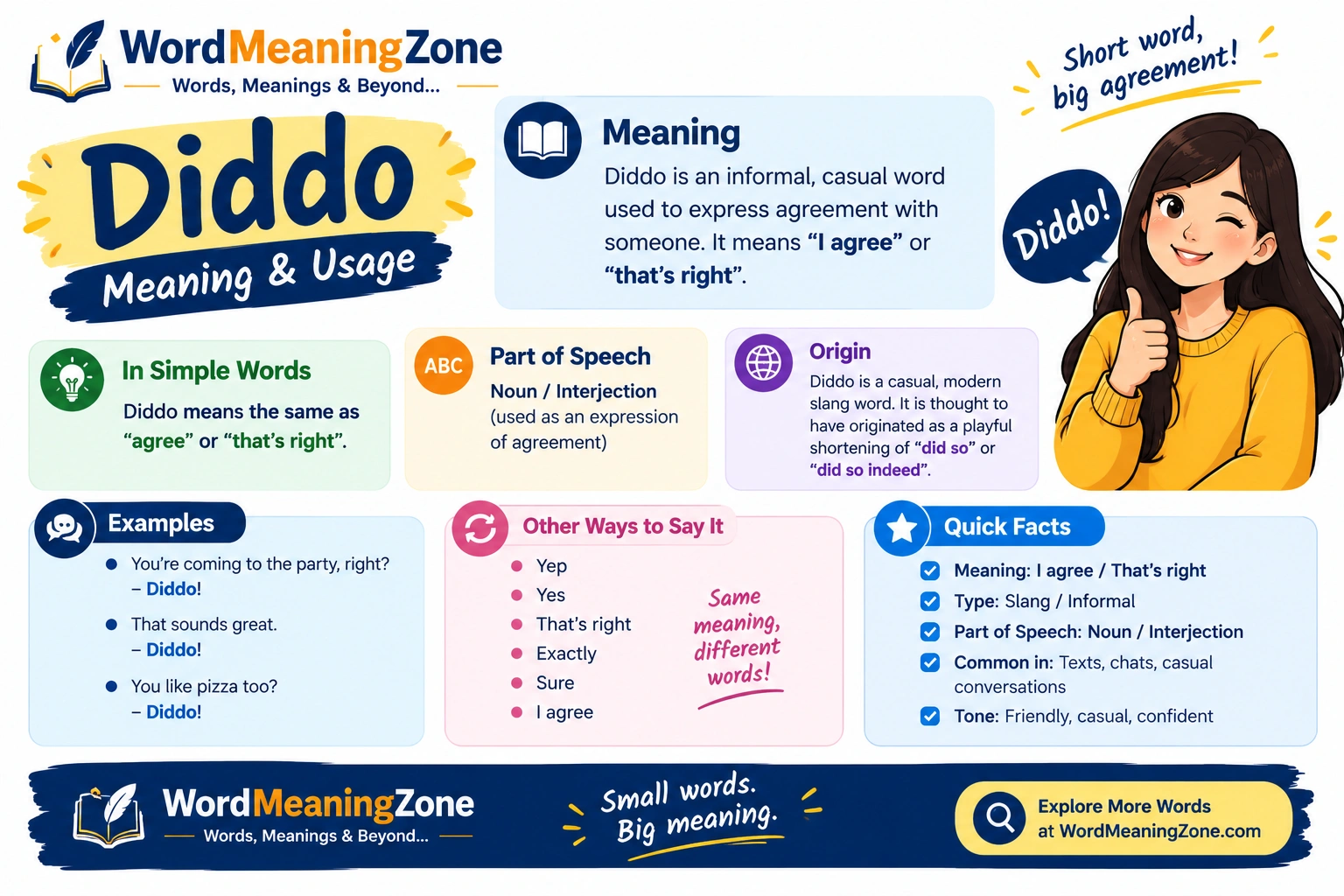
TL;DR: “Diddo” usually means “same,” “me too,” or “I agree,” but when that is the intended meaning, the standard English spelling is “ditto.” “Diddo” is generally a misspelling or informal spelling of “ditto.”
Diddo Meaning: Quick Facts
| Point | Answer |
|---|---|
| Focus Word | Diddo Meaning |
| What does “diddo” usually mean? | Same, me too, or I agree |
| Correct standard spelling | Ditto |
| Is “diddo” standard English? | Generally, no |
| Common use | Texting, chats, comments and casual conversation |
| “Ditto” pronunciation | Roughly “DIT-oh” |
| Origin of “ditto” | Italian detto, meaning “said” |
| Best formal alternative | I agree, likewise, the same applies |
What Is the Diddo Meaning?
The most common Diddo Meaning is “same,” “me too,” “I agree,” or “the same thing applies to me.”
But there is an important spelling catch.
If you mean the standard English word, “ditto” is correct—not “diddo.”
For example:
Person A: “I am tired today.”
Person B: “Ditto.”
Here, “ditto” means:
“I am tired too.”
Cambridge Dictionary defines ditto as a word used to agree with something just said or to avoid repeating it.
So if somebody sends you “Diddo!” in a WhatsApp message, Instagram comment or casual chat, they probably mean:
“Same here!”
The spelling may be wrong, but the intended Diddo Meaning is usually easy to understand.
Also Read: Acception vs Exception
Next question to explore
Why do people write “diddo” if “ditto” is correct?
The answer is surprisingly simple: pronunciation.
Diddo or Ditto: Which Spelling Is Correct?
Here is the easiest way to remember it:
| Word | Standard English? | Meaning |
|---|---|---|
| Ditto | ✅ Yes | Same, likewise, I agree |
| Diddo | ❌ Usually no | Common misspelling of ditto |
Oxford lists ditto as an English word used to avoid repeating a word or phrase. It also traces the word to an Italian form related to detto, meaning “said.”
Merriam-Webster likewise defines ditto as “as before or aforesaid” and records its use for indicating that a previous statement applies again.
So, when someone asks “Ditto or Diddo Meaning?”, the answer is:
Ditto is the correct standard spelling. Diddo is generally a misspelling when the intended meaning is “same” or “I agree.”
Read More: Waisted or Wasted
Why Do People Spell Ditto as Diddo?
This little spelling mistake actually makes sense.
When people say ditto quickly, the middle sound can be heard differently depending on accent and speaking speed. Someone who has mainly heard the word rather than seen it written may assume the spelling is diddo.
It is a classic “write what you hear” problem.
Think about how many English words look completely different from how beginners expect them to look. English loves doing that.
There is also a second reason: online communication is fast. People type quickly, autocorrect is not perfect, and informal spelling spreads easily through chats and social media.
That does not, however, make “diddo” the standard spelling.
What Does Diddo Mean in Slang?
When people search for Diddo Meaning Slang, they are usually asking about its use in texting and casual conversations.
In that setting, diddo generally intends to communicate:
- Same
- Me too
- I agree
- Same here
- I feel the same
- Likewise
For example:
Friend: “I could sleep for twelve hours.”
You: “Diddo.”
The intended message is:
“Same. I could sleep for twelve hours too.”
However, if you are writing an article, school assignment, professional email or formal document, use ditto only when it genuinely fits—or choose a clearer phrase such as “I agree” or “the same applies.”
Oxford specifically labels the conversational use of ditto as informal.
Read More: Imitate Synonym
A useful rule
Casual chat: “Ditto!” works perfectly.
Formal writing: “I agree” or “the same applies” is often clearer.
Ditto Meaning in Everyday Conversation
The word ditto is useful because one tiny word can replace an entire repeated sentence.
Consider this:
A: “I love this restaurant.”
B: “Ditto.”
Instead of saying:
“I also love this restaurant.”
the speaker simply says ditto.
Cambridge gives essentially the same conversational function: ditto can show agreement with something just said.
Here are some natural examples:
| Conversation | Diddo Meaning |
|---|---|
| “I am hungry.” — “Ditto.” | I am hungry too. |
| “That movie was brilliant.” — “Ditto!” | I agree. |
| “I need a holiday.” — “Ditto.” | I need one too. |
| “She disliked the proposal. Ditto the committee.” | The committee also disliked it. |
| “The same problem happened Monday. Ditto Tuesday.” | The same thing happened Tuesday. |
Notice something important: ditto does not always mean exactly “me too.”
Its broader idea is “the same thing applies.”
Read More: Another Word for Marginalized
Ditto in Lists and Written Records
There is another meaning that many people miss.
Historically and practically, ditto can be used to avoid writing the same information repeatedly.
For example:
| Name | City |
|---|---|
| Rahul | Jaipur |
| Priya | Ditto |
| Aman | Delhi |
Here, “Ditto” means Jaipur, because it repeats the information from the line above.
Oxford describes this use as placing ditto below a word or phrase to show that it should be repeated.
Cambridge also records the ditto mark, a symbol used to indicate that the same information should be repeated.
So ditto is not merely modern texting slang. It has a much older role in written records.
Ditto vs Diddo: Easy Comparison
| Feature | Ditto | Diddo |
|---|---|---|
| Standard English spelling | ✅ Yes | ❌ Generally no |
| Means “same” | ✅ Yes | Usually intended |
| Means “I agree” | ✅ Yes | Usually intended |
| Used in texting | ✅ Yes | Sometimes |
| Used in formal writing | Possible, but context matters | Avoid |
| Dictionary-standard word | ✅ Yes | Not as the standard spelling |
| Best choice when writing | Ditto | Avoid |
Our editorial verdict
Score:
- Ditto: 10/10 for correctness
- Diddo: 3/10 for standard English writing
That is not a scientific measurement—it is our editorial shorthand based on dictionary-standard usage. In other words, use “ditto” when you mean “same.”
Read More: Synonym for Better
What Is the Origin of Ditto?
Here is the fun historical bit.
Oxford traces ditto to a Tuscan dialect form related to Italian detto, meaning “said.”
Merriam-Webster also traces the word through Italian usage and records its English history going back centuries. Its dictionary entry gives the first known English use of ditto as 1668.
So this is definitely not a new internet invention.
Your group chat may be using it today, but ditto has been doing the “same thing again” job for centuries.
How to Use Ditto Correctly
If you want to use the word correctly, keep these simple patterns in mind.
1. To show agreement
“I think this plan will work.”
“Ditto.”
Meaning: I agree.
2. To say “me too”
“I am exhausted.”
“Ditto.”
Meaning: I am exhausted too.
3. To indicate repetition
“Monday — Jaipur”
“Tuesday — Ditto”
Meaning: Tuesday — Jaipur.
4. To refer to the same opinion
“She thinks the new policy needs changes, and ditto for me.”
Meaning: I have the same view.
Common Mistakes to Avoid
Mistake 1: Writing “diddo” in formal content
If you mean “same,” write ditto.
Mistake 2: Assuming “diddo” has a separate standard meaning
Usually it does not. In ordinary English, it is most often a misspelling of ditto.
Mistake 3: Using “ditto” when clarity matters
In a formal report, “I agree” may be much clearer than “ditto.”
Mistake 4: Assuming ditto always means “me too”
Sometimes it means “the same information applies,” rather than personal agreement.
Mini Glossary: Diddo Meaning and Related Terms
Diddo: Usually an informal misspelling of ditto.
Ditto: The standard English word meaning “the same,” “as before,” or “I agree.”
Ditto mark: A mark used to show that information is repeated.
Same here: A casual phrase meaning that you share someone’s feeling or opinion.
Likewise: A slightly more polished way of saying that the same applies.
Key Takeaways On Diddo Meaning
If you only remember five things from this article, remember these:
- Diddo Meaning usually refers to “same,” “me too” or “I agree.”
- Ditto is the standard English spelling.
- “Diddo” is generally a misspelling when used with this meaning.
- Diddo Meaning Slang usually points to the informal texting use of “ditto.”
- Ditto can also indicate repeated information in lists and records.
Next questions to explore Related to Diddo Meaning
If you are learning everyday English, useful follow-up topics include the difference between “ditto,” “likewise,” “same here,” “me too,” and “I agree.”
Conclusion Of Diddo Meaning
The simplest answer to Diddo Meaning is: people usually mean “same,” “me too,” or “I agree.”
But here is the spelling lesson worth remembering: ditto is the correct standard English word.
So if your friend says, “I need a vacation,” you can reply:
“Ditto!”
Short, clear and perfectly understood.
If you see “diddo” in a text, don’t panic. The person probably means the same thing. Just remember that if you are the one doing the writing—especially in professional, academic or polished content—ditto is the safer and standard choice.
In short:
Diddo = usually intended as “same.”
Ditto = the correct standard spelling.
FAQs About Diddo Meaning
1. What is the Diddo Meaning?
“Diddo” usually means “same,” “me too,” or “I agree.” However, “ditto” is the standard English spelling when you want to express the same meaning.
2. Is “diddo” a correct English word?
Generally, no. “Diddo” is usually considered a misspelling of “ditto.” In casual texting or social media, people may use “diddo” informally, but “ditto” is the appropriate standard spelling.
3. What does diddo mean in slang?
In casual slang or texting, diddo meaning is usually “same here,” “me too,” or “I feel the same way.” For example, if someone says, “I am so tired,” replying “Diddo” usually means “I am tired too.”
4. Is it ditto or diddo?
The correct standard spelling is ditto. “Diddo” is generally an informal or incorrect spelling. If you are writing an email, article, assignment or professional message, use “ditto.”
5. What is the difference between ditto and diddo?
Ditto is the standard English word meaning “the same,” “likewise,” or “I agree.” Diddo is generally a misspelling that people sometimes use in casual online communication.
6. Can I use “ditto” instead of “me too”?
Yes. Ditto can be used to express agreement or indicate that the same thing applies to you. For example, “I love this song.” — “Ditto.” This means, “I love it too.”
Verification note: Claims about slang or informal internet usage can change over time. For future updates, authoritative dictionaries such as Cambridge, Oxford and Merriam-Webster should be treated as the primary references.
