
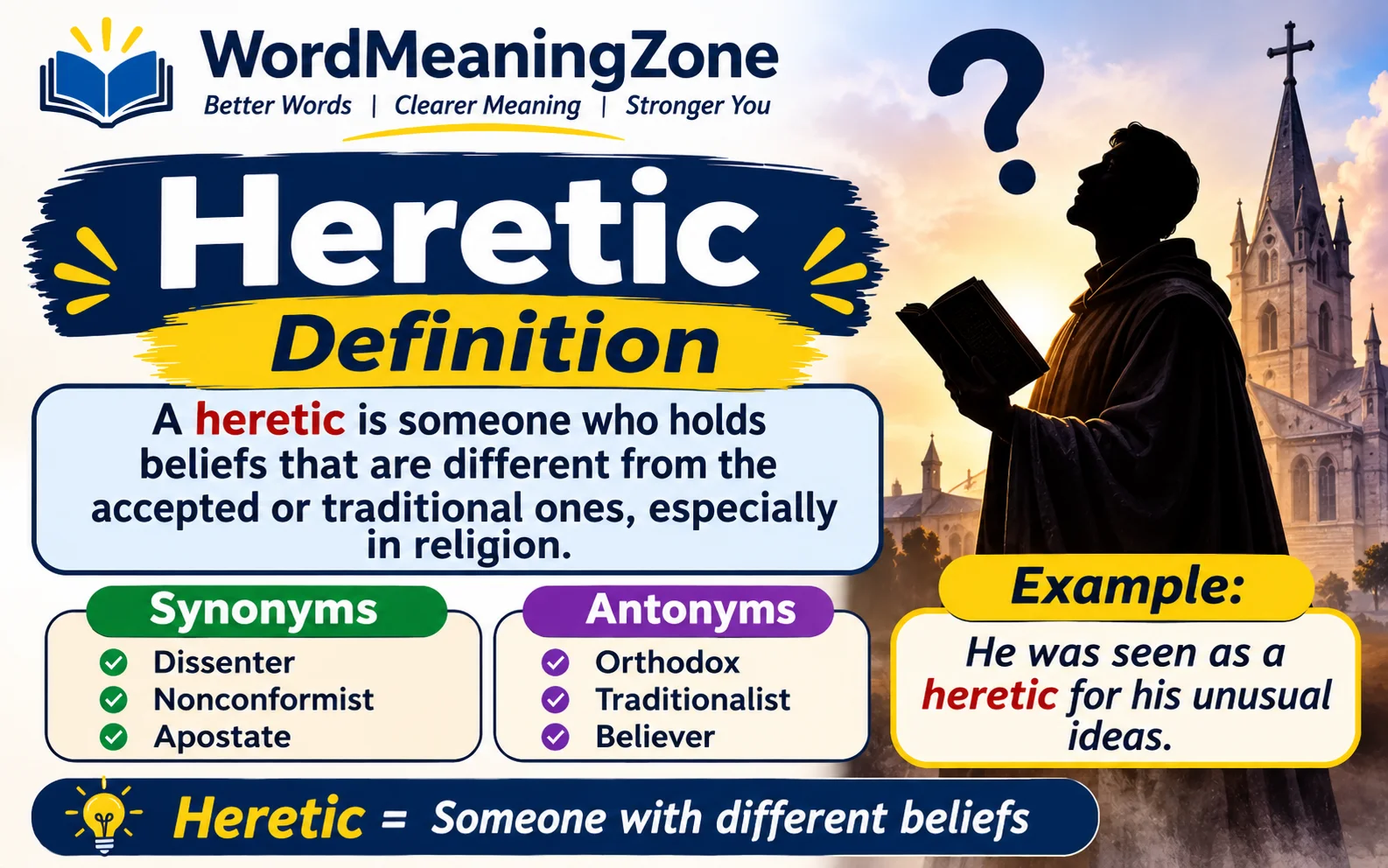
A heretic is a person whose beliefs go against the accepted teachings of an established religion. The word is also used more loosely for anyone who rejects the accepted view in any field. Merriam-Webster gives both senses: a religious one and a broader “nonconformist” one.
Heretic definition at a glance
| Question | Short answer |
|---|---|
| Part of speech | Noun (adjective: heretical) |
| Simple meaning | Someone who believes or teaches something opposed to accepted beliefs |
| Religious meaning | A person who differs from established religious dogma |
| Broader meaning | Anyone who breaks with a dominant opinion or practice |
| Pronunciation | HAIR-uh-tik (Merriam-Webster: ˈher-ə-ˌtik) |
| Spanish | hereje |
| First known use | 14th century (Merriam-Webster) |
What is the definition of a heretic?
The word has two main uses.
- Religious: a person who holds beliefs that conflict with the official teaching of their religion, often while still claiming to belong to it.
- General: a person who disagrees with a widely accepted idea, such as a company rule or a political party line.
Merriam-Webster’s example for the religious sense: Galileo was condemned as a heretic for supporting Copernicus’s idea that the earth moves around the sun. For the general sense, its example is that it would be “heretical” to suggest changing company policy.
Why the “claiming to belong” part matters: a heretic is usually an insider who disagrees. Someone who simply follows another religion is not normally called a heretic in the strict sense.
Heretic definition in simple words
A heretic is a person who says “I don’t agree with the official teaching,” about faith or about anything else people treat as settled.
Where the word comes from
The word comes from Greek hairetikos, “able to choose,” via Late Latin and Old French into Middle English. Dictionary.com and Oxford agree on this origin.
| Stage | Form | Meaning |
|---|---|---|
| Greek | haireomai | to choose |
| Greek | hairetikos | able to choose; later “heretical” |
| Late Latin | haereticus | heretic |
| Middle English | heretik | heretic (14th century) |
Why it matters: the root idea is “choice.” A heretic picks their own belief over the official one. That is why the word carries both negative and admiring meanings, depending on who is speaking.
Heretic definition in the Bible
The English word “heretic” appears once in the traditional King James Bible, in Titus 3:10: “A man that is an heretic after the first and second admonition reject.” The Greek word is hairetikos (Strong’s G141), found only here in the New Testament.
Modern Bible translations often use different words:
| Translation | Wording in Titus 3:10 |
|---|---|
| King James Version | heretic |
| English Revised Version | heretical |
| World English Bible | factious man |
| Berean Standard Bible | divisive man |
The International Standard Bible Encyclopedia says Paul used the idea of “heresy” to mean parties or factions. So in the Bible, a heretic is first of all someone who causes division, not only someone with a wrong idea.
The passage also sets out a process: warn once, warn twice, then separate. Bible dictionaries note the same pattern, which is why it is often cited when churches discuss discipline.
Heretic definition in religion
Different traditions define heresy in their own way.
| Tradition | How heresy is defined |
|---|---|
| Roman Catholic | Under Canon 751, the obstinate denial or doubt, after baptism, of a truth that must be believed with divine and Catholic faith |
| Eastern Orthodox | Most often, beliefs declared heretical by the first seven Ecumenical Councils |
| Wider usage | Beliefs seen as false by a religious group; the term also appears in Judaism and Islam |
Manifest heretic definition
Catholic teaching separates several kinds of heretics. Here is how the key terms differ.
| Term | Meaning |
|---|---|
| Formal heretic | Knowingly and stubbornly rejects a defined teaching |
| Material heretic | Holds a mistaken belief in good faith, without sinful intent |
| Manifest heretic | Someone whose error or doubt cannot be hidden by any excuse |
| Occult heretic | Someone whose error remains hidden |
Why the difference matters: the church treats someone who made an honest mistake very differently from someone who knowingly and openly rejects a teaching.
Heretic definition in world history
Calling someone a heretic has often been a serious matter. Here are some well-documented examples.
| Person or movement | What happened |
|---|---|
| Priscillian (385 CE) | Described as the first Christian executed for heresy |
| Cathars (12th-13th century) | The Church launched the Cathar Crusade against them in Languedoc |
| Medieval Inquisition (from about 1184) | Church bodies charged with suppressing heresy |
| Joan of Arc (1431) | Tried for heresy and found guilty |
| Martin Luther | Declared a heretic for rejecting parts of Roman Catholic teaching |
| Galileo Galilei | Brought before the Inquisition, gave up his views, and was placed under house arrest for life |
Historians also point out a useful idea from Walter Bauer: in some early Christian regions, what was later judged heresy may have been the original form of Christianity there. And an old Britannica essay (1911) makes a related point: there is no heresy without an orthodoxy, because the church must first declare what is true. In other words, the label depends on who holds power to define “correct” belief.
Heresy vs. heretic vs. similar words
| Word | Meaning | Example |
|---|---|---|
| Heresy | The belief or opinion itself | “He was accused of heresy.” |
| Heretic | The person who holds it | “The church regards them as heretics.” |
| Heretical | Describing the belief or act | “Heretical writings” |
| Heresiarch | Founder or leader of a heretical movement | A leader who starts a new sect |
| Apostate | Someone who abandons a belief entirely | A person who leaves the faith |
| Dissenter / nonconformist | Someone who disagrees, not always about religion | A member who votes against a party line |
Heretic definition and examples in sentences
| Sentence | Type of use |
|---|---|
| Galileo was condemned as a heretic for backing Copernicus. | Religious / historical |
| The church regards them as heretics. | Religious |
| Some fans called him a heretic for preferring opera at a country bar. | Humorous, everyday |
| It would be heretical to suggest changing company policy. | Workplace, general |
| She was branded a heretic for questioning the magazine’s long-held stance. | Media |
Heretic definition in Vampire Diaries (TVD)
In The Vampire Diaries, Heretics are witch-vampire hybrids. They were once siphoner witches of the Gemini Coven who were cast out and then turned into vampires by Lily Salvatore. They return to the show’s storyline in later seasons.
| Detail | In the show |
|---|---|
| What they are | Witches who became vampires |
| Where they came from | The Gemini Coven (Pacific Northwest, USA) |
| How they were made | Turned by Lily Salvatore |
| Why they are feared | Characters say they “break the laws of nature” |
Why the writers chose the word: in the show’s world, heretics are people who should not exist, much like religious heretics who break the rules of an official belief system. Fan sites disagree on how heretics appear later in Legacies, so check an episode guide before relying on any claim there.
Heretic definition in the movie
Heretic (2024) is an American psychological horror film written and directed by Scott Beck and Bryan Woods. It stars Hugh Grant, Sophie Thatcher and Chloe East. It premiered at the Toronto International Film Festival on September 8, 2024, and was released in the US by A24 on November 8, 2024.
| Detail | Info |
|---|---|
| Plot setup | Two young missionaries visit the home of Mr. Reed (Hugh Grant) |
| Themes | Religion, skepticism, morality |
| Why the title fits | The film is about belief, doubt and challenging faith |
Heretic definition in Romeo and Juliet
In Act 1, Scene 2, Romeo says that if his eyes ever say another woman is fairer than Rosaline, they should be punished. He calls his tears “transparent heretics” who should “be burnt for liars.”
| Part of the speech | Meaning |
|---|---|
| “devout religion of mine eye” | His eyes worship Rosaline like a faith |
| “transparent heretics” | Tears that betray that faith |
| “burnt for liars” | Punished the way heretics were burned |
Why it matters: Shakespeare’s audience knew that heretics were burned. Romeo uses that image to show how strong his (short-lived) devotion is.
Heretic definition in Spanish
The Spanish word is hereje (IPA: /eˈɾexe/). It is used for both men and women: el hereje, la hereje.
| English | Spanish |
|---|---|
| heretic | hereje |
| heresy | herejía |
| heretical | herético |
Hereje also came into other languages, such as Tagalog, from Spanish.
Heretic definition in Supernatural
I could not find a verified, official “heretic” creature type or definition in the TV series Supernatural. If you see the word in that context, it most likely carries its normal meaning: someone who rejects the accepted beliefs of a group. Check the specific episode or fan wiki before using any show-specific claim.
Is “heretic” an insult?
It depends on who says it and why.
| Context | Tone |
|---|---|
| Used by a religious authority | Serious accusation |
| Used by a critic | Insult |
| Used by the person themselves | Often proud or playful |
| Used in business or sports | Usually humorous |
FAQs About Heretic Definition
Is a heretic the same as an atheist?
No. An atheist doesn’t believe in God. A heretic usually still believes in the religion but disagrees with a part of its official teaching.
Can a person be a heretic outside Christianity?
Yes. The term has been applied in Judaism and Islam too, though the details differ by tradition.
Does the word only apply to religion?
No. Dictionaries also list a general sense: anyone who goes against a widely accepted opinion, as in business, science or politics.
Key takeaways On Heretic Definition
- A heretic holds beliefs opposed to accepted teaching, usually religious.
- The word comes from Greek for “able to choose.”
- In the Bible it appears once (Titus 3:10) and may mean a divisive person.
- Heretics in TV and film are fictional uses of the word.
