
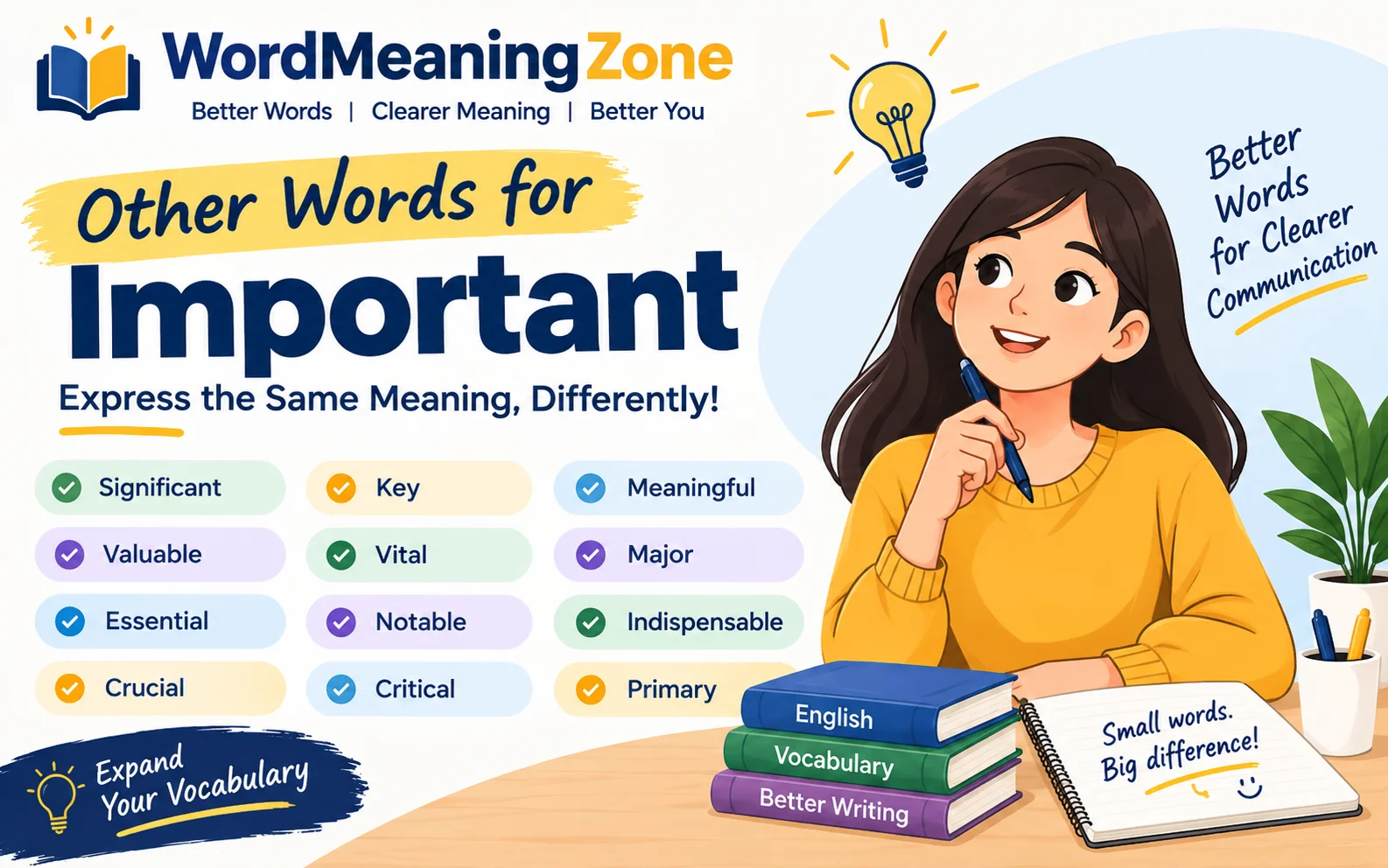
The best other word for important depends on what kind of important you mean: use “essential” or “vital” for must-haves, “urgent” for deadlines, “significant” for impact, “valuable” for worth, and “prominent” for status.
That one line will save you ten minutes of thesaurus scrolling. But if you want to actually sound like a sharper writer in 2026, stay with me. Picking the right other word for important is less about vocabulary and more about telling your reader exactly how something matters.
What Is the Other Word for Important?
People type “what is the other word for important” into Google every day, and the honest answer is: there isn’t one. There are about fifty, and each carries a different shade of meaning.
Here’s the quick version.
| If you mean… | Use this other word for important |
|---|---|
| You can’t do without it | essential, vital, indispensable |
| It needs action now | urgent, pressing, time-sensitive |
| It changes outcomes | significant, consequential, momentous |
| It has real worth | valuable, invaluable, meaningful |
| It has status or fame | prominent, notable, eminent |
| It’s the main thing | key, central, principal, primary |
Quick definitions (so we’re on the same page):
- Synonym: a word with a similar meaning to another word.
- Connotation: the feeling or association a word carries beyond its literal meaning. “Crucial” feels tense; “valuable” feels warm.
- Register: how formal or casual a word sounds. “Imperative” is formal; “a big deal” is casual.
Why does this matter? Because “important” is a container word. It holds meaning but doesn’t show it. The word comes from the Latin importare, which means “to bring in,” and by medieval times it came to mean “to carry weight or significance.” Your job as a writer is to unpack the container.
Also Read: WYO Meaning in Text
Why Swapping “Important” Actually Matters in 2026
Let’s talk about readers, because they’re brutal.
According to the Nielsen Norman Group, only about 16% of users read web text word by word, while roughly 79% scan the page. In a separate NN/g analysis, readers took in around 20–28% of the words on a typical page visit.
Translation: if “important” shows up eight times in your post, your reader sees it as wallpaper.
Meanwhile, the U.S. government’s plainlanguage.gov guidelines push writers to favor specific, concrete words and keep sentences around 20 words or fewer. Vague words like “important” fight that goal. A specific word like “non-negotiable” or “time-sensitive” does the opposite.
And in 2026, there’s one more reason. Readers (and search engines) are swimming in AI-generated copy where “it’s important to note” appears in every third paragraph. Precise word choice is now a quiet signal that a human cared.
Author POV: My rule of thumb after years of editing blog drafts: if a sentence says “this is important” and the next sentence doesn’t say why, the sentence is lying by omission. The fix is rarely just a synonym. It’s a synonym plus a consequence. More on that formula below.
An Other Word for Important: The Full List by Meaning
Writers often search for “an other word for important” when they’re stuck mid-sentence. Skip the alphabetical dump. Match the word to the job.
Essential and Necessary (can’t live without it)
| Word | Example sentence | Tone |
|---|---|---|
| Essential | Sleep is essential for memory. | Neutral |
| Vital | A vital signature is missing. | Strong |
| Crucial | The next 48 hours are crucial. | Tense |
| Critical | This is a critical security patch. | Technical |
| Indispensable | She became indispensable to the team. | Formal |
| Necessary | A visa is necessary for entry. | Neutral |
| Imperative | It is imperative that we respond today. | Very formal |
| Fundamental | Trust is fundamental to any brand. | Academic |
| Requisite | He lacked the requisite experience. | Formal |
| Non-negotiable | Data privacy is non-negotiable. | Casual-firm |
Urgent (needs action now)
| Word | Example sentence |
|---|---|
| Urgent | We have an urgent client request. |
| Pressing | Hiring is our most pressing need. |
| Time-sensitive | This offer is time-sensitive. |
| High-priority | Mark it as a high-priority ticket. |
| Acute | There’s an acute shortage of nurses. |
| Exigent | Exigent circumstances require action. |
| Mission-critical | Uptime is mission-critical for banks. |
Significant and Consequential (changes outcomes)
| Word | Example sentence |
|---|---|
| Significant | A significant rise in conversions. |
| Consequential | A consequential ruling for the industry. |
| Momentous | A momentous day for the company. |
| Weighty | A weighty decision for the board. |
| Major | A major milestone for our team. |
| Substantial | Substantial savings over five years. |
| Far-reaching | Far-reaching changes to tax rules. |
| Material | A material change to the contract. |
| Game-changing | A game-changing product launch. |
Valuable and Meaningful (worth something)
| Word | Example sentence |
|---|---|
| Valuable | Customer feedback is valuable. |
| Invaluable | Her advice was invaluable. |
| Precious | Time is our most precious resource. |
| Prized | A prized skill in 2026’s job market. |
| Worthwhile | A worthwhile investment. |
| Meaningful | Meaningful work keeps people engaged. |
| Beneficial | Beneficial for long-term growth. |
Notable and Prominent (has status)
| Word | Example sentence |
|---|---|
| Notable | A notable exception to the rule. |
| Prominent | A prominent voice in the field. |
| Eminent | An eminent scientist. |
| Influential | An influential report. |
| Distinguished | A distinguished career. |
| Noteworthy | A noteworthy result. |
| Renowned | A renowned chef. |
| Landmark | A landmark court decision. |
| High-profile | A high-profile partnership. |
Core and Main (the primary thing)
| Word | Example sentence |
|---|---|
| Key | The key takeaway is simple. |
| Core | Our core value is transparency. |
| Central | Pricing is central to the debate. |
| Principal | The principal reason for delay. |
| Primary | Our primary goal this quarter. |
| Chief | His chief concern is cost. |
| Foremost | Safety is the foremost priority. |
| Paramount | Customer trust is paramount. |
| Cardinal | Cardinal rule: back up your files. |
| Main | The main reason people leave. |
That’s 56 words, grouped by what they really mean.
Also Read: GTS Meaning in Text
The Importance Compass: A Simple Framework for Picking the Right Word
Here’s the original model I use when I edit. I call it the Importance Compass. It has four directions, and you ask one question for each.
| Direction | Question | Word family |
|---|---|---|
| N: Necessity | Would things break without it? | essential, vital, indispensable |
| E: Emergency | Does it have a deadline? | urgent, pressing, time-sensitive |
| S: Significance | Will it change a result? | significant, consequential, major |
| W: Worth | Is it valuable to someone? | valuable, meaningful, invaluable |
Pick the direction first. Then pick the word.
Why it works: the biggest mistake with any other word for important is choosing by sound, not by meaning. “Crucial” sounds powerful, so people use it for everything. But if nothing is breaking and nothing is due, it’s not crucial. It’s just valuable. The compass forces you to name the real reason something matters.
The 4-Step “Swap and Prove” Workflow (Copy This)
Use this every time you catch “important” in your draft.
- Highlight every instance of “important” (Ctrl+F is your friend).
- Ask the Compass question (N, E, S, or W).
- Replace it with one word from the matching family.
- Prove it by adding a “because” clause or a number.
The Power Sentence Formula
[Precise word] + [subject] + because + [consequence]
Example: “Backups are essential because a single ransomware hit can erase years of work.”
That “because” is what turns a label into an argument.
Mini Case Study: Fixing a Real-World Draft
Illustrative example based on a very common editing pattern.
A SaaS team wrote this in a product update email:
Before:
“It’s important to update your password. This is an important security step and an important part of keeping your account safe.”
Three “importants” in two sentences. Readers skim past all of them.
After:
“Update your password today. It’s essential because reused passwords are one of the easiest ways attackers get into accounts. Skipping it leaves your data exposed.”
What changed:
- “Important” became essential (Necessity direction).
- A consequence replaced the vague claim.
- One sentence now opens with a direct action.
This is the pattern you’ll see in almost every edit: a better word helps, but a better reason helps more.
Also Read: TMP Meaning in Text
The Other Word for Important: Formal vs. Casual Cheat Sheet
The other word for important you choose should match your audience. Use this as your register guide.
| Context | Best choices | Avoid |
|---|---|---|
| Academic paper | significant, fundamental, pivotal | “a big deal” |
| Business email | key, critical, high-priority | “game-changing” overuse |
| Resume / LinkedIn | instrumental, strategic, core | “vital” (sounds dramatic) |
| Blog / social | non-negotiable, must-have, big deal | “exigent”, “requisite” |
| Legal / policy | material, substantial, requisite | “super important” |
| Speeches | paramount, momentous, cardinal | “pressing” overused |
Industry benchmark: many plain-language style guides, including the Federal Plain Language Guidelines, recommend choosing the familiar word over the fancy one when both mean the same thing. If “key” does the job, you don’t need “cardinal.”
Common Mistakes When Using Another Word for Important
- Thesaurus roulette. Swapping words without checking connotation. “Momentous” for a routine meeting reads absurd.
- Crying wolf with “urgent.” If everything is urgent, nothing is.
- Stacking synonyms. “It’s vital, crucial, and essential” says the same thing three times.
- Starting with “It’s important to note.” This phrase adds nothing. Say the note.
- Using formal words in casual spaces. “Imperative” in a text message feels like a legal notice.
- Skipping the “why.” A strong word with no reason still reads as hype.
- Ignoring collocations. We say “play a key role,” not “play a vital-ish role.” Natural pairings matter. “Pivotal moment,” “crucial decision,” “essential ingredient,” “paramount concern.”
Quick Checklist Before You Hit Publish
No more than one “important” per 500 words
Each replacement matches the Compass direction
Every strong word is followed by a reason or number
Register fits the audience (formal vs. casual)
No stacked synonyms in a single sentence
Read aloud once: does any word sound fake?
Also Read: Another Word for Equitable
FAQs About Other Word for Important
1. What is the best other word for important in formal writing?
For formal writing, significant, fundamental, paramount, and imperative work best. Use “significant” for impact, “fundamental” for foundations, and “paramount” when something outranks everything else.
2. What is the other word for important in a resume or interview?
Try key, instrumental, strategic, or core. For example, “I played a key role in launching…” beats “I played an important role.” Pair it with a number to add proof.
3. Is “crucial” stronger than “important”?
Yes. “Crucial” signals that the outcome hinges on this one thing, which is why it works best when a decision or result truly depends on it. Overusing it weakens it.
4. What is a casual other word for important?
Casual options include a big deal, a must, non-negotiable, huge, and game-changing. They suit blogs, social posts, and chats, but not legal or academic writing.
5. How many times can I use “important” in one article?
A good guideline: once per 500 words, at most. Replace the rest with a more precise other word for important, then add a reason for each claim.
Conclusion: Make “Important” Earn Its Place
Finding the right other word for important isn’t about showing off your vocabulary. It’s about respecting your reader’s time. Name how something matters (necessity, urgency, significance, or worth), choose the matching word, and back it up with a reason.
Do that, and your writing stops sounding like everyone else’s and starts sounding like you. Try the Importance Compass on your next draft. Your readers, and your search rankings, will notice.
Key Takeaways On Other Word for Important
- “Important” is a vague container word; the best other word for important reveals why something matters.
- Match your word to one of four directions: Necessity, Emergency, Significance, Worth.
- Follow every strong word with a “because” clause or a number.
- Avoid thesaurus roulette, stacked synonyms, and “it’s important to note.”
- Match register to audience: formal, business, casual.
Short Summary Of Other Word for Important
The right word depends on meaning: essential for must-haves, urgent for deadlines, significant for impact, valuable for worth, and prominent for status. Use the Importance Compass to choose and the Power Sentence Formula to prove it, and your 2026 content will read sharper, clearer, and more human.
