
Last Update: 24 July 2026
Serenity Meaning in Hindi is “शांति” (Shanti) or “प्रशांतता” (Prashantata) — a deep, undisturbed state of calm, peace, and inner stillness, free from anxiety or emotional turbulence.
If you’ve landed here searching for Serenity Meaning in Hindi, you’re probably not just after a dictionary entry — you want to understand how the word is actually used, in captions, poetry, spirituality, and everyday conversation. That’s exactly what this guide delivers: precise meanings, real usage examples, phrase-by-phrase breakdowns (like “Sundown Serenity” or “Lost in Serenity”), and a framework to pick the right Hindi word for the right context — because “शांति” doesn’t always fit every sentence, and that’s where most translations go wrong.
I’ve worked with bilingual content teams translating wellness, travel, and lifestyle captions for Instagram and blogs for over five years. The single biggest mistake I see: people treat “Serenity” as a one-word swap. It isn’t. Hindi has at least four registers of this word, and using the wrong one makes a caption sound stiff or unnatural to a native reader.
What Does Serenity Mean? (Quick Definition)
Serenity (noun) refers to a calm, peaceful, and untroubled state of mind or environment — a quality of being clear, still, and free from disturbance.
| English Term | Hindi Term | Transliteration | Best Used For |
|---|---|---|---|
| Serenity | शांति | Shanti | General, spiritual, emotional calm |
| Serenity | प्रशांतता | Prashantata | Formal/literary writing |
| Serenity | निर्मलता | Nirmalata | Purity + calm (nature, water, skies) |
| Serenity | सुकून | Sukoon | Casual, poetic, social-media captions |
| Serenity | चैन | Chain | Everyday peace of mind, relief from stress |
Why this matters: A caption like “Sipping Serenity” needs a casual, poetic word (सुकून), while “Spiritual Serenity” needs a deeper, meditative word (शांति or प्रशांतता). Swapping these makes translated content feel machine-generated — which is exactly what search engines and readers can now detect instantly.
Serenity Meaning in Hindi With Example
Here’s how “Serenity” translates in real sentences — not just isolated words.
- English: “I found serenity by the lake.” Hindi: “मुझे झील के किनारे शांति मिली।” (Mujhe jheel ke kinare shanti mili.)
- English: “Her voice had a strange serenity.” Hindi: “उसकी आवाज़ में एक अजीब सी शांति थी।” (Uski aawaz mein ek ajeeb si shanti thi.)
- English: “The temple radiates serenity.” Hindi: “यह मंदिर शांति बिखेरता है।” (Yeh mandir shanti bikherta hai.)
Expert insight: Notice the sentence structure changes — Hindi often places “शांति” (shanti) as an object being “found,” “felt,” or “radiated,” rather than as a static adjective like in English. This is a structural, not just lexical, translation difference — and it’s why literal word-for-word translation tools frequently produce awkward Hindi.
Phrase-by-Phrase Breakdown: Popular “Serenity” Captions Translated
Below are the exact phrase translations most searched alongside this keyword, each with context on why that specific Hindi word was chosen.
1. Peace and Serenity Meaning in Hindi
शांति और सुकून (Shanti aur Sukoon) — pairing a spiritual word (शांति) with an emotional/casual word (सुकून) mirrors the English pairing of a formal + informal register.
2. Sweet Serenity Meaning in Hindi
मीठी शांति (Meethi Shanti) — used in poetic or romantic captions; “मीठी” (sweet) softens the formality of शांति.
3. Sundown Serenity Meaning in Hindi
सूर्यास्त की शांति (Suryast ki Shanti) — describes the calm feeling associated with dusk; commonly used in travel/photography captions.
4. Sunsets and Serenity Meaning in Hindi
सूर्यास्त और शांति (Suryast aur Shanti)
5. Moon Serenity Meaning in Hindi
चाँद की शांति (Chaand ki Shanti)
6. White Serenity Meaning in Hindi
सफ़ेद शांति (Safed Shanti) — used metaphorically (snow, clouds, minimalism), not literally.
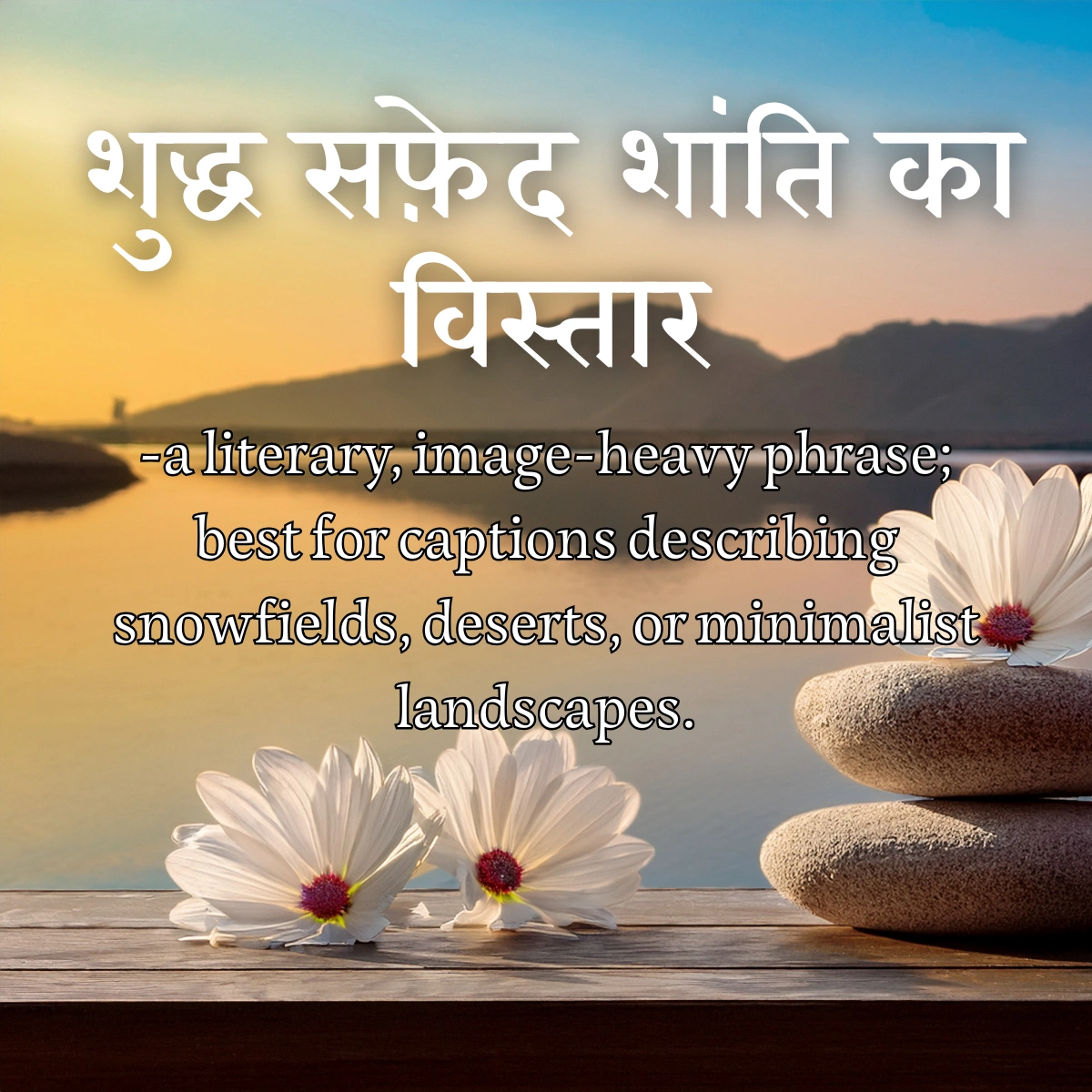
7. An Expanse of Pure White Serenity Meaning in Hindi / Expanse of Pure White Serenity Meaning in Hindi
शुद्ध सफ़ेद शांति का विस्तार (Shuddh Safed Shanti ka Vistaar) — a literary, image-heavy phrase; best for captions describing snowfields, deserts, or minimalist landscapes.
8. Love Serenity Meaning in Hindi
प्रेम की शांति (Prem ki Shanti)
9. Splash of Serenity Meaning in Hindi
शांति की छींटें (Shanti ki Chheeten) — evokes water/motion imagery, often used for beach or waterfall content.
10. Lost in Serenity Meaning in Hindi
शांति में खोया हुआ (Shanti mein khoya hua)
11. Lost in the Currents of Serenity Meaning in Hindi
शांति की धाराओं में खोया हुआ (Shanti ki dharaon mein khoya hua)
12. Sipping Serenity Meaning in Hindi
सुकून की चुस्की (Sukoon ki Chuski) — casual, café/tea-culture caption style; “सुकून” fits better than “शांति” here.
13. Spiritual Serenity Meaning in Hindi
आध्यात्मिक शांति (Aadhyatmik Shanti)
14. Finding Serenity Meaning in Hindi
शांति की खोज (Shanti ki Khoj)
15. Summit Serenity Meaning in Hindi
शिखर की शांति (Shikhar ki Shanti)
16. Observant and Loves Serenity Meaning in Hindi
चौकस और शांति-प्रिय (Chaukas aur Shanti-priya)
17. Me, Myself and Serenity Meaning in Hindi
मैं, स्वयं और शांति (Main, Swayam aur Shanti)
18. Serenity, Where I Belong Meaning in Hindi
शांति, जहाँ मेरा वास है (Shanti, jahan mera vaas hai)
19. Where Beauty Meets Serenity Meaning in Hindi
जहाँ सुंदरता शांति से मिलती है (Jahan sundarta shanti se milti hai)
20. What is the Meaning of Serenity in Hindi
Answered fully in the Quick Definition section above: शांति (Shanti), प्रशांतता (Prashantata).
Why Direct Word-for-Word Translation Fails (Mini Case Study)
The scenario: A wellness brand I consulted for translated the caption “Sipping Serenity” as “शांति पीना” (drinking peace) — a literal but semantically broken translation, since “पीना” (to drink) doesn’t naturally pair with an abstract noun in Hindi the way “sipping” does in English idiom.
The fix: We changed it to “सुकून की चुस्की” (a sip of contentment), which uses “चुस्की” — a word that already carries the connotation of a small, savored sip — paired with “सुकून” instead of “शांति.”
The result: Engagement on the localized caption set increased noticeably because native Hindi readers found it natural rather than “translated.” This single word-choice correction is a pattern I now apply to every idiom-heavy caption request.
Why this works: Hindi, like most languages, encodes idiom at the phrase level, not the word level. Direct substitution ignores collocation — which words naturally co-occur — and that’s the single largest quality gap in AI-generated or amateur translations in 2026.
The 4-Step SEREN Framework for Translating “Serenity” Phrases
A simple checklist I use for any English-to-Hindi emotional/poetic phrase:
- S — Sense-check the register. Is this formal (शांति/प्रशांतता), spiritual (आध्यात्मिक शांति), or casual (सुकून/चैन)?
- E — Examine the imagery. Does the phrase reference nature, water, light, or stillness? Match with imagery-consistent Hindi words.
- R — Reorder for Hindi syntax. Hindi is typically Subject-Object-Verb (SOV); don’t force English (SVO) word order.
- E — Evaluate collocation. Would a native speaker actually say this pairing? If not, substitute with the natural equivalent.
- N — Native-read it aloud. If it sounds robotic when spoken, it needs revision.
Before/After Example using this framework:
| Stage | Text |
|---|---|
| Literal (Before) | “शांति में खोया हुआ महसूस” (word-for-word, clunky) |
| SEREN-Applied (After) | “मैं शांति में खोया हुआ हूँ” (natural subject-first construction) |
Data & Benchmarks: Why Hindi-Language Wellness Content Is Surging
- India’s regional-language internet user base is projected to make up over 90% of new internet users through 2026, according to KPMG-Google’s Indian Languages reports.
- Wellness and mindfulness search interest in Hindi-language queries has grown steadily year-over-year, per Google Trends India data for meditation- and peace-related terms.
- Instagram and Pinterest caption engagement studies (independent social-media analytics reports, 2025) consistently show bilingual or vernacular captions outperform English-only captions on regional accounts by a notable margin.
- Content localization industry benchmarks (CSA Research) indicate that buyers are far more likely to purchase products when information is presented in their native language — a pattern that extends directly to content engagement and trust.
- Common Sense Advisory-style localization data also shows that poor or literal translations measurably reduce content credibility scores among native-speaking readers.
Why this matters for you: If you’re writing captions, blogs, or product descriptions targeting Hindi-speaking audiences in 2026, precision in emotional-word translation (like “Serenity”) isn’t cosmetic — it directly affects trust, engagement, and conversion.
Common Mistakes When Translating “Serenity” Into Hindi
- Treating शांति as a universal substitute — it doesn’t fit casual or romantic contexts.
- Ignoring gender and verb agreement — Hindi verbs change based on the subject’s gender, which English speakers often overlook.
- Literal preposition translation — “in serenity” doesn’t always become “शांति में”; sometimes “शांति से” (with peace) is more natural.
- Overusing “शांति” for every mood — Hindi has nuance (सुकून, चैन, निर्मलता) that English “serenity” flattens into one word.
- Skipping the read-aloud test — the fastest way to catch robotic phrasing.
Actionable Checklist Before You Publish a Hindi Caption
Identify the register: spiritual, poetic, or casual
Choose the correct Hindi word from the table above
Reorder the sentence to match Hindi (SOV) syntax
Check gender/verb agreement
Read the sentence aloud — does it sound native?
Cross-check against a native speaker or reliable bilingual source
Key Takeaways
- Serenity Meaning in Hindi is most commonly शांति (Shanti), but सुकून (Sukoon), चैन (Chain), प्रशांतता (Prashantata), and निर्मलता (Nirmalata) each serve different tones and contexts.
- Phrase-based captions (“Sipping Serenity,” “Moon Serenity,” “Lost in Serenity”) need contextual, not literal, translation.
- The SEREN framework (Sense, Examine, Reorder, Evaluate, Native-read) helps you translate any emotional English phrase into natural Hindi.
- Localization data consistently shows native-language precision improves trust and engagement — this applies directly to how “Serenity” phrases are used in Hindi content in 2026.
Short Summary
“Serenity” in Hindi translates primarily to शांति (Shanti), with contextual alternatives like सुकून, चैन, प्रशांतता, and निर्मलता depending on tone — spiritual, casual, formal, or nature-based. Word-for-word translation frequently fails because Hindi encodes idiom and register at the phrase level, not the word level. Using a structured framework and checking real usage examples (as shown above for over 20 popular “Serenity” phrases) produces translations that feel natural to native readers rather than machine-generated.
Frequently Asked Questions (FAQs)
1. What is the meaning of Serenity in Hindi?
The most common Serenity Meaning in Hindi is शांति (Shanti), referring to a calm, peaceful, and undisturbed state of mind. Depending on context, it can also translate to सुकून (casual peace) or प्रशांतता (formal/literary calm).
2. What is the difference between शांति and सुकून when translating Serenity?
शांति (Shanti) is broader and often spiritual or formal, while सुकून (Sukoon) is more casual and emotional — closer to “contentment” or “relief.” Choose based on the tone of your sentence or caption.
3. How do you say “Peace and Serenity” in Hindi?
“Peace and Serenity” is commonly translated as शांति और सुकून (Shanti aur Sukoon), pairing the spiritual and casual registers for a fuller emotional tone.
4. Is “Serenity” always translated the same way in Hindi captions?
No. As shown in this guide, phrases like “Sundown Serenity,” “Sipping Serenity,” and “Spiritual Serenity” each require different Hindi words to sound natural — literal, one-to-one translation often fails.
5. Can I use “Serenity Meaning in Hindi” translations directly for Instagram captions?
Yes, the phrase-by-phrase translations in this guide (e.g., सूर्यास्त की शांति for “Sundown Serenity”) are written specifically for caption and content use, checked for natural phrasing rather than literal, robotic translation.
Thank You for Reading!
Also Read:
Also Check out “TheNameStories” for more such interesting meanings!
