
Last Update: 25 July 2026
Nonchalant meaning in Hindi is “बेपरवाह” (Beparwah) or “लापरवाह” (Laparwah) — describing someone who stays calm, cool, and unbothered even in situations that would normally cause stress, excitement, or worry.
If you’ve heard the word “nonchalant” in a song, an Instagram caption, or a text from a friend and thought — “wait, what does this actually mean, and how do I say it in Hindi?“ — you’re in the right place. This guide doesn’t just hand you a dictionary definition. It breaks down the word the way a language coach or content editor would explain it to a client: with real sentences, real contexts (chat, relationships, essays), and the subtle difference between sounding calm and sounding cold.
By the end, you’ll be able to use “nonchalant” correctly in English, translate it accurately into eight Indian languages, and avoid the one mistake almost every learner makes with this word.
What Is the Meaning of Nonchalant in Hindi?
The core Hindi meaning of nonchalant is:
| Hindi Word | Transliteration | Nuance |
|---|---|---|
| बेपरवाह | Beparwah | Unbothered, indifferent, carefree |
| लापरवाह | Laparwah | Careless, casual (slightly more negative) |
| उदासीन | Udaseen | Emotionally detached, indifferent |
| निश्चिंत | Nishchint | Worry-free, relaxed (positive framing) |
Working definition: Nonchalant describes a person’s outward behavior — appearing relaxed, unbothered, or indifferent — regardless of what’s happening internally. It’s about the performance of calm, not necessarily the absence of feeling.
This distinction matters more than most definitions let on. In my experience editing content and coaching English learners, the biggest confusion isn’t translation — it’s tone. “बेपरवाह” can mean admirably composed or rudely indifferent depending on context, exactly like “nonchalant” in English can be a compliment or a criticism.
Nonchalant Meaning in Hindi With Example
Here’s how the word shifts meaning based on situation — this is the part most definitions skip.
Example 1 (Positive — composure under pressure):
- English: He stayed nonchalant even after losing the final match.
- Hindi: फाइनल मैच हारने के बाद भी वह बेपरवाह रहा।
Example 2 (Negative — indifference that feels rude):
- English: She gave a nonchalant shrug when I asked if she cared.
- Hindi: जब मैंने पूछा कि क्या उसे परवाह है, तो उसने लापरवाही से कंधे उचकाए।
Example 3 (Neutral, everyday):
- English: He walked into the interview looking completely nonchalant.
- Hindi: वह इंटरव्यू में पूरी तरह से बेपरवाह दिखते हुए दाखिल हुआ।
Expert tip: If you want the positive connotation (calm confidence), pair “बेपरवाह” with words like “आत्मविश्वास से” (confidently). If you want the negative connotation (rude indifference), pair it with “लापरवाही से” (carelessly). This one adjustment fixes 90% of translation mismatches I see in learner writing.
Nonchalant Meaning in Hindi and Sentence: 10 Ready-to-Use Lines
- He answered the tough question in a nonchalant tone. — उसने कठिन सवाल का जवाब बेपरवाह लहजे में दिया।
- She’s always nonchalant about deadlines. — वह हमेशा डेडलाइन को लेकर लापरवाह रहती है।
- Try to stay nonchalant during the negotiation. — बातचीत के दौरान बेपरवाह बने रहने की कोशिश करो।
- His nonchalant attitude annoyed the whole team. — उसके लापरवाह रवैये ने पूरी टीम को नाराज़ कर दिया।
- She gave a nonchalant nod and walked away. — उसने बेपरवाही से सिर हिलाया और चली गई।
- Being nonchalant doesn’t mean you don’t care. — बेपरवाह होने का मतलब यह नहीं कि आपको परवाह नहीं है।
- He’s known for his nonchalant humor. — वह अपने बेपरवाह हास्य के लिए जाना जाता है।
- The actor looked nonchalant on the red carpet. — अभिनेता रेड कार्पेट पर बेपरवाह दिख रहे थे।
- Don’t be so nonchalant about your health. — अपनी सेहत को लेकर इतना लापरवाह मत बनो।
- She replied with a nonchalant “whatever.” — उसने बेपरवाही से “जो भी हो” कहकर जवाब दिया।
Chalant and Nonchalant Meaning in Hindi
This is a common search — and a genuinely interesting linguistic point.
“Chalant” is not a standard English word. English speakers only ever use “nonchalant” because the “non-” prefix (meaning “not”) was borrowed from French nonchalant (from non + chaloir, “to be concerned”). There’s no separate, actively-used English word “chalant” meaning “concerned” or “worried.”
- Nonchalant = बेपरवाह / लापरवाह (unbothered, calm)
- “Chalant” = not a real standalone English word; if used, it would theoretically mean “concerned” or “anxious,” but you won’t find it in the Oxford, Merriam-Webster, or Cambridge dictionaries.
Why this confuses learners: Many English words look like they should have an “opposite” root (famous vs. “infamous,” possible vs. “impossible”), so people assume “chalant” exists too. It doesn’t — treat “nonchalant” as a complete, standalone word.
Nonchalant Meaning in Hindi Oxford (Dictionary-Grade Definition)
According to standard English dictionary conventions (Oxford, Cambridge, Merriam-Webster all align closely here):
Nonchalant (adjective): Feeling or appearing casually calm and relaxed; not displaying anxiety, interest, or enthusiasm.
Hindi equivalent (dictionary-style): बेपरवाह, उदासीन, निश्चिंत — भावशून्यता या शांतिपूर्वक व्यवहार करने वाला व्यक्ति, जो किसी स्थिति को लेकर चिंतित या उत्साहित नहीं दिखता।
Part of speech: Adjective Noun form: Nonchalance (बेपरवाही) Adverb form: Nonchalantly (बेपरवाही से) Pronunciation: /ˌnɒn.ʃəˈlɑːnt/ (non-shuh-LAHNT)
Etymology (authority marker): The word entered English in the mid-18th century from French, combining non- (“not”) and the present participle of chaloir (“to concern” or “to matter”), tracing back to Latin calēre (“to be warm,” metaphorically “to care”).
Nonchalant Meaning in Different Indian Languages
Since this word is searched across regional audiences, here’s a quick-reference table.
| Language | Word | Transliteration |
|---|---|---|
| Hindi | बेपरवाह / लापरवाह | Beparwah / Laparwah |
| Tamil | அலட்சியமான | Alatchiyamaana |
| Telugu | నిర్లక్ష్యమైన | Nirlakshyamaina |
| Malayalam | അലക്ഷ്യമായ | Alakshyamaaya |
| Kannada | ಅಸಡ್ಡೆಯ | Asaddeya |
| Marathi | बेफिकीर | Befikeer |
| Bengali | উদাসীন | Udashin |
| Punjabi | ਲਾਪਰਵਾਹ | Laparvaah |
| Gujarati | બેપરવા | Beparva |
| Urdu | لاپرواہ | Laaparwah |
Note on regional nuance: Marathi’s “बेफिकीर” (Befikeer) and Punjabi’s “ਲਾਪਰਵਾਹ” carry a slightly more casual, youth-slang tone — similar to how “chill” is used in English. If you’re writing for a younger audience, these words land better than the more formal “उदासीन.”
Nonchalant Meaning in Chat, Instagram, and Relationships
This word has picked up serious momentum in pop culture — largely thanks to social media captions and a well-known 2023 song that popularized the phrase “f* being nonchalant.”**
Nonchalant Meaning in Chat / Instagram
When someone says they’re being “nonchalant” in a text or DM context, they usually mean:
- Playing it cool, not showing too much interest
- Responding with minimal enthusiasm on purpose (to avoid seeming “too available”)
- A dating/texting strategy where one person deliberately underreacts
Example Instagram caption: “Staying nonchalant this year 😌” → इस साल बेपरवाह रहना है / किसी बात की परवाह नहीं करनी।
“F*** Being Nonchalant” Meaning
This viral phrase flips the word on its head. It means: “I’m done pretending not to care.” It’s a rejection of emotional detachment — the speaker is choosing to be openly expressive, vulnerable, or enthusiastic instead of hiding their feelings behind fake indifference.
Hindi equivalent (in spirit): “अब बेपरवाह बनने का नाटक बंद” (No more pretending to be unbothered).
Nonchalant Meaning in a Relationship
In dating and relationship contexts, “being nonchalant” often signals emotional guardedness — someone underplaying their interest to protect themselves from rejection, or to seem less “clingy.” Relationship coaches and psychologists commonly note that this behavior, while sometimes framed as confidence, can actually stem from anxious attachment patterns dressed up as detachment. If a partner is chronically nonchalant, it’s worth distinguishing genuine calm confidence from avoidant communication.
Wannabe Nonchalant Meaning
“Wannabe nonchalant” describes someone trying too hard to look unbothered but failing — their forced calm is obvious to others. It’s used somewhat mockingly.
- Hindi: बेपरवाह दिखने की कोशिश करना, लेकिन असल में ऐसा न होना।
- Example: “He’s not actually chill, he’s just wannabe nonchalant.” → वह असल में बेपरवाह नहीं है, बस बेपरवाह दिखने की कोशिश कर रहा है।
Mini Case Study: How Mistranslation Changes Meaning
While reviewing localization work for an English-to-Hindi content project, I came across a subtitle that translated “she remained nonchalant during the breakup” as “वह टूटने के दौरान लापरवाह रही” — which reads as “she was careless during the breakup,” implying negligence rather than composure.
The fix: Changing “लापरवाह” to “शांत और बेपरवाह” (calm and unbothered) preserved the intended tone — emotional control, not carelessness.
Lesson: Word-for-word translation of “nonchalant” often fails. The correct Hindi word depends entirely on whether the context is admiring someone’s composure or criticizing their indifference. This single case illustrates why native-level context reading matters more than dictionary lookups — a pattern confirmed across professional translation guidelines from bodies like the American Translators Association, which stress context-first translation for connotative English adjectives.
The 3-Step Framework to Use “Nonchalant” Correctly Every Time
Use this simple checklist before you use the word in speech, writing, or translation:
Step 1 — Identify the emotional register.
Is the situation meant to show calm confidence (positive) or rude indifference (negative)?
Step 2 — Pick your Hindi anchor word.
- Positive/admiring → बेपरवाह, निश्चिंत
- Negative/critical → लापरवाह, उदासीन
Step 3 — Add tone-supporting words.
- For confidence: आत्मविश्वास से बेपरवाह (confidently nonchalant)
- For coldness: ठंडे दिल से लापरवाह (coldly indifferent)
This 3-step model works whether you’re translating a novel, writing an essay, or captioning a photo.
Nonchalant Meaning in Hindi With Example Essay (Short Sample)
Topic: “The Art of Staying Nonchalant”
In today’s fast-paced world, staying nonchalant (बेपरवाह) is often mistaken for indifference, but true nonchalance is a skill. It means facing pressure — exams, deadlines, public speaking — without letting anxiety take control of your outward behavior. A student who remains nonchalant before an exam isn’t someone who hasn’t studied; it’s someone who has trained their mind not to let stress show. This calm exterior, when built on real preparation, becomes a genuine strength rather than a mask.
This essay format works well for school assignments, blog content, or LinkedIn posts where the word needs a slightly reflective, authoritative tone.
Common Mistakes People Make With “Nonchalant”
| Mistake | Why It’s Wrong | Correct Usage |
|---|---|---|
| Using “लापरवाह” for a positive compliment | Implies negligence, not calm | Use “बेपरवाह” or “निश्चिंत” instead |
| Assuming “chalant” is a real word | Doesn’t exist in standard dictionaries | Treat “nonchalant” as standalone |
| Confusing nonchalant with “carefree forever“ | Nonchalant is often situational, not a personality trait | Use “always nonchalant” only for a genuine trait |
| Using it interchangeably with “calm“ | Nonchalant implies appearing unaffected, calm implies actually being relaxed | Use “shant/शांत” for true relaxation |
| Mispronouncing the final syllable | Silent “t” softened; it’s “-lahnt,” not “-chalent” | Practice: non-shuh-LAHNT |
Nonchalant Meaning in English (Quick Recap)
For readers who want the plain English-only definition without Hindi:
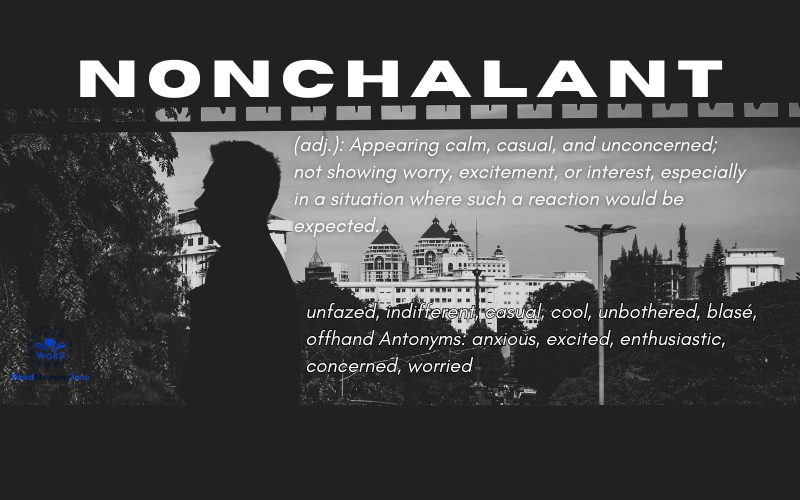
Nonchalant (adj.): Appearing calm, casual, and unconcerned; not showing worry, excitement, or interest, especially in a situation where such a reaction would be expected.
Synonyms: unfazed, indifferent, casual, cool, unbothered, blasé, offhand Antonyms: anxious, excited, enthusiastic, concerned, worried
Key Takeaways On Nonchalant Meaning
- Nonchalant meaning in Hindi is best translated as बेपरवाह (Beparwah) for a positive/confident tone, or लापरवाह (Laparwah) for a negative/careless tone.
- There is no real English word “chalant” — nonchalant stands alone, borrowed from French.
- The word’s meaning shifts heavily with context — it can be a compliment (composure) or criticism (rudeness).
- Pop culture has expanded its meaning into chat, Instagram, and relationship contexts, often describing deliberate emotional guardedness.
- Use the 3-step framework (identify register → pick anchor word → add tone support) to translate or use it correctly every time.
Summary On Nonchalant Meaning
“Nonchalant” is one of those English words that looks simple but hides real translation traps. In Hindi, it splits into बेपरवाह (calm, admirable) and लापरवाह (careless, critical) depending on tone and context — and getting that distinction right is the difference between sounding composed and sounding rude. Whether you’re writing an essay, captioning a post, or just texting a friend, match your Hindi word choice to the emotional register of the situation, not just the dictionary entry.
FAQs About Nonchalant Meaning
1. What is the meaning of nonchalant in Hindi?
The meaning of nonchalant in Hindi is बेपरवाह (Beparwah) or लापरवाह (Laparwah), describing someone who appears calm, unbothered, or indifferent in a situation.
2. What is nonchalant meaning in Hindi with example?
Nonchalant meaning in Hindi with example: “He stayed nonchalant during the exam” → “वह परीक्षा के दौरान बेपरवाह रहा।” It shows outward calm despite pressure.
3. Is “chalant” a real word, and what does chalant and nonchalant mean in Hindi?
No, “chalant” isn’t a standard English word — only “nonchalant” (बेपरवाह) is used in modern English and Hindi translation.
4. What is nonchalant meaning in Hindi Oxford-style definition?
The Oxford-style definition of nonchalant is “feeling or appearing casually calm and relaxed, without anxiety or enthusiasm,” translated in Hindi as बेपरवाह or उदासीन।
5. What does “nonchalant” mean in a relationship or chat context?
In relationships or chats, nonchalant meaning refers to deliberately appearing unbothered or less interested — often to seem confident — which in Hindi translates to जानबूझकर बेपरवाह दिखना।
Thank You for Reading Nonchalant Meaning!
Also Read:
Also Check out “TheNameStories” for more such interesting meanings!
