
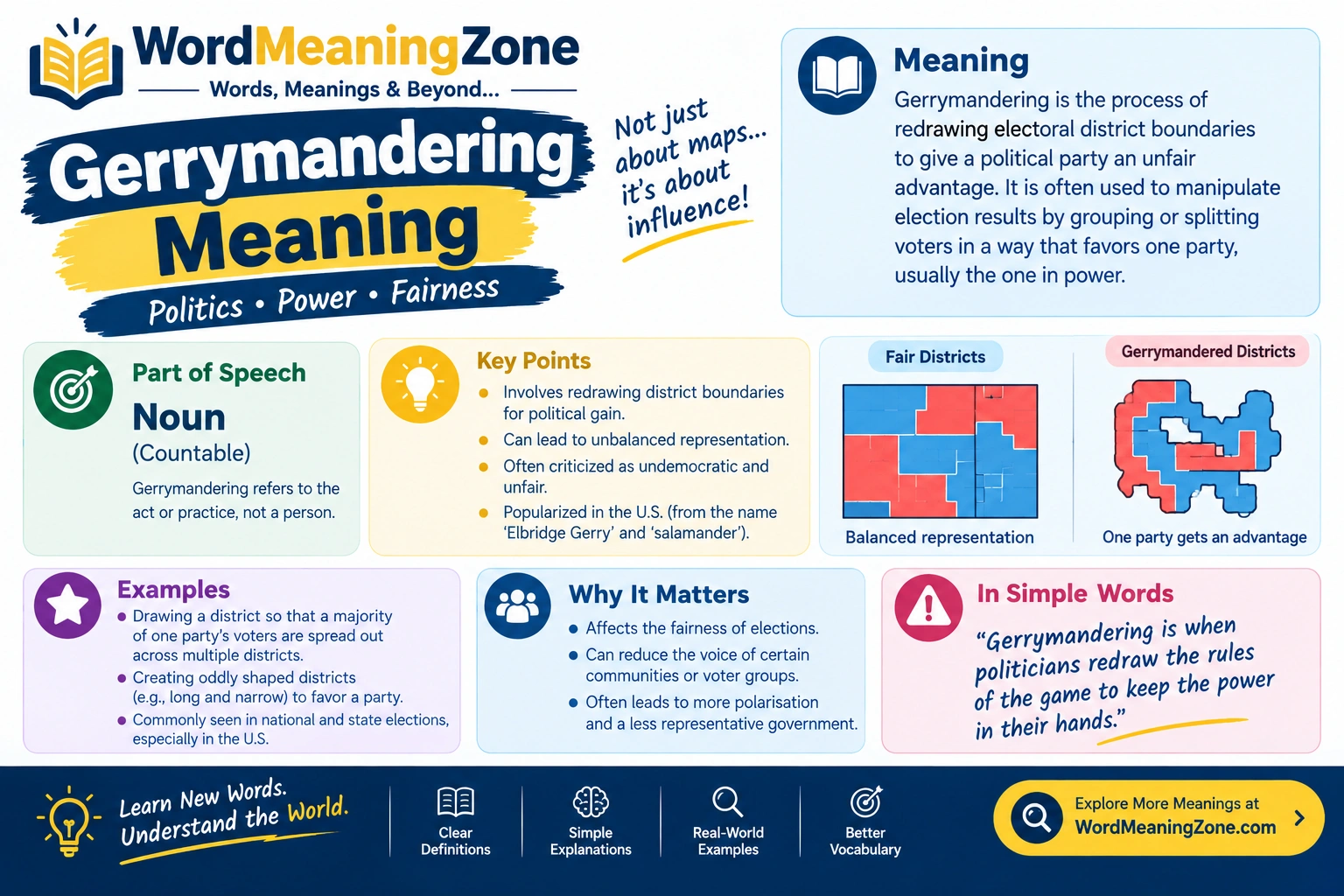
TL;DR — Gerrymandering Meaning in One Line: Gerrymandering means drawing voting-district lines to help one political group win more seats than its actual vote share would earn it — legal in most cases when done for partisan reasons, illegal when race is the main factor.
If you’ve been scrolling the news and seeing headlines about Texas, California, and courtrooms fighting over “maps,” you’ve bumped into gerrymandering. It sounds complicated. It isn’t. Let’s talk it through like two people chatting over coffee — no legal jargon, no political science degree required.
Quick Facts Table On Gerrymandering Meaning
| Fact | Detail |
|---|---|
| Term coined | 1812, after Massachusetts Governor Elbridge Gerry |
| Origin of the word | “Gerry” + “salamander” (a district was said to look like one) |
| Who can be gerrymandered against | Any political party, racial group, or community of voters |
| Legal status (partisan) | Generally allowed under U.S. federal law since a 2019 Supreme Court ruling |
| Legal status (racial) | Illegal under the Voting Rights Act and the Constitution — though recent rulings have narrowed protections (verify current status with a legal source before citing in formal work) |
| States using independent redistricting commissions | Roughly a dozen, though the exact number shifts as laws change (verify against your state’s latest rules) |
| Big 2026 flashpoint | Texas and California both redrew congressional maps for the 2026 midterms |
So, What Does Gerrymandering Actually Mean?
In the simplest terms: gerrymandering is when the people in charge of drawing election-district boundaries draw them in a shape that helps their side win, instead of drawing them to fairly reflect where voters actually live.
Every ten years (after the census), states redraw the lines for congressional and state legislative districts. That part is normal and required. Gerrymandering happens when that redrawing gets used as a weapon — stretching, splitting, and twisting district lines into weird shapes so one party (or one racial group’s voting power) comes out ahead.
That’s gerrymandering meaning in simple terms: rigging the map, not the votes.
Read More: Diddo Meaning
Where Did the Word Come From?
Here’s the fun bit. Back in 1812, Massachusetts Governor Elbridge Gerry signed off on a district so oddly shaped that a newspaper cartoonist thought it looked like a salamander. Someone smashed his name and “salamander” together, and “gerrymander” was born. Gerry himself reportedly wasn’t thrilled about the map either — but his name stuck to it forever. That’s the whole gerrymandering meaning in English 101 story, and it’s over 200 years old.
How Does It Actually Work? “Packing” and “Cracking”
This is the packing and cracking gerrymandering meaning everyone asks about, and it’s genuinely simple:
| Technique | What It Does | Effect |
|---|---|---|
| Packing | Crams as many opposing-party voters as possible into one district | That district is “wasted” — the other side wins it by a landslide, but only wins that one seat |
| Cracking | Splits opposing-party voters across many districts, so they’re a minority in each | Their votes get diluted, and they can’t win a majority anywhere |
Imagine 100 voters split 60-40 between two parties, spread across four districts. Drawn fairly, the map might roughly mirror that split. Drawn with packing and cracking, the majority party can end up winning three or all four districts — without a single vote actually changing.
The Different Types of Gerrymandering
People search for a lot of variations on this term, so let’s clear them all up in one place:
| Type | Gerrymandering Meaning in Plain Words |
|---|---|
| Partisan gerrymandering | Drawing lines to favor one political party over another |
| Racial gerrymandering | Drawing lines based mainly on race, usually to dilute the voting power of a racial group — this is the one courts treat as illegal |
| Prison gerrymandering | Counting incarcerated people as “residents” of the district where their prison sits (often rural) rather than their home community, which can shift a district’s population numbers and representation |
| Bipartisan/incumbent gerrymandering | Both major parties agree to draw safe seats for each other’s incumbents |
Read More: Ocher Definition
A Real 2026 Example: Texas and California
This isn’t just a textbook topic — it’s playing out right now.
In 2025, Texas Republicans redrew their congressional map mid-decade (something states don’t normally do outside the once-a-decade cycle), aiming to flip several U.S. House seats. A panel of federal judges initially blocked it, ruling the state had likely engaged in racial gerrymandering. The U.S. Supreme Court then stepped in, first pausing that block and later reversing it outright in a 6–3 decision, clearing the map for use in the 2026 midterms. The majority found the map was drawn for “pure and simple” partisan advantage — which current law allows — rather than being predominantly about race.
California answered with its own move. Voters approved Proposition 50 in November 2025, temporarily replacing the state’s independent redistricting commission with a legislature-drawn map for the 2026–2030 elections, explicitly framed by supporters as a counterweight to Texas’s redraw. It’s expected to shift several California seats toward Democrats.
Other states — including Missouri, Ohio, Utah, North Carolina, and Indiana — have also moved on mid-decade maps around the same period. Courts are still sorting through several of these disputes, so treat any specific seat-count or “who’s winning” claims as a fast-moving target and check a current source like Ballotpedia or your state’s official redistricting page before repeating them.
A quick, honest note: redistricting fights involve real disagreements between political parties, and reasonable people land on different sides of whether any given map is fair. This guide sticks to what happened and what courts ruled, not who was “right.”
Is Gerrymandering Legal? What Do the Courts Say?
This trips people up constantly, so here’s the short version:
- Partisan gerrymandering (drawing maps to help a political party) — the U.S. Supreme Court ruled in 2019 (Rucho v. Common Cause) that federal courts generally can’t referee this. It’s treated as a political question, not a legal one.
- Racial gerrymandering (drawing maps primarily based on race) — this remains illegal under the 14th Amendment and the Voting Rights Act. That said, a 2026 Supreme Court decision (Louisiana v. Callais) narrowed how Section 2 of the Voting Rights Act can be used to challenge maps, and legal experts expect this to open the door to more redistricting fights across Southern states. This is an evolving area of law — verify the current standard before relying on it for anything formal.
Gerrymandering Meaning Around the World
Gerrymandering isn’t a uniquely American problem — it happens anywhere elected officials draw their own district lines, including the UK, parts of Europe, and various democracies worldwide. For readers searching in other languages: in Spanish, it’s typically just borrowed as “gerrymandering” or described as “manipulación de distritos electorales” (manipulation of electoral districts). In Urdu, it’s generally explained rather than directly translated, roughly as “انتخابی حلقوں کی من مانی حد بندی” (arbitrary boundary-drawing of electoral constituencies). If you’re citing a translation for formal use, double-check with a native-language source, since regional phrasing varies.
Read More: Ostensibly Definition
Gerrymandering vs. Normal Redistricting
| Normal Redistricting | Gerrymandering | |
|---|---|---|
| When it happens | Every 10 years, after the census | Can happen anytime maps are redrawn, including mid-decade |
| Goal | Keep districts roughly equal in population | Tilt outcomes toward one group or party |
| Who draws it | Legislatures, courts, or independent commissions | Often legislatures with a partisan majority |
| District shapes | Reasonably compact | Sometimes oddly shaped (the “salamander” look) |
Quick Q&A: Gerrymandering Meaning for Dummies
Q: Is gerrymandering the same as voter fraud? No. Nobody’s votes are miscounted or faked — the district lines themselves are drawn to produce a favorable outcome before anyone votes.
Q: Can regular citizens stop gerrymandering? In some states, yes — through ballot measures creating independent redistricting commissions, or lawsuits challenging maps in state or federal court.
Q: Does gerrymandering only help Republicans or only Democrats? Neither — both major U.S. parties have used it where they’ve held the legislative majority; Texas and California in 2025–2026 are a real-time example of both sides doing it.
Mini Glossary On Gerrymandering Meaning
- District — A geographic area that elects one representative.
- Redistricting — The process of redrawing district lines, usually after a census.
- Packing — Concentrating opposing voters into few districts.
- Cracking — Spreading opposing voters thinly across many districts.
- Independent redistricting commission — A non-legislative body (sometimes bipartisan) tasked with drawing maps instead of elected officials.
Read More: IYKYK Meaning in Text
Key Takeaways Of Gerrymandering Meaning
- Gerrymandering meaning, boiled down: manipulating district boundaries to favor a party or dilute a group’s voting power.
- The two core techniques are packing (concentrate) and cracking (dilute).
- Partisan gerrymandering is currently allowed under federal law; racial gerrymandering is illegal, though the legal protections around it are actively shifting in 2026.
- Texas and California’s dueling 2025–2026 maps are the clearest real-world example happening right now.
FAQs About Gerrymandering Meaning
1. What is the simplest definition of gerrymandering?
Drawing election-district lines to give one side an unfair advantage, rather than to fairly represent where people live.
2. What is the meaning of gerrymandering in politics specifically?
It refers to legislators or officials shaping district boundaries to protect their own party’s seats or weaken an opponent’s — a purely political use of map-drawing power.
3. What’s the difference between racial and partisan gerrymandering?
Partisan gerrymandering targets political parties and is generally legal; racial gerrymandering targets a racial group’s voting power and is illegal, though what counts as “racial” versus “partisan” is often the exact question courts are fighting over.
4. What does prison gerrymandering mean?
It’s when incarcerated people are counted as residents of the (often rural) district containing their prison instead of their home community, which can inflate that district’s official population and representation.
5. Why is gerrymandering back in the news in 2026?
Because Texas redrew its congressional map mid-decade in 2025, California responded with its own map via Proposition 50, and both maps have been through Supreme Court fights — with primaries and the 2026 midterms happening under the new lines.
6. Can gerrymandering ever be completely eliminated?
Not entirely, as long as elected officials or partisan bodies draw the maps — but independent, non-partisan commissions in states like Arizona, Michigan, and Colorado have measurably reduced it there.
Disclaimer: This article is written for general educational purposes and simplifies an area of election law that is genuinely still being litigated as of 2026. It is not legal advice. Several facts above are flagged as needing verification because redistricting litigation is moving quickly — always confirm current legal status and figures with a primary source (court opinions, Ballotpedia, or your state election office) before citing this in formal or published work.
Methodology note: This piece was compiled by reviewing recent court rulings and reporting (including coverage from the Texas Tribune, Ballotpedia, Democracy Docket, and the California Legislative Analyst’s Office), cross-checked for consistency as of September 2026.
