
Hubris Definition
Excessive pride, overconfidence, and the path to downfall
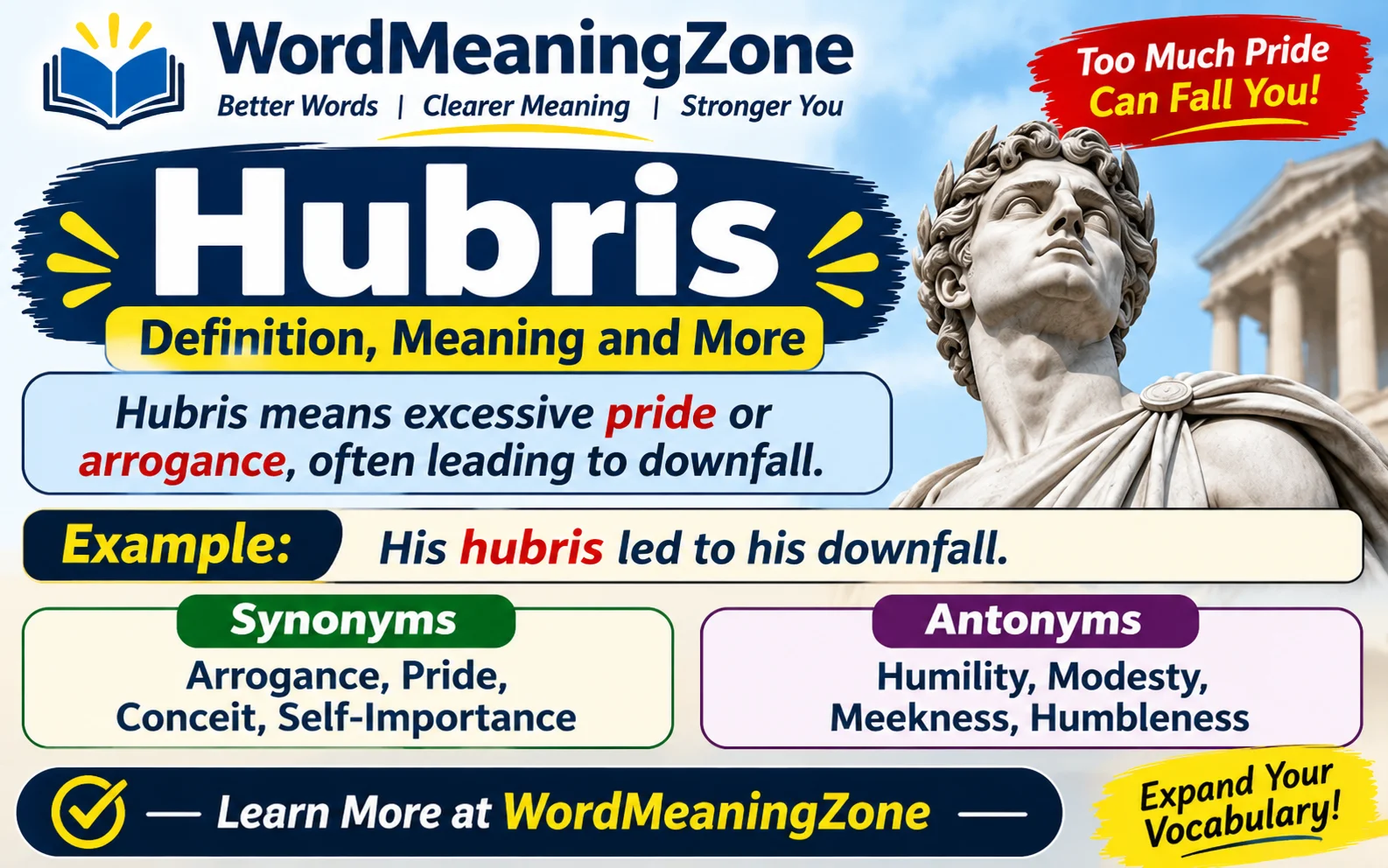
Hubris means excessive pride or overconfidence, the kind that makes a person ignore limits and often leads to their downfall.
The word comes from the ancient Greek hybris. In Greek stories, a proud hero crosses a line, and a punishment follows. Today, people use “hubris” for any leader, doctor, company, or character whose confidence grows bigger than their judgment.
Quick Answer: Hubris Definition
| Part of speech | Noun (adjective: hubristic) |
|---|---|
| Pronunciation | HYOO-bris |
| Simple meaning | Too much pride that blinds you to risk |
| Origin | Ancient Greek hybris (insolence, outrage) |
| Classic result | Downfall, often called nemesis |
| Famous examples | Odysseus, Macbeth, Oedipus, Icarus |
What Is the Definition of Hubris?
Dictionaries agree on the core idea, with small differences in tone.
| Source | Definition (paraphrased) |
|---|---|
| Merriam-Webster | Exaggerated pride or self-confidence; arrogance |
| Merriam-Webster Learner’s / Britannica Learner’s | A great or foolish amount of pride or confidence; formal and literary |
| Dictionary.com | From Greek hybris, meaning insolence; first recorded in English in the early 1880s |
Hubris definition in simple words: it is pride so big that you stop seeing your own limits. A person with hubris does not just feel good about themselves. They believe the rules, risks, or warnings do not apply to them.
Hubris Definition in a Sentence
| Sentence | Context |
|---|---|
| “His hubris made him ignore every warning from his team.” | Workplace |
| “The company’s failure came from the hubris of its founder.” | Business |
| “Macbeth’s hubris pushes him to believe he cannot be beaten.” | Literature |
| “It was pure hubris to sail into the storm without a plan.” | Everyday |
| “The surgeon’s hubris kept him from asking for a second opinion.” | Medicine |
Hubris Definition in Ancient Greek
In Greek, hybris did not simply mean “being proud.” It described an act, not just a feeling.
- Everyday Greek meaning: insulting, shaming, or using force against someone, often to feel superior.
- Aristotle’s view: in his Rhetoric, hubris is shaming another person for your own pleasure, not for profit or revenge.
- Honor and shame: hubris attacked another person’s timē (honor). That is why it was serious. Athens even had laws against it.
- Modern shorthand: scholar Rush Rehm sums it up as “insolence, contempt, and excessive violence.”
Many pages say hubris only means “defying the gods.” That is the popular version. Some classical scholars point out that in Greek texts, hubris was often one mortal abusing another, and that the idea of gods punishing it grew stronger in later retellings and modern use. Both meanings are useful, but they are not identical.
| Greek term | Meaning | Role in the story |
|---|---|---|
| Koros | Surfeit, having too much | Success makes a person careless |
| Hybris | Insolent, shameful overreach | The proud act itself |
| Atē | Blind folly, ruin | Judgment fails |
| Nemesis | Fair payback | The downfall |
Greek writers often linked these ideas into a cycle: success, then overreach, then blindness, then payback. This is the pattern behind most “hubris” plots.
Hubris in Greek Mythology and Greek Tragedy
Hubris in Greek Mythology
Myths use hubris as a warning: humans are not gods.
| Figure | Hubristic act | Result |
|---|---|---|
| Icarus | Flies too close to the sun despite his father’s warning | Falls into the sea |
| Achilles | Drags Hector’s body around the walls of Troy | Shows disrespect that the epic treats as shocking |
| Pentheus (The Bacchae) | Refuses to accept Dionysus as a god | Destroyed by the god’s followers |
Hubris Definition in Greek Tragedy
Greek tragedy shows a respected person falling from good fortune to bad. Hubris is one common cause.
Hamartia comes from a Greek verb meaning “to err.” Britannica describes it as a defect or error of judgment in a tragic hero.
Hubris is one form of hamartia, not the only one. Other tragic flaws include jealousy, ambition, and naivety.
Aristotle’s Poetics says the best tragic hero is neither perfectly good nor evil. Their misfortune comes from a mistake, which makes the audience feel pity and fear.
| Hubris | Hamartia |
|---|---|
| Excessive pride or arrogance | Any mistake or flaw that causes a downfall |
| Always a kind of tragic flaw | Can be pride, jealousy, ambition, or ignorance |
| Often leads to a clear punishment | Can lead to ruin, suffering, or growth |
| Example: Creon refuses to listen in Antigone | Example: Oedipus acts without knowing who he is |
Hubris Definition in Greek Theatre
On the Greek stage, hubris is the engine of the plot. The audience watches the hero rise, overreach, and fall. The tragedy works because the hero is admirable, not evil, so the fall feels costly.
| Stage of the tragedy | What happens |
|---|---|
| Rise | A noble hero holds power or fame |
| Hubris | The hero overreaches or ignores a warning |
| Reversal | Fortune turns |
| Recognition | The hero finally sees the truth |
| Downfall | Loss, exile, or death; the audience feels pity and fear |
Oedipus is often used as the example. His pride in his own intelligence and his stubborn push to uncover the truth lead him straight into the fate he tried to avoid. Critics still debate whether his flaw is better called pride or error, which is a good reminder that “hubris” is a tool for reading these plays, not the only one.
Hubris Definition in the Odyssey
Homer’s Odyssey treats hubris as a danger for both heroes and villains.
| Character | Hubristic act | Consequence |
|---|---|---|
| Odysseus | After blinding Polyphemus, he shouts his real name from the ship | Polyphemus prays to his father Poseidon, and Odysseus’s journey home gets longer |
| Polyphemus | Believes his size makes him safe and disrespects the rules of hospitality | Blinded by Odysseus |
| The suitors | Waste Odysseus’s wealth, abuse his servants, mock a disguised beggar | Killed when Odysseus returns |
| Odysseus’s crew | Eat the sun god’s cattle against warnings | Lost in a storm |
Scholars do not all agree on every case. Some see Odysseus’s taunt as clear hubris. Others focus on the suitors as the main example because their disrespect to a household and its guests is so sustained. For a school essay, the safest approach is to name the act, say why it crosses a line, and show the result.
Hubris Definition in Macbeth
Macbeth is a favorite example in classrooms. He starts as a loyal, celebrated soldier. Then he acts on his ambition and begins to believe he is above consequences.
| Moment in the play | Why it shows hubris |
|---|---|
| He murders King Duncan to take the throne | He acts as if there will be no penalty |
| He trusts the witches’ prophecies of safety | He feels invincible and stops listening to his conscience |
| He treats servants and allies harshly | His pride isolates him |
| He faces Macduff, who was not “born” in the usual way | The prophecy he relied on turns against him |
A useful nuance: some critics call Macbeth’s ambition his hamartia, and his overconfidence his hubris. If your teacher asks about the “tragic flaw,” define your terms first, then argue your case.
More Hubris Examples in Literature
| Work | Character | How hubris appears |
|---|---|---|
| Frankenstein | Victor Frankenstein | Tries to “play God” by creating life |
| Paradise Lost | Satan | Pride drives him to challenge Heaven |
| Doctor Faustus | Faustus | Trades his soul for knowledge and power |
| The Great Gatsby | Jay Gatsby | Believes he can rise above the class he was born into |
| Things Fall Apart | Okonkwo | Even in exile, imagines rising to power again |
Writers use hubris to teach a lesson: success without humility is fragile.
Managerial Hubris Definition
In business research, hubris means a leader’s exaggerated self-confidence that distorts decisions.
| Idea | Who | What it says |
|---|---|---|
| Hubris hypothesis | Richard Roll, 1986 (Journal of Business) | Bidding firms infected by hubris simply pay too much for takeover targets |
| “Exaggerated self-confidence” | Hayward & Hambrick, 1997 | A widely used research definition of CEO hubris |
| Executive hubris and ethics | A peer-reviewed study (DOI) | CEO hubris is linked to a higher incidence of earnings manipulation |
| Organizational hubris | Pfarrer & Curran, 2024 (Strategic Management Journal) | A shared, long-lasting group attitude of exaggerated pride in the organization |
Why it matters: a confident leader who stops listening to critics loses the early warnings that prevent expensive mistakes. Researchers also note the concept is contested, and some argue hubris can have a “bright side” in moderation (Zeitoun & Nordberg).
Medical Hubris Definition
Medical Hubris Definition is overconfidence in medicine: a clinician, a field, or a system acting as if it cannot be wrong.
| Term | Meaning | Note |
|---|---|---|
| Medical hubris | Overconfidence in diagnosis, treatment, or medical knowledge | Can delay second opinions and hide uncertainty |
| Hubris syndrome | A proposal by Lord David Owen (a neurologist and former UK health minister) to describe leaders changed by power | Not an official diagnosis in classification systems |
| Medical humility | Openness, honest self-disclosure, and avoiding arrogance | The counterweight to hubris |
Writers in medical journals have argued that arrogance can be encouraged during training (CMAJ), and the BMJ has published a debate on whether hubris should be treated as a disease (BMJ blog). This is opinion and debate, not settled science. If you have a health concern, talk to a licensed clinician.
Hubris vs. Arrogance, Pride, and Confidence
| Word | Meaning | Is it always bad? |
|---|---|---|
| Confidence | Realistic belief in your ability | No |
| Pride | Satisfaction in your work or group | No (it can be healthy) |
| Arrogance | Acting as if you are better than others | Usually |
| Hubris | Pride so extreme it ignores limits and invites a fall | Almost always in stories |
Arrogance is the more general, milder word. Hubris usually involves overreaching, and in stories, a consequence follows. The well-known proverb “pride goes before a fall” is often used to sum it up.
Why Hubris Leads to Downfall
Hubris is dangerous because it removes feedback. A person who thinks they cannot be wrong stops listening to advice, checking facts, or respecting others. Small errors grow unseen.
| Healthy habit | What hubris does to it |
|---|---|
| Listening to warnings | Dismissed as weakness or jealousy |
| Admitting mistakes | Avoided to protect the ego |
| Respecting other people | Replaced by contempt |
| Planning for risk | Replaced by “it won’t happen to me” |
FAQs About Hubris Definition
What is the opposite of hubris?
Humility. In Greek thought, the balancing idea is sophrosyne: moderation and self-control.
Is hubris always negative?
In most stories, yes. In real life, researchers debate it. Some argue that a small amount of daring confidence helps leaders and innovators, but too much blocks learning.
How can you avoid hubris?
Ask for honest feedback, write down your assumptions, and give people permission to disagree with you. These are common-sense habits, not a guarantee.
