
Nakadashi (中出し)
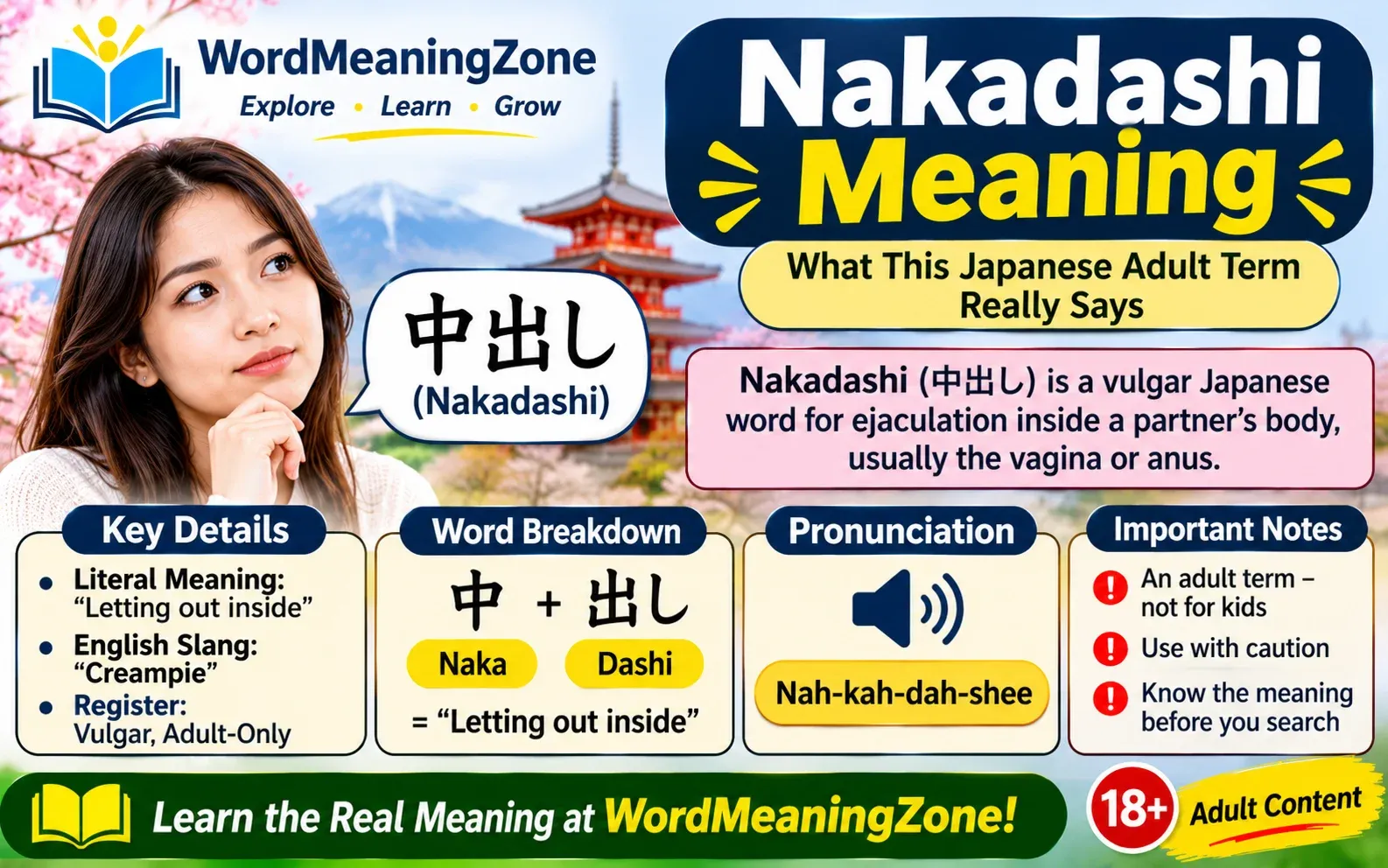
Nakadashi (中出し) is a vulgar Japanese word for ejaculation inside a partner’s body, usually the vagina or anus. Literal Nakadashi Meaning is “letting out inside,” and English-language adult slang calls it a “creampie.”
Last verified: November 20, 2026, against Japanese dictionaries, Wiktionary and Urban Dictionary.
Quick Definition
| Item | Detail |
|---|---|
| Word | Nakadashi |
| Japanese writing | 中出し (なかだし) |
| Part of speech | Noun; can be used as a verb with suru (“to do”) |
| Literal meaning | “Letting out inside” |
| Dictionary sense | Ejaculation inside the vagina or anus |
| English slang equivalent | Creampie |
| Register | Vulgar, adult-only |
| Opposite | Sotodashi (外出し), “letting out outside” |
Japanese dictionaries such as Nihongo Master and Tangorin define it as intravaginal (or anal) ejaculation. Tangorin and the JMdict-based entries also tag it as vulgar.
Nakadashi Meaning in English Translation
There is no polite English translation. The closest matches are:
| Japanese | Reading | English meaning |
|---|---|---|
| 中出し | nakadashi | Ejaculation inside; “creampie” in adult slang |
| 外出し | sotodashi | The opposite: ejaculation outside |
| 出す | dasu | To take out, put out, let out (ordinary verb) |
So when someone asks for the nakadashi meaning in English, the honest answer is a two-part one: the literal translation is “letting out inside,” and the slang translation is “creampie.”
Breaking Down the Word: 中 + 出し
The term is built from two simple parts. That is why it looks ordinary on paper but reads as vulgar in context.
| Part | Reading | Meaning |
|---|---|---|
| 中 | naka | Inside, middle, center |
| 出し | dashi | From 出す (dasu), “to put out” or “to let out” |
Why it matters: the everyday verb 出す is used for submitting homework, showing motivation or taking something out. Only the full noun 中出し carries the sexual sense. Wiktionary traces 出す back to Old Japanese, so the building blocks are very old; the adult meaning belongs to the combined word.
You may also see it written 中だし (with hiragana) or 中出 (without the final し). A humorous alternative spelling, 中田氏, is also listed by Tangorin. These are all the same word.
Nakadashi Meaning in Japanese Pronunciation
Say it as nah-kah-dah-shee. Japanese syllables are usually spoken with fairly even weight, so avoid putting heavy stress on one part.
| Syllable | Sounds like |
|---|---|
| na | “nah” |
| ka | “kah” |
| da | “dah” |
| shi | “shee” |
A common mistake among English speakers is saying “nakadoshi” or “nakadashy.” The third syllable is “dah,” not “doh.”
Nakadashi Slang: How and Where It Is Used
In English, nakadashi is not everyday slang. It is a borrowed adult-content word.
A user-submitted Urban Dictionary entry (2007) describes it as the Japanese term that American porn calls a “creampie.” Urban Dictionary is crowd-sourced, so treat it as a sign of how people use the word, not as an authority on its meaning.
| Where you may see it | What it means there |
|---|---|
| Japanese adult video and manga titles | The act itself, used as a label |
| English-language adult manga sites | A content tag or theme |
| Online forums and comment sections | Borrowed slang for “creampie” |
| Chinese-language slang (中出) | Borrowed from the Japanese word, per Wiktionary |
Nakadashi Meaning in Hentai and Anime
Hentai is the English name for Japanese-style pornographic anime and manga, and Wikipedia notes that in Japan the word does not name a genre in the same way. Nakadashi belongs to this adult corner of Japanese media.
Two sources show how it is used there:
- Dictionary.com’s pop-culture entries list it among typical themes of a large English-language hentai publisher.
- Pixiv’s encyclopedia treats “creampie” as an illustration tag and notes it is also called nakadashi.
| Question | Short answer |
|---|---|
| Is nakadashi a genre? | Not really. It is a tag or theme within adult works, not a genre like shonen or romance. |
| Does regular anime use this word? | It is not part of normal anime vocabulary; it belongs to adult (18+) manga, anime and games. |
| Is it the same as “ecchi”? | No. Ecchi means suggestive content that stops short of explicit; hentai is explicit. |
Words That Look Similar (Don’t Mix Them Up)
Searchers sometimes land here after misspelling a harmless Japanese word. These are different words entirely:
| Word | Japanese | Meaning |
|---|---|---|
| Nakadachi | 中立ち | The break between the light meal and the tea in a formal tea ceremony |
| Nakadachi | 仲立ち | Mediation; a go-between |
| Nakadori | 中取り | The middle portion collected when pressing sake |
If you were reading about tea, sake or mediation, you probably do not need the article above.
Safety and Legal Notes for Readers in India
Looking up what a word means is not an offence. But sharing sexually explicit material can be.
| IT Act section | Covers | First-conviction penalty |
|---|---|---|
| 67 | Publishing or transmitting obscene material electronically | Up to 3 years in prison and a fine up to ₹5 lakh |
| 67A | Publishing or transmitting material with a sexually explicit act | Up to 5 years in prison and a fine up to ₹10 lakh |
| 67B | Material showing children in sexually explicit acts | Stricter; covers anyone under 18 |
The Section 67 figures come from a Government of India parliamentary reply; the Section 67A figures are from a legal explainer. For a specific situation, check the current text of the Act or ask a lawyer.
There is also a real-life side. The act the word describes can lead to pregnancy, and one dictionary example sentence notes that a “low-risk day” does not guarantee otherwise. For questions about pregnancy or infections, a doctor or clinic is the right place, not an adult-content forum.
FAQs
Is nakadashi spelled the same everywhere?
Not always. Japanese uses 中出し, 中だし or 中出, and English text sometimes writes “nakadashi,” “naka dashi” or “nakadashi!” as a tag. They all point to the same word.
A teenager in my family searched this word. What should I do?
It is an adult-content term, so the search likely led to explicit sites. A calm, non-judgmental talk works better than punishment, and family-safe search settings or content filters on devices can reduce accidental exposure.
