
Last Update: 12 August 2026
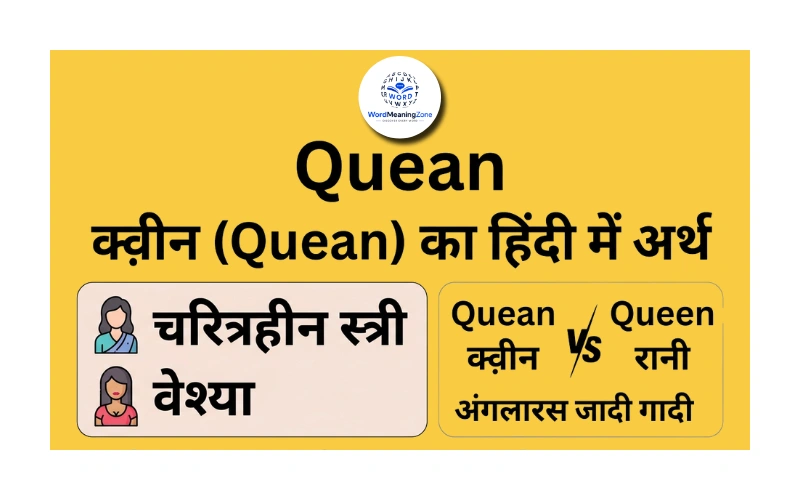
Quean meaning in Hindi, in its old English sense, is closest to बदचलन औरत or कुलटा (a woman of disreputable character) — but in Scots dialect the same word simply means छोकरी or युवती (a young woman). Two meanings, one spelling, and a thousand years of confusion.
If you landed here searching for quean meaning in Hindi, you’ve probably already noticed the problem: half the dictionary sites online give you a totally different answer than the other half. One says it’s an insult. Another says it’s just “girl.” A few even quietly swap it for रानी, which is actually the Hindi word for queen — a completely different word. That’s not a translation error you want to repeat in an essay, a subtitle, or a tattoo.
I’ve spent a good chunk of my career untangling exactly this kind of word — old, regional, half-forgotten English terms that trip up translators because they look familiar but aren’t. “Quean” is a textbook case. Let’s fix it properly.
Quean Meaning in Hindi — The Quick Answer
Here’s the breakdown by sense, because “quean” genuinely carries more than one meaning depending on era and region.
| English Sense | Register | Hindi Translation | Roman Hindi |
|---|---|---|---|
| A bold, disreputable, or ill-behaved woman (archaic, 16th–17th c.) | Insulting | बदचलन औरत / कुलटा | Badchalan Aurat / Kulata |
| A woman engaged in sex work (older, specific archaic use) | Insulting/dated | वेश्या | Veshya |
| A young, unmarried, or robust woman (Scottish/Northern English dialect) | Neutral, sometimes affectionate | युवती / छोकरी | Yuvati / Chhokri |
| Alternate old spelling of “queen” (rare, historical texts only) | Neutral | रानी | Raani |
The reason the internet disagrees so much is that most quick-answer dictionary sites collapse all four rows into one line. That’s how you end up with a Scots love-song word getting translated as if it were a slur — or an insult getting softened into “girl.”
Quean vs. Queen: Why Everyone Confuses Them
This is the heart of the problem, and it’s worth explaining why, not just that.
“Quean” and “queen” aren’t the same word wearing different clothes — they’re siblings. Both descend from the Old English root for “woman,” which split in two directions: cwēn (a woman of high status → queen) and cwene (a woman generally, later a servant → quean). Same parent, opposite social trajectory. One word went up in the world; the other went down.
| Feature | Queen | Quean |
|---|---|---|
| Pronunciation | /kwiːn/ | /kwiːn/ or /kweɪn/ depending on dialect |
| Meaning today | Female monarch | Archaic insult or Scots word for young woman |
| Common Hindi translation | रानी | बदचलन औरत / युवती (context-dependent) |
| Modern usage | Everyday word | Rare, mostly literary or dialectal |
That shared pronunciation is exactly why so many auto-generated Hindi dictionary pages just borrow the Hindi word for “queen” and slap it onto “quean.” It’s a lazy shortcut, and it’s wrong more often than it’s right.
Where “Quean” Comes From: A 1,000-Year Word Journey
A few grounded facts, because vague “it’s an old word” claims aren’t useful:
- The Oxford English Dictionary traces the earliest recorded use of “quean” to the Old English period, before the year 1150 — making it well over 900 years old.
- Merriam-Webster likewise dates its first known use to before the 12th century.
- According to word-history reference Etymonline, the “hussy” sense of quean was in especially heavy popular use during the 16th and 17th centuries — the exact window when Shakespeare and his contemporaries were writing, which is why you’ll spot it in Elizabethan drama.
- Collins English Dictionary’s COBUILD frequency data places “quean” in its lowest usage band — meaning it’s now genuinely rare in everyday written English, encountered mostly in classic literature rather than conversation.
That last point matters for translators: you’re not translating a live, everyday word. You’re translating a fossil. Treat it accordingly.
Mini Case Study: Translating Sir Walter Scott
Here’s a real example of the trap in action. Walter Scott’s The Heart of Mid-Lothian uses the line: “this mad quean, after cracking like a pen-gun…”
- Before (naive translation): A translator sees “quean,” assumes it’s a spelling variant of “queen,” and renders it as “यह पागल रानी” — “this mad queen.” The sentence now sounds like royal satire. It isn’t.
- After (context-checked translation): Scott is Scottish, writing in Scots-inflected English, describing a loud, excitable young woman — not royalty at all. The accurate rendering is closer to “यह सिरफिरी छोकरी” — “this scatterbrained young woman.” Tone, register, and meaning all land correctly.
That one-word swap — रानी versus छोकरी — is the difference between a coherent translation and an embarrassing one.
The 3-Step Context-Check Framework
Whenever you hit a rare, dual-meaning English word like this, run it through this framework before translating:
- Check the era and source. Is this Elizabethan drama, Victorian fiction, or Scots dialect? Each pulls “quean” in a different direction.
- Check the surrounding tone. Is the sentence around it affectionate, neutral, or clearly insulting? Let the sentence — not the word alone — decide the register.
- Check for the cognate trap. Ask: “Am I about to swap this for the modern word it merely sounds like?” If yes, stop and re-verify against a real dictionary entry, not just pronunciation.
Run any tricky old English word through those three checks, and you’ll rarely get burned.
Common Mistakes With Quean Meaning in Hindi
- Defaulting to रानी (queen) because the pronunciation overlaps — this is the single most common error, and it’s the one that changes meaning entirely.
- Treating every use as an insult, when Scots dialect usage is often neutral or even warm.
FAQs About Quean Meaning in Hindi
1. What is the exact quean meaning in Hindi?
It depends on context: बदचलन औरत or कुलटा for the archaic insulting sense, and युवती or छोकरी for the Scots dialect sense meaning “young woman.”
2. Is quean meaning in Hindi the same as queen (रानी)?
No. This is the most common mix-up. “Quean” and “queen” share an ancestor word but split into completely different meanings centuries ago. Translating quean as रानी is almost always wrong.
3. Is the quean meaning in Hindi always an insult?
Not always. In its 16th–17th century English usage it was insulting, but in Scottish and Northern English dialect it’s simply a neutral or affectionate word for a young woman.
4. Why do different websites give different quean meaning in Hindi results?
Because most sites only list one of its four senses instead of separating them by era and dialect, so their single “correct” answer often applies to the wrong context.
5. Where would I actually encounter quean meaning in Hindi being relevant today?
Mostly in classic English literature — Walter Scott, Shakespeare-era plays, and older Scots poetry — since the word is now rare in everyday modern English, per Collins’ frequency data.
Key Takeaways On Quean Meaning in Hindi
- Quean meaning in Hindi isn’t one fixed answer — it splits into four senses depending on era and dialect.
- The default safe Hindi renderings are बदचलन औरत / कुलटा (archaic insult) and युवती / छोकरी (Scots dialect, neutral).
- Never default to रानी — that’s “queen,” a false-cognate trap, not “quean.”
- Use the 3-step Context-Check Framework (era → tone → cognate trap) before translating any rare, dual-meaning English word.
Summary On Quean Meaning in Hindi
“Quean” is a 1,000-year-old English word that split from “queen” and now carries two very different Hindi translations depending on whether you’re reading Elizabethan insult or Scots dialect. Get the context right, and the correct Hindi word follows naturally — get it wrong, and you’ll accidentally turn a scolding into royalty, or a compliment into an insult.
Thank you so much for reading this far—we really appreciate it!
Also Read:
Also Check out “TheNameStories” for more such interesting meanings!
