
Last Update: 31 July 2026
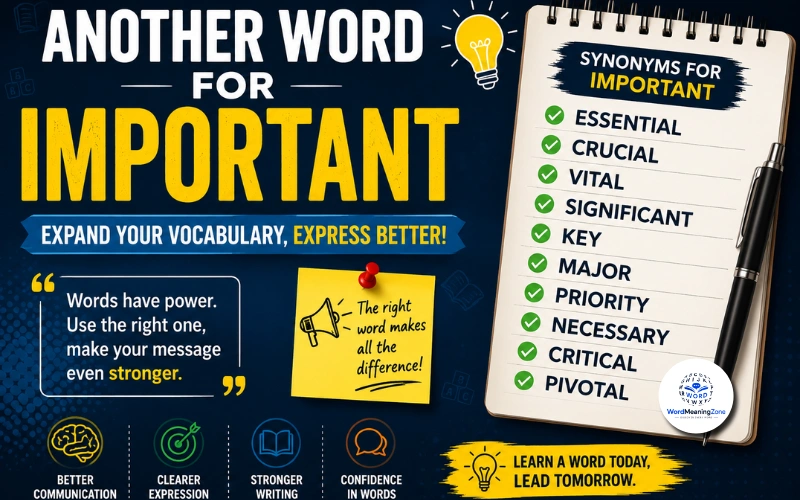
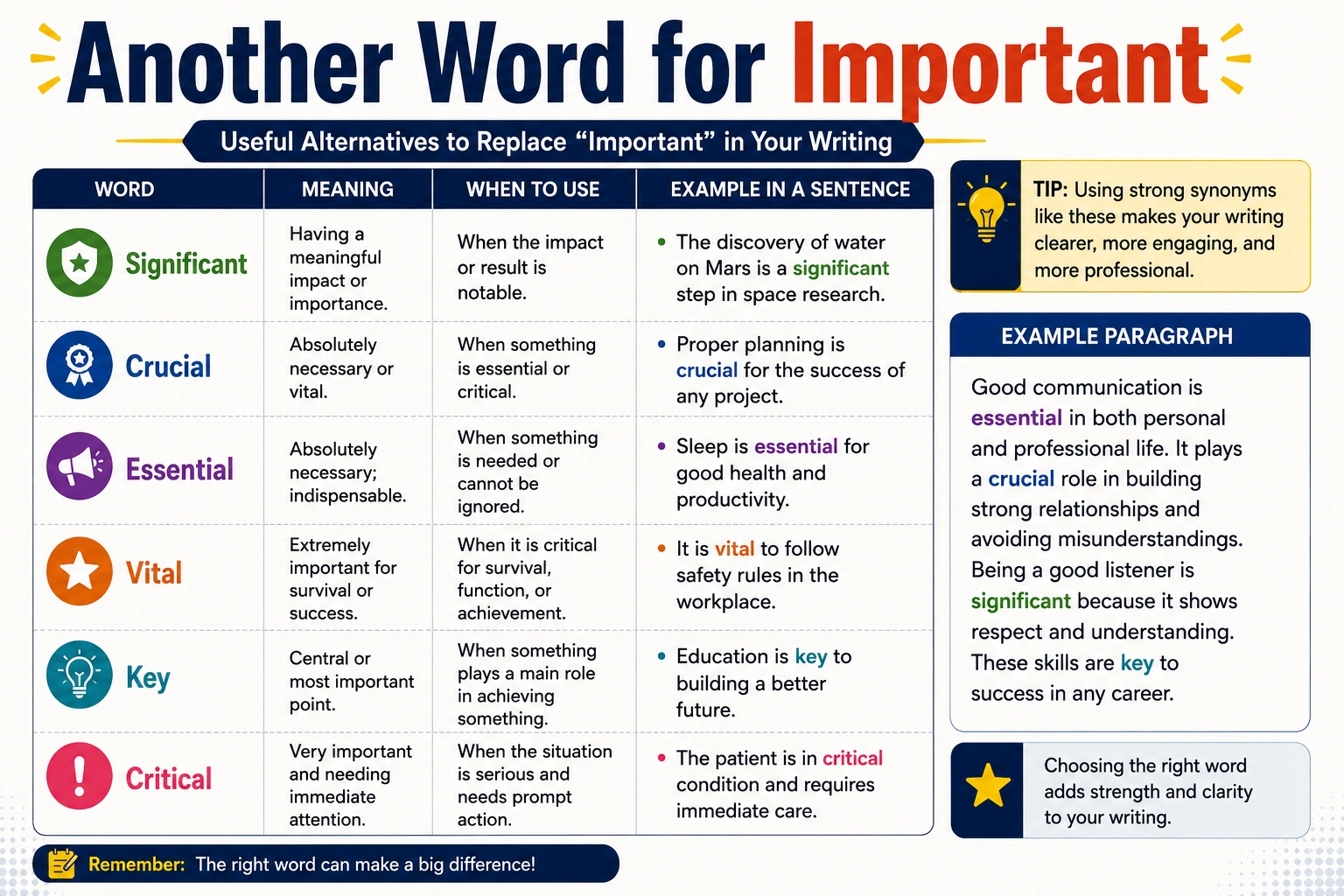
The simplest another word for important is “significant”—but depending on your sentence, “crucial,” “vital,” “essential,” “critical,” or “key” can all work just as well.
That one-liner is the whole answer. Now let’s actually have some fun with it, because “important” is one of those words we use so often that it starts to feel a little tired—like a comfy old t-shirt with a hole in the shoulder. Nothing wrong with it, but sometimes you want something a bit sharper in your closet.
Quick Stats: “Important” at a Glance
| Metric | Detail |
|---|---|
| Word type | Adjective |
| First recorded use | Late 16th century (from Latin importare, “to bring in, to matter”) |
| Number of common synonyms | 25–30+ |
| Most searched related phrase | “another word for important“ |
| Most formal alternative | Paramount |
| Most casual alternative | Big deal |
| Most used in business writing | Critical / Key |
| Most used in essays | Significant |
Note: search-volume rankings can shift month to month; verify current numbers with a keyword tool like Google Trends or Ahrefs if you need exact figures.
Why Do People Even Search for “Another Word for Important”?
Here’s the thing—”important” isn’t a bad word. It’s just overused. Think about it: you write “important” in an email, then again in a report, then again in a text to your friend about weekend plans. By the fifth time, it barely means anything anymore.
That’s exactly why so many people type “what is another word for important” into a search bar. They’re not confused about the meaning. They just want their writing to sound less repetitive and more alive.
A few common reasons people look this up:
- Students want a stronger word for an essay.
- Professionals want to sound sharper in emails or reports.
- Writers want to avoid repeating the same adjective five times on one page.
- Some folks are just doing a crossword puzzle (we see you).
Another Word for Important: The Core List
Let’s get into the good stuff. Below is a categorized table so you’re not just scrolling through a wall of synonyms with no context.
Formal & Professional Alternatives
| Word | Best Used For |
|---|---|
| Significant | Reports, research, essays |
| Crucial | Deadlines, decisions |
| Essential | Requirements, must-haves |
| Vital | Health, survival, core needs |
| Critical | Emergencies, priorities |
| Paramount | Legal or formal documents |
| Imperative | Urgent instructions |
| Fundamental | Core principles, basics |
| Key | Business strategy, meetings |
| Substantial | Data, numbers, impact |
Everyday & Conversational Alternatives
| Word | Best Used For |
|---|---|
| Big deal | Casual conversation |
| Major | General emphasis |
| Serious | Warnings, concerns |
| Meaningful | Relationships, personal topics |
| Worthwhile | Effort, time spent |
| Notable | Achievements, events |
| Big | Simple, kid-friendly writing |
| Weighty | Decisions, choices |
Creative & Descriptive Alternatives
| Word | Best Used For |
|---|---|
| Momentous | Life events |
| Pivotal | Turning points in a story |
| Central | Themes, main ideas |
| Prominent | People, figures, roles |
| Consequential | Long-term effects |
| Indispensable | People or tools you can’t do without |
| Salient | Academic or analytical writing |
| Compelling | Persuasive writing |
| High-priority | Task lists, project management |
That’s your master bank of 27 words. Bookmark this table—it’ll save you more time than you’d think.
What is Another Word for Important in an Essay?
Essays have their own personality. You want words that sound confident but not stiff, and definitely not like you swallowed a thesaurus.
If someone asks, “what is another word for important in an essay,” here’s the honest answer: stick to words like significant, crucial, essential, or central. These sound academic without sounding like you’re trying too hard.
Avoid overly casual options like “big deal” in essays—save those for texts to your group chat, not your literature review.
Example sentence:
- Weak: “This event was important in history.”
- Better: “This event was a significant turning point in history.”
See how one swap instantly makes the sentence feel more polished? That’s the magic of variety.
Another Word for Important Information
When you’re talking about data, facts, or details that people need to know, another word for important information could be:
- Essential information
- Critical data
- Key facts
- Vital details
- Need-to-know information
Example: “Please review the critical data before Monday’s meeting” sounds a lot more professional than “Please review the important information before Monday’s meeting.”
Another Word for Important Role
Talking about someone’s job, responsibility, or position? Try these instead of repeating “important role” over and over:
- Key role
- Central role
- Vital position
- Pivotal part
- Crucial responsibility
Example: “She played a pivotal part in launching the product” hits differently than “She played an important role.”
Another Word for Important to Me
This one’s personal—literally. When you’re expressing that something (or someone) matters deeply to you, softer and warmer words fit better than corporate ones like “critical” or “paramount.”
Try:
- “You mean a lot to me.”
- “This is meaningful to me.”
- “This holds real value for me.”
- “This matters deeply to me.”
Notice how none of these sound like a business memo? That’s intentional. Emotional writing needs emotional words, not office jargon.
Another Word for Important Documents
Paperwork deserves respect too. If you’re labeling files, contracts, or records, consider:
- Essential documents
- Key paperwork
- Critical records
- Vital files
- Priority documents
Government forms, HR files, and legal paperwork often use “vital” or “essential” because these words sound official without sounding dramatic.
Another Word for Important Person
Whether you’re writing a bio, an introduction, or a tribute, here are options for describing a person of significance:
- Prominent figure
- Key player
- Influential individual
- Notable personality
- Distinguished person
Example: “He is a prominent figure in the tech industry” sounds far more polished than “He is an important person in the tech industry.”
Another Word for Important Things
Sometimes you just need a plural, everyday replacement. Options include:
- Priorities
- Essentials
- Key matters
- Core issues
- Must-haves
Example: “Let’s focus on the priorities first” reads cleaner than “Let’s focus on the important things first.”
Another Word for Important or Significant
If you’re looking for a pair that can be used together or interchangeably, think of words that sit at roughly the same weight as “significant”:
- Notable
- Consequential
- Substantial
- Meaningful
- Weighty
These words all carry a similar sense of “this matters,” just with slightly different flavors—some more emotional, some more statistical.
Degrees of Importance: From Mild to Maximum
Not everything that’s important is equally important. Here’s a table to help you match intensity to meaning.
| Intensity Level | Word Choice |
|---|---|
| Another word for not important | Minor, negligible, trivial, insignificant |
| Mildly important | Relevant, useful, worth noting |
| Moderately important | Notable, meaningful, valuable |
| Another word for very important | Vital, essential, critical, indispensable |
| Another word for extremely important | Paramount, imperative, non-negotiable, mission-critical |
| Another word for most important | The top priority, the number one focus, the centerpiece |
| Another word for more important | Higher priority, greater significance, more pressing |
This table is genuinely useful because so many writers use “very important” or “so important” as a lazy shortcut. Pick a word from the right intensity level instead, and your sentence instantly sounds more intentional.
Another Word for Really Important
“Really important” is something we say out loud all the time, but in writing, it can feel a little flat. Swap it for:
- Genuinely crucial
- Truly essential
- Deeply significant
- Absolutely vital
Example: “This is really important” becomes “This is absolutely vital“—same meaning, more punch.
Another Word for How Important
Sometimes the question itself needs rewording. Instead of asking “how important is this,” try:
- “How significant is this?”
- “How critical is this to the outcome?”
- “What’s the priority level here?”
- “How much does this matter?”
These small rewordings can make a question sound more precise, especially in workplace conversations or interviews.
A Short History of the Word “Important”
It helps to know where a word comes from, because it often explains why it feels the way it does. “Important” traces back to the Latin word importare, which literally meant “to bring in” or “to carry into.” Over time, the meaning shifted from a physical action (carrying something in) to a more abstract idea: something that “brings weight” into a situation, or something that matters.
That’s actually a nice way to think about synonyms too. Words like “weighty” and “substantial” still carry that old idea of physical heaviness, just applied to meaning instead of mass. Meanwhile, words like “crucial” come from the Latin crux, meaning “cross” — as in, a crossroads or turning point. So when you say something is crucial, you’re technically saying it’s a fork in the road, a moment where things could go one way or another.
Knowing this kind of background doesn’t just make you sound smart at dinner parties. It also helps you pick the right word instinctively, because you start to feel the subtle shade of meaning each one carries.
Regional and Style Differences Worth Knowing
Not every synonym lands the same way in every English-speaking country or writing style. A few quick notes:
- British English leans slightly more toward “vital” and “paramount” in formal writing, while American English often prefers “critical” and “key” in business contexts.
- Academic writing across most regions favors “significant” and “substantial,” especially in research papers where precision matters.
- Marketing copy tends to reach for punchier, shorter words like “big,” “major,” or “game-changing” because attention spans are short and sentences need to move fast.
- Legal writing almost always defaults to “material” or “essential” rather than casual alternatives, since legal language values precision over personality.
If you’re writing for an international audience, it’s worth picking neutral words like “significant” or “key,” since they translate well across regions without sounding overly formal or overly casual.
A Word List Cheat Sheet by Sentence Type
Sometimes it’s easier to match a synonym to the shape of your sentence rather than just its topic. Here’s a quick cheat sheet:
| Sentence Style | Suggested Word |
|---|---|
| “It is _____ that we finish on time.” | Imperative, essential |
| “This is a(n) _____ point to remember.” | Key, notable |
| “She holds a(n) _____ position at the company.” | Prominent, senior |
| “That was a(n) _____ moment in my life.” | Momentous, pivotal |
| “These are the _____ facts you need.” | Essential, core |
| “This decision is _____ for our future.” | Crucial, consequential |
Print this table out, stick it near your desk, and you’ll never freeze mid-sentence looking for the right word again.
Expert Insight: The 3-Second Swap Rule
Here’s a trick worth stealing. Whenever you write “important,” pause for three seconds and ask: Is this urgent, valuable, or central?
- If it’s urgent → use critical or crucial.
- If it’s valuable → use meaningful or worthwhile.
- If it’s central → use key or essential.
This tiny mental filter does more for your writing than memorizing fifty synonyms ever will, because it forces you to think about why something matters, not just that it does.
Note: this framework is based on practical writing experience and general linguistic patterns, not a peer-reviewed study. If you’re citing word-usage statistics for academic work, cross-check with a source like Merriam-Webster or the Oxford English Dictionary.
Common Mistakes People Make With These Words
- Using “critical” for small things. Save it for genuine emergencies or top priorities—overusing it dilutes its punch.
- Repeating the same synonym too much. Swapping “important” for “significant” five times in one page is just… the same problem in a new outfit.
- Ignoring tone. “Paramount” in a text message to your best friend will sound odd. Match the word to the setting.
- Forgetting emotional context. For personal topics, avoid stiff corporate words like “imperative.”
A Simple Framework: Choosing the Right Synonym
| Ask Yourself | Pick This Type of Word |
|---|---|
| Is this a feeling or relationship? | Meaningful, valuable, dear |
| Is this a deadline or task? | Critical, urgent, high-priority |
| Is this a fact or data point? | Significant, notable, substantial |
| Is this a person’s role? | Key, pivotal, central |
| Is this a document or record? | Essential, vital, key |
Conclusion: Key Takeaways On Another Word for Important
- Another word for important isn’t just one word—it’s a whole toolbox, and the right choice depends on tone, context, and intensity.
- For essays and formal writing, lean on significant, crucial, or essential.
- For personal topics, choose warmer words like meaningful or dear to me.
- For business writing, key, critical, and high-priority do the heavy lifting.
- Match the intensity of the word to the actual weight of the situation—not everything needs to be “critical.”
- Keep this article bookmarked as a quick reference the next time you’re stuck repeating the same adjective.
At the end of the day, good writing isn’t about knowing fancy words. It’s about picking the right word for the moment—and now you’ve got a full bank of them ready to go.
Frequently Asked Questions (FAQs) on Another Word for Important
1. What is another word for important?
Common alternatives include significant, crucial, essential, vital, critical, and key, depending on the context of your sentence.
2. What’s another word for important in a resume or cover letter?
Try “key,” “core,” or “essential”—for example, “core responsibilities” or “key achievements” sound more professional than repeating “important.”
3. What is another word for important information?
You can use “critical data,” “key facts,” or “essential details” instead of repeating “important information.”
4. What is another word for very important?
Words like vital, essential, indispensable, and critical all convey a stronger degree of importance than the plain word “important.”
5. What is another word for not important?
Minor, trivial, negligible, and insignificant are all solid opposites of “important.”
6. Is “significant” always a safe replacement for “important”?
Mostly, yes—”significant” works well in essays, reports, and formal writing. However, for personal or emotional topics, warmer words like “meaningful” fit better.
7. What is another word for important role?
Key role, pivotal part, central position, or vital responsibility all work well as replacements.
Thank you so much for reading Another Word for Important this far—we really appreciate it!
Also Read:
Also Check out “TheNameStories” for more such interesting meanings!
