
Last Update: 13 August 2026
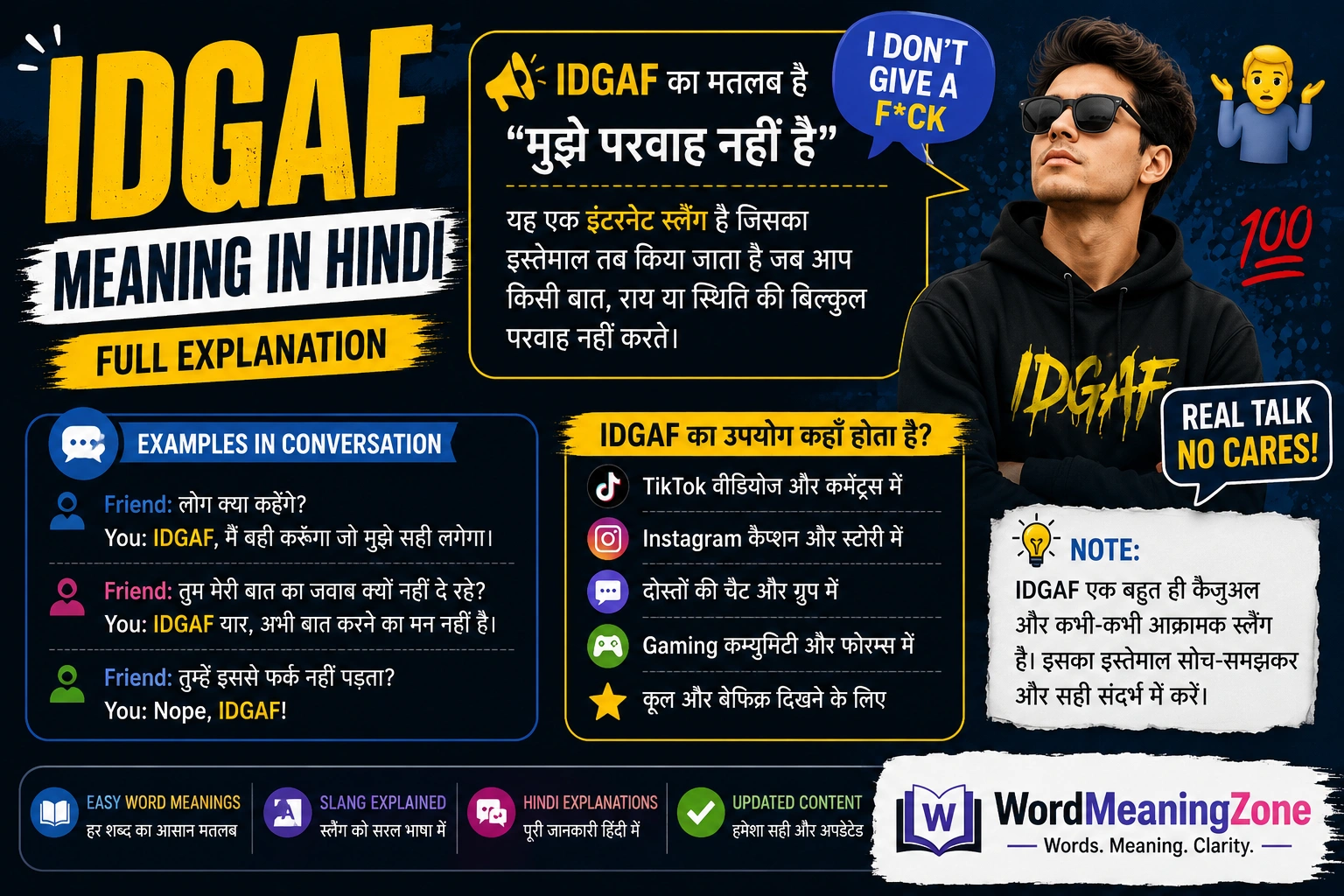
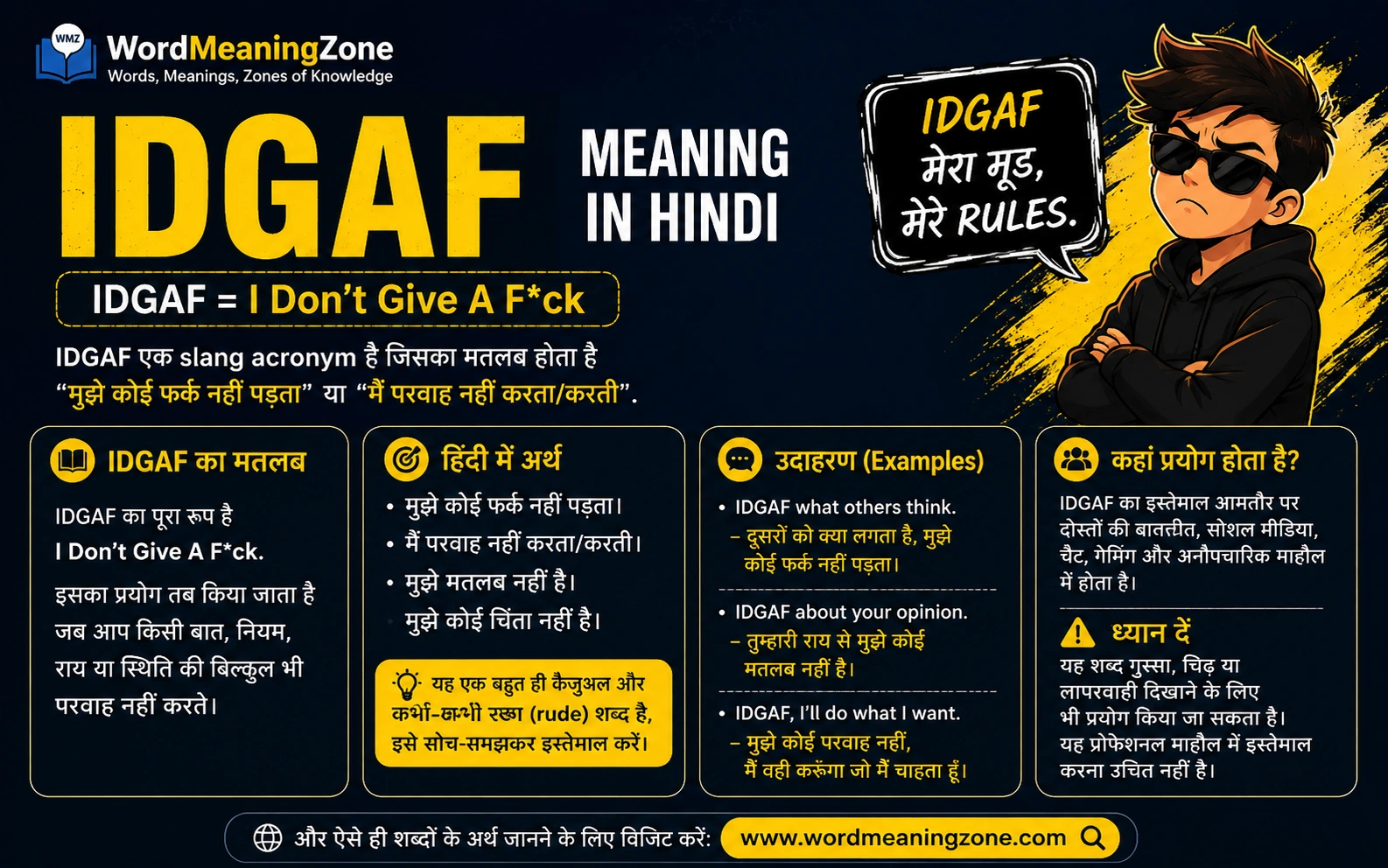
IDGAF meaning in Hindi is “मुझे कोई फर्क नहीं पड़ता” (mujhe koi farak nahi padta) — a blunt way of saying “I don’t care,” adapted from the English internet slang “I Don’t Give A F*.”** It’s not one fixed phrase, though. Depending on how savage you want to sound, the Hindi version can shift from polite to downright ruthless.
I’ve spent years watching English slang land in Indian group chats and mutate within a week — new spelling, new tone, sometimes a completely different vibe. IDGAF is one of the cleanest examples of that shift, and understanding it properly (not just Google-translating it) is the difference between sounding natural and sounding like a confused NRI uncle.
Let’s break it down properly.
What Does IDGAF Actually Mean?
IDGAF is an acronym for “I Don’t Give A F*”** — internet slang used to express indifference, defiance, or a total lack of concern. Merriam-Webster’s dictionary entry defines it plainly as informal shorthand for that exact phrase, and Dictionary.com lists it the same way, describing it as an initialism used to express dismissal.
It’s not new. Wiktionary traces documented use of the phrase back to at least the early 1990s in music lyrics, and language trackers note that Urban Dictionary logged one of its earliest formal definitions of the acronym around 2003 — right as instant messaging culture was exploding.
By 2026, both Dictionary.com and Merriam-Webster had folded IDGAF into their informal digital-slang coverage, alongside terms like “ghosting” and “FOMO.” That’s a real signal: dictionaries only formalize slang once usage is sustained across multiple platforms and communities for years, not months.
IDGAF Meaning in Hindi — 7 Ways to Say It (Polite to Full Savage)
Here’s the part most articles get lazy about. There isn’t one correct IDGAF meaning in Hindi — there’s a whole spectrum, and picking the wrong register can make you sound rude in a professional chat or weirdly formal with your friends.
| Hindi Phrase | Transliteration | Register | Best Used When |
|---|---|---|---|
| मुझे इसकी चिंता नहीं है | Mujhe iski chinta nahi hai | Formal / Neutral | Talking to elders, colleagues |
| यह मेरे लिए मायने नहीं रखता | Yeh mere liye maayne nahi rakhta | Formal, softer | Explaining a decision calmly |
| मुझे कोई फर्क नहीं पड़ता | Mujhe koi farak nahi padta | Everyday / Standard | Most casual conversations |
| मुझे परवाह नहीं है | Mujhe parwah nahi hai | Everyday, slightly firmer | Standing your ground |
| मुझे बिलकुल परवाह नहीं है | Mujhe bilkul parwah nahi hai | Emphatic | When “I really don’t care” isn’t strong enough |
| छोड़ यार | Chhod yaar | Casual slang | Dismissing something with friends |
| मुझे फर्क नहीं पड़ता, चाहे कुछ भी हो | Mujhe farak nahi padta, chahe kuch bhi ho | Full savage | Meme captions, dramatic clapbacks |
Notice the pattern: as the phrase gets more emphatic, it also gets more Hinglish-friendly. That’s not an accident — it’s exactly how code-mixed slang behaves online, and it’s why the next section matters.
Why IDGAF Meaning in Hindi Blew Up on Indian Social Media
This isn’t a fringe trend. It’s backed by real language-usage data.
- A usage report by Milestone Localization on Hinglish found that 37% of Gen Z respondents mix Hindi and English “sometimes,” while only 25% said they never do it — and a striking 75% of Gen Z respondents prefer writing in Latin script over Devanagari, compared to just 43% of Gen X.
- A 2024 study published in Humanities and Social Sciences Communications (Sengupta et al.) tracked Hinglish on Twitter between 2014 and 2022 and found the code-mixed population grew at an annualized rate of roughly 1.2%, with Hinglish usage on the platform itself climbing about 2% every year.
- Roughly 60% of respondents from Tier 2 and Tier 3 Indian cities, per the same Milestone report, actively use Hinglish in daily communication — proof this isn’t a metro-only phenomenon.
Why this matters for IDGAF specifically: it’s an attitude-word, not an information-word. Attitude-words spread fastest through code-mixed speech because tone travels better in the language you feel things in, while vocabulary travels in the language you’re exposed to online — which for most young Indians is English. IDGAF sits exactly at that intersection, so it code-mixes almost effortlessly.
The C.O.D.E. Framework: Picking the Right Hindi IDGAF Every Time
After translating and localizing slang for years, I built a simple four-point check I use before choosing a register. I call it C.O.D.E.:
- Context — Is this a chat, a caption, or a conversation with your boss? Formal contexts pull you toward “मुझे इसकी चिंता नहीं है.”
- Others — Who’s reading it? Elders and strangers deserve the softer versions; close friends can handle “छोड़ यार.”
- Delivery — Text or speech? Text can carry more attitude (emojis, caps) than spoken Hindi usually can.
- Emphasis — How much do you actually not care? Match the intensity of the phrase to the intensity of the feeling, or it reads as sarcastic when you didn’t mean it to.
Run any sentence through C.O.D.E. before you hit send, and you’ll almost never misjudge the tone.
A Quick Before/After Example Of IDGAF Meaning in Hindi
A friend of mine — a college senior in Pune — once replied to a group project complaint with a straight Google-translated line: “मुझे परवाह नहीं है इसके बारे में,” stiff and oddly formal. It read like a legal notice, and the group thought she was genuinely angry.
She switched to “yaar mujhe farak nahi padta, jo karna hai kar lo” — same meaning, completely different result. The group laughed, moved on, and the actual message (relax, do what you need to) landed correctly. That’s the whole game with IDGAF meaning in Hindi: the words barely matter compared to the register.
IDGAF vs. Its Cousins
| Term | Full Form | Intensity |
|---|---|---|
| IDC | I Don’t Care | Mild |
| IDGAF | I Don’t Give A F*** | Strong |
| IDGARA | I Don’t Give A Rat’s Ass | Strong, informal |
| IDGAFF | I Don’t Give A Flying F*** | Maximum |
Wiktionary documents this whole family of acronyms, and the Hindi equivalents scale the same way — from “मुझे कोई चिंता नहीं” (mild) up to “मुझे रत्ती भर भी परवाह नहीं” (maximum, literally “not even a grain’s worth of care”).
Common Mistakes People Make On IDGAF Meaning in Hindi
- Using the harshest Hindi version in a professional message. IDGAF’s Hindi cousins can sound like insubordination in the wrong setting.
- Assuming there’s a single “correct” translation. There isn’t — tone drives word choice, not the dictionary.
- Skipping tonal markers. Words like “यार” or a well-placed 😅 do half the emotional work Hindi speech relies on that English text doesn’t need.
- Using it with elders or teachers. Just as IDGAF is inappropriate in an English email to your manager, its Hindi versions are inappropriate with anyone you owe formal respect to.
A 30-Second Checklist Before You Hit Send
Am I texting a friend or someone I need to respect? → Pick the matching register from the table above.
Does this need a softer landing? → Add “यार” or a light emoji.
Am I writing a caption or a real conversation? → Captions can go full savage; conversations usually shouldn’t.
Would I be okay if this got screenshotted? → If not, dial it down a notch.
Key Takeaways On IDGAF Meaning in Hindi
- IDGAF meaning in Hindi has no single fixed translation — it ranges from “मुझे इसकी चिंता नहीं है” (formal) to “छोड़ यार” (casual slang).
- The term originated as English internet slang, logged on Urban Dictionary as early as 2003, and formalized by major dictionaries only recently.
- Gen Z code-mixing data (Milestone Localization, 2025) shows Hinglish, and attitude-slang like IDGAF, is now mainstream — not niche — across Indian cities.
- Use the C.O.D.E. framework (Context, Others, Delivery, Emphasis) to pick the right version every time.
Summary Of IDGAF Meaning in Hindi
IDGAF meaning in Hindi isn’t a single phrase — it’s a spectrum from “मुझे इसकी चिंता नहीं है” to “मुझे रत्ती भर भी परवाह नहीं,” and picking the right one depends entirely on who you’re talking to and how much attitude you want to carry. Backed by real Hinglish usage data and dictionary-verified origins, this slang is here to stay through 2026 and beyond.
FAQs About IDGAF Meaning in Hindi
1. What is the exact IDGAF meaning in Hindi?
The closest everyday translation is “मुझे कोई फर्क नहीं पड़ता” (mujhe koi farak nahi padta), meaning “it doesn’t matter to me at all.”
2. Is there a polite IDGAF meaning in Hindi for formal settings?
Yes — “मुझे इसकी चिंता नहीं है” or “यह मेरे लिए मायने नहीं रखता” both carry the same sentiment without sounding rude.
3. Where did IDGAF come from originally?
It’s English internet slang short for “I Don’t Give A F***,” with documented use dating back to the early 1990s and a widely cited Urban Dictionary entry from 2003.
4. Is IDGAF meaning in Hindi appropriate to use with elders?
No — like the English version, it’s informal and can come across as disrespectful with elders, teachers, or in professional messages. Use the formal alternatives instead.
5. Why has IDGAF meaning in Hindi become so popular on Indian social media?
Because Hinglish and code-mixed slang have surged among Gen Z, with reports like Milestone Localization’s Hinglish study showing 75% of Gen Z preferring casual, code-mixed, Latin-script communication over formal Hindi.
Thank you so much for reading this far—we really appreciate it!
Also Read:
Also Check out “TheNameStories” for more such interesting meanings!
