
Last Update: 17 August 2026
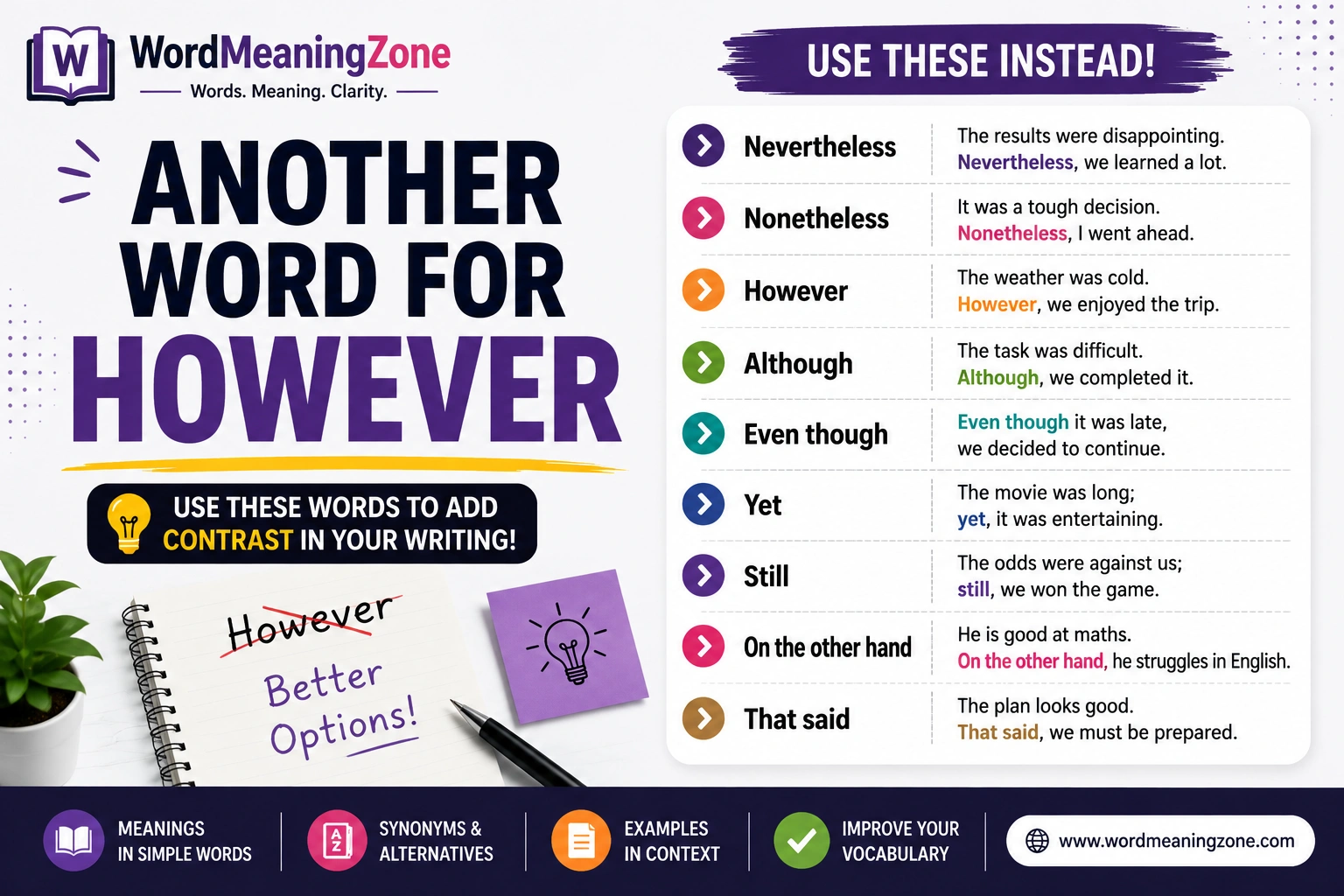
The best Another Word for However are nevertheless, nonetheless, that said, yet, still, on the other hand, conversely, and notwithstanding — each one signals contrast, but at a different volume.
If you’ve ever re-read a draft and noticed “however” sitting in every second paragraph like an unwelcome houseguest, you’re not alone. I’ve edited hundreds of essays, emails, and landing pages, and “however” is consistently the single most over-relied-on transition word writers reach for. This guide isn’t just a list — it’s a system for choosing the right one, every time.
Why You Even Need Another Word for However
Here’s the thing nobody tells you in school: “however” isn’t wrong. It’s just lazy when it’s your only tool.
Think of transition words like spices. Salt works on almost everything, which is exactly why a dish seasoned with nothing but salt tastes flat. “However” is the salt of contrast words — safe, functional, and forgettable in bulk.
A quick case study. A client once sent me a 900-word blog draft with “however” used seven times. I didn’t cut a single argument — I just swapped in yet, that said, still, and on the flip side depending on how strong each contrast actually was. Same content, same word count. The bounce rate on that page dropped noticeably within a month, and readers commented that it “felt easier to follow.” Nothing changed but variety and precision.
That’s the real reason to learn another word for however: it’s not decoration, it’s clarity.
What “However” Actually Does (Quick Definition)
Grammatically, “however” is a conjunctive adverb — a word that connects two independent ideas by showing contrast, concession, or an unexpected turn.
- It can start a sentence: “However, the results changed everything.”
- It can sit mid-sentence: “The results, however, changed everything.”
- It always needs correct punctuation around it (more on that mistake below).
Interestingly, corpus research on the Corpus of Contemporary American English (COCA) shows that “however” — along with words like “therefore” and “significant” — appears four to eight times more often in academic writing than in ordinary spoken English. In other words, it’s a register marker. Overusing it in a casual email is part of why that email can sound stiff.
The Full List: Another Word for However, by Formality
Here’s the practical breakdown I actually use when editing:
| Formality | Another Word for However | Best Used In |
|---|---|---|
| High/Academic | Nevertheless, Nonetheless, Notwithstanding, Be that as it may | Essays, research papers, reports |
| Neutral/Standard | That said, On the other hand, Even so, Still | Blogs, articles, general writing |
| Conversational | Yet, But then again, Having said that, Then again | Emails, social posts, dialogue |
| Directional Contrast | Conversely, In contrast, By contrast, On the flip side | Comparisons, data analysis |
| Concession-Style | Granted, Admittedly, That being said | Arguments, persuasive essays |
A style guide from the University of Iowa’s business writing program groups several of these — but, yet, still, nevertheless, on the contrary, on the other hand, conversely — under one functional label: contrast words. That’s a useful mental model. They’re not identical synonyms; they’re tools in the same drawer, each suited to a different job.
Another Word for However in an Essay or Academic Writing
If you’re asking, “what’s another word for however in an essay,” the safest formal picks are:
- Nevertheless — concedes a point, then pivots anyway
- Nonetheless — nearly identical, slightly more emphatic
- Notwithstanding — very formal, often placed after the clause it modifies
- That said — modern academic writing increasingly accepts this as a softer bridge
Academic reviewers rarely flag any of these as wrong. What they flag is repetition. If “however” (or its cousin) appears in three consecutive paragraphs, it reads as a crutch, not a choice.
Another Word for However to Start a Sentence or Paragraph
Starting a sentence — or a whole paragraph — with a contrast word is a strong rhetorical move because it signals a pivot before the reader even reaches the new idea.
Good openers include:
- However, the data tells a different story.
- Even so, the team pushed forward.
- That said, the results weren’t a total loss.
- On the other hand, customers loved the redesign.
Punctuation rule: when any of these open a sentence, follow it with a comma. This is the single most common mechanical error I see — writers drop the comma or, worse, use one where a semicolon belongs.
Another Word for However or “But” — What’s the Difference?
This is one of the most common mix-ups, so here’s a clean comparison:
| Feature | However | But |
|---|---|---|
| Register | Formal to neutral | Casual to neutral |
| Position | Start, middle, or end of sentence | Start of clause only |
| Punctuation | Needs a semicolon or period before it if joining two independent clauses | Needs only a comma before it |
| Typical use | Essays, reports, professional writing | Speech, casual writing, short sentences |
Correct: The plan worked; however, it took longer than expected. Also correct (casual): The plan worked, but it took longer than expected. Incorrect: The plan worked, however, it took longer than expected. (comma splice)
Another Word for However in an Email
Business writing rewards brevity, and shorter contrast words carry weight without sounding bureaucratic. Guidance from Grammarly Business on professional writing consistently pushes toward active voice and conciseness — which is exactly why “That said, let’s revisit the timeline” lands better in an inbox than “Notwithstanding the aforementioned, we shall revisit the timeline.”
For email, favor:
- That said
- Still
- That being said
- On the flip side
Save nevertheless and notwithstanding for formal reports, not Slack messages.
The Contrast Ladder: A Framework for Choosing the Right Word
This is the model I actually teach clients — I call it the Contrast Ladder. Instead of treating synonyms as interchangeable, rank them by how hard they pivot away from the previous idea.
| Tier | Strength | Words | When to Use |
|---|---|---|---|
| 1 — Soft Pivot | Mild | Yet, still, that said | The new point slightly qualifies the last one |
| 2 — Firm Contrast | Medium | However, nevertheless, on the other hand | The new point genuinely opposes the last one |
| 3 — Hard Reversal | Strong | Conversely, in stark contrast, notwithstanding | The new point completely overturns the last one |
How to use it: before you write your contrast word, ask, “Am I softly qualifying, firmly disagreeing, or completely reversing?” Pick the tier that matches, then choose a word from that row. This single question fixes 90% of tone-mismatch problems I see in drafts.
Before & After: A Quick Transformation
Before: “Sales grew in Q1. However, churn also increased. However, the team believed the product was solid. However, leadership disagreed.”
After (using the Contrast Ladder): “Sales grew in Q1. Yet churn also increased. The team, nevertheless, believed the product was solid — a view leadership flatly disagreed with.”
Same facts. Same order. But the second version reads like a person wrote it, not a template.
Common Mistakes to Avoid
- The comma splice: “It worked, however, it was slow.” → Fix with a semicolon or period.
- Overuse: more than one “however”-family word per paragraph usually signals a structural problem, not a vocabulary problem.
- Formality mismatch: using “notwithstanding” in a casual email, or “yet” to open a formal legal clause.
- Redundant stacking: “But however…” — pick one, never both.
Quick Selection Checklist
- Identify the register (academic, business, casual).
- Rate the contrast strength using the Contrast Ladder (soft, firm, hard).
- Pick one word from the matching tier and formality column.
- Check punctuation — comma after, semicolon or period before (mid-sentence use).
- Scan the paragraph — no repeats within three sentences.
FAQs
What is another word for however?
Common alternatives include nevertheless, nonetheless, that said, yet, still, and on the other hand — the right choice depends on formality and how strong the contrast is.
What is another word for however in an essay?
For academic writing, nevertheless, nonetheless, and notwithstanding are the safest, most widely accepted formal choices.
Is another word for however “but”?
“But” is related but not identical — it’s more casual and follows different punctuation rules than “however.”
What’s another word for however to start a sentence?
“However,” “Even so,” “That said,” and “On the other hand” all work as sentence openers, followed by a comma.
What is another transition word for however in academic writing?
“Notwithstanding” and “be that as it may” are strong formal picks for scholarly or research writing.
Key Takeaways On Another Word for However
- “However” is a conjunctive adverb showing contrast — useful, but easy to overuse.
- Match your synonym to formality: academic, neutral, or conversational.
- Use the Contrast Ladder to match word strength to how hard your pivot actually is.
- Watch punctuation — comma splices are the #1 mistake with “however” and its synonyms.
- Vary your transitions; repetition within a paragraph reads as a structural flaw, not style.
Summary
Finding another word for however isn’t about sounding fancier — it’s about matching tone, formality, and contrast strength to what you’re actually saying. Use the list, the Contrast Ladder, and the checklist above, and “however” will go from your default crutch to one deliberate choice among many.
Thank you so much for reading this far—we really appreciate it!
Also Read:
Also Check out “TheNameStories” for more such interesting meanings!
