
Last Updated: 19 August 2026
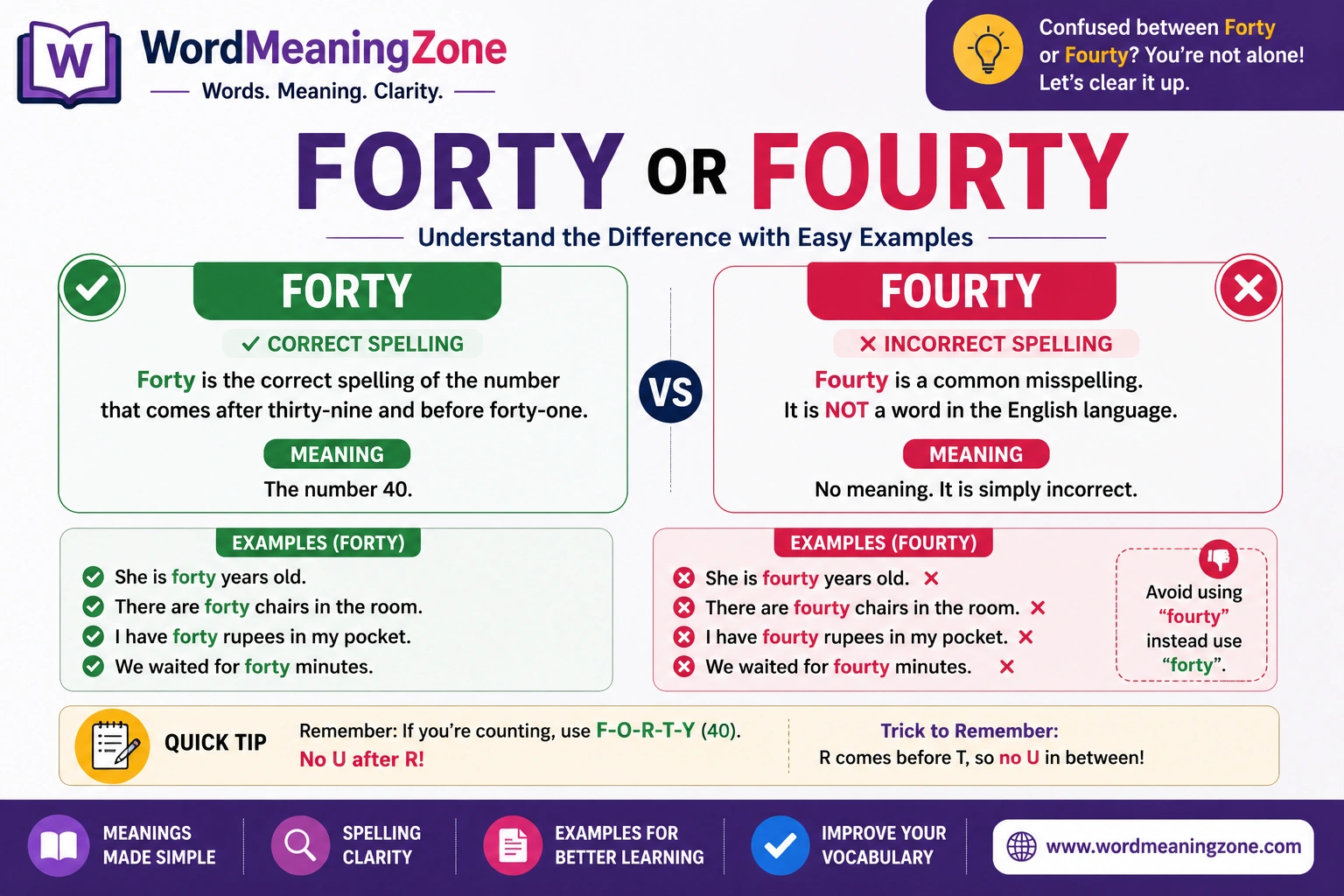
The correct spelling is forty — no “u,” no exceptions. “Fourty” is a common misspelling, not a valid alternative, in American, British, Canadian, or any other standard English.
If you’ve ever paused mid-sentence wondering “is it forty or fourty,” you’re not alone — and you’re not bad at spelling either. This is one of the strangest quirks in the English number system, because logically, “fourty” should be right. Four has a “u.” Fourteen has a “u.” So why does forty stand alone?
Let’s settle the forty or fourty debate for good — with the history, the logic, and a framework you’ll never forget.
Forty or Fourty: The Quick Answer
Before we go deeper, here’s the cheat sheet:
| Word | Correct? | Notes |
|---|---|---|
| Forty | ✅ Yes | Standard spelling in all English dialects |
| Fourty | ❌ No | Common misspelling, flagged by every major dictionary |
| Fortieth | ✅ Yes | Ordinal form of forty — no “u” |
| Fourtieth | ❌ No | Incorrect ordinal spelling |
| Forty-five | ✅ Yes | Same rule applies to compound numbers |
| Fourty-five | ❌ No | Still incorrect |
Simple rule of thumb: if you can spell “fortieth” without a u, you can spell “forty” without one too.
Why Do So Many People Write “Fourty” Instead of “Forty”?
Here’s the honest, expert answer: it’s not carelessness — it’s pattern-matching gone slightly wrong.
Your brain sees:
- Four (with a u)
- Fourteen (with a u)
- Fourth (with a u)
…and reasonably assumes the next number in the family should follow suit. But English spelling isn’t always logical — it’s historical. And history is exactly where forty broke from the pack.
The “Four Family” Trap
Every English learner falls into this trap at least once. The visual link between “four” and “forty” is so strong that even confident writers second-guess themselves. In my years editing business documents and manuscripts, “fourty” is one of the top three number-spelling errors I catch — right up there with mixing up “fourty” or “forty” in headings and titles where spell-check often gets skipped.
Is It Forty or Fourty? A Quick History Lesson
This isn’t a modern typo — it’s centuries old.
- Old English (7th–11th century): The word appeared as feowertig or feowurtig, according to the Oxford English Dictionary, a compound of feower (“four”) and tig (“group of ten”).
- Middle English (12th–15th century): Spelling was a free-for-all. Variants included fourti, fourty, feouwerti, and vourty. Geoffrey Chaucer even used “fourty” in The Canterbury Tales around 1386.
- 18th century onward: Merriam-Webster notes that “fourty” gradually fell out of standard use, and “forty” became the fixed, dictionary-recognized spelling — for reasons no linguist can fully explain.
So when people ask, “is it spelled forty or fourty,” the honest answer is: fourty used to be acceptable — about 300 years ago. Today, it’s simply outdated.
Regional note: Unlike “color” vs. “colour,” this isn’t a US-vs-UK split. Forty is correct in American English, British English, Australian English, and every other standardized dialect. There’s no “fourty” version hiding in a British dictionary.
The “Trim-Then-Ty” Framework: Why Forty Isn’t Actually Weird
Here’s a perspective most articles miss: forty isn’t an exception — it’s following a pattern.
Look at how every multiple of ten simplifies its root word before adding “-ty”:
| Base number | Tens word | What happens |
|---|---|---|
| Three | Thirty | Drops the “e” |
| Four | Forty | Drops the “u” |
| Five | Fifty | “ve” becomes “f” |
| Eight | Eighty | Root stays, “-y” adds |
| Nine | Ninety | Drops the “e” |
Every tens-word trims something for smoother pronunciation. Forty just happens to trim the letter people notice most. Once you see this pattern, the forty-or-fourty question stops feeling random and starts feeling like part of a system — because it is.
Forty or Fourty in Real Life: Cheques, Dollars, and Business Writing
This isn’t just a spelling-quiz issue. It shows up where it actually costs you credibility — or money.
Forty or Fourty in a Cheque
When writing a cheque, the written amount is the legal figure banks rely on if numerals and words don’t match. Writing “Fourty Dollars” instead of “Forty Dollars” can raise a flag during processing, since it’s not a recognized standard spelling.
Mini case study: A freelance client once handed me a cheque made out for “Fourty Thousand” — the bank’s teller manually queried it before processing, delaying the deposit by a day. The numeral was correct; the word wasn’t. That’s the real-world cost of “forty or fourty” confusion.
Forty or Fourty Dollars in Business Writing
In invoices, contracts, and receipts, “forty dollars” is standard. “Fourty dollars” reads as a typo and can undermine trust in an otherwise professional document — especially in legal or financial paperwork where precision matters.
Forty-Five or Fourty-Five? Same Rule, Bigger Numbers
The rule doesn’t change for compound numbers. Whether you’re writing 41 or 49, the base word stays “forty”:
- Forty-one, forty-two, forty-three… forty-nine
- Forty-five or fourty five which is correct? Always forty-five.
- Same goes for forty-fifth, forty-second, and so on.
If “forty” has no u, none of its compounds get one either.
The 3-Second Forty Check (Copy This Checklist)
Next time you’re unsure, run this quick mental check:
- Say “fortieth” in your head. No u, right?
- Match it. Forty follows the exact same spelling.
- Scan for stray u’s. If you typed “fourty,” delete the u.
- Apply it to compounds. Forty-five, forty-nine — same rule, no exceptions.
This works because fortieth and forty are spelling twins — they rise and fall together.
Common Mistakes to Avoid
- Writing “fourty” because “four” has a u (visual association error)
- Assuming British English uses “fourty” (it doesn’t — no dialect does)
- Spelling “fourty-five” in checks, invoices, or legal contracts
- Forgetting the same rule applies to “fortieth,” not just “forty”
- Trusting autocorrect blindly — some form fields and templates don’t flag it
Before & After: How Correct Spelling Changes Perception
Before: “We had fourty guests attend the fourty-fifth anniversary event.” After: “We had forty guests attend the forty-fifth anniversary event.”
The second version reads as polished and professional. The first quietly signals a lack of attention to detail — which matters more than most writers realize in resumes, proposals, and client-facing copy.
FAQs: Forty or Fourty
1. Which is correct, forty or fourty?
Forty is correct. Fourty is a spelling error in all modern English dialects.
2. Is it forty or fourty when writing a cheque?
Always write “forty” on a cheque. “Fourty” is not a recognized banking or legal spelling.
3. How do you spell forty or fourty correctly in formal writing?
Use “forty” in resumes, contracts, essays, and business documents. It’s the only dictionary-approved form.
4. Is 40 spelled forty or fourty in British English?
Forty — the same as American, Canadian, and Australian English. There’s no regional variant with a “u.”
5. Fourty-five or forty-five, which is correct?
Forty-five is correct. The rule for “forty” applies to every compound number built from it, including forty-one through forty-nine.
Key Takeaways
- Forty is the only correct spelling of 40 — in every English-speaking country.
- Fourty was a real variant centuries ago but has been obsolete since the 18th century.
- Forty follows the same “trim-then-ty” pattern as thirty, fifty, and ninety — it’s not a random exception.
- The rule extends to fortieth, forty-five, and every compound number.
- Getting it wrong on a cheque, invoice, or resume can cost more than embarrassment — it can cost trust and time.
Summary
The forty or fourty debate has one clear winner: forty, every time, in every context. The confusion comes from “four’s” visual pull, but history, dictionaries, and modern style guides — from Merriam-Webster to the Oxford English Dictionary — all agree on one spelling. Memorize it once using the fortieth trick, and you’ll never second-guess it again.
Thank you so much for reading this far—we really appreciate it!
Also Read:
Also Check out “TheNameStories” for more such interesting meanings!
