
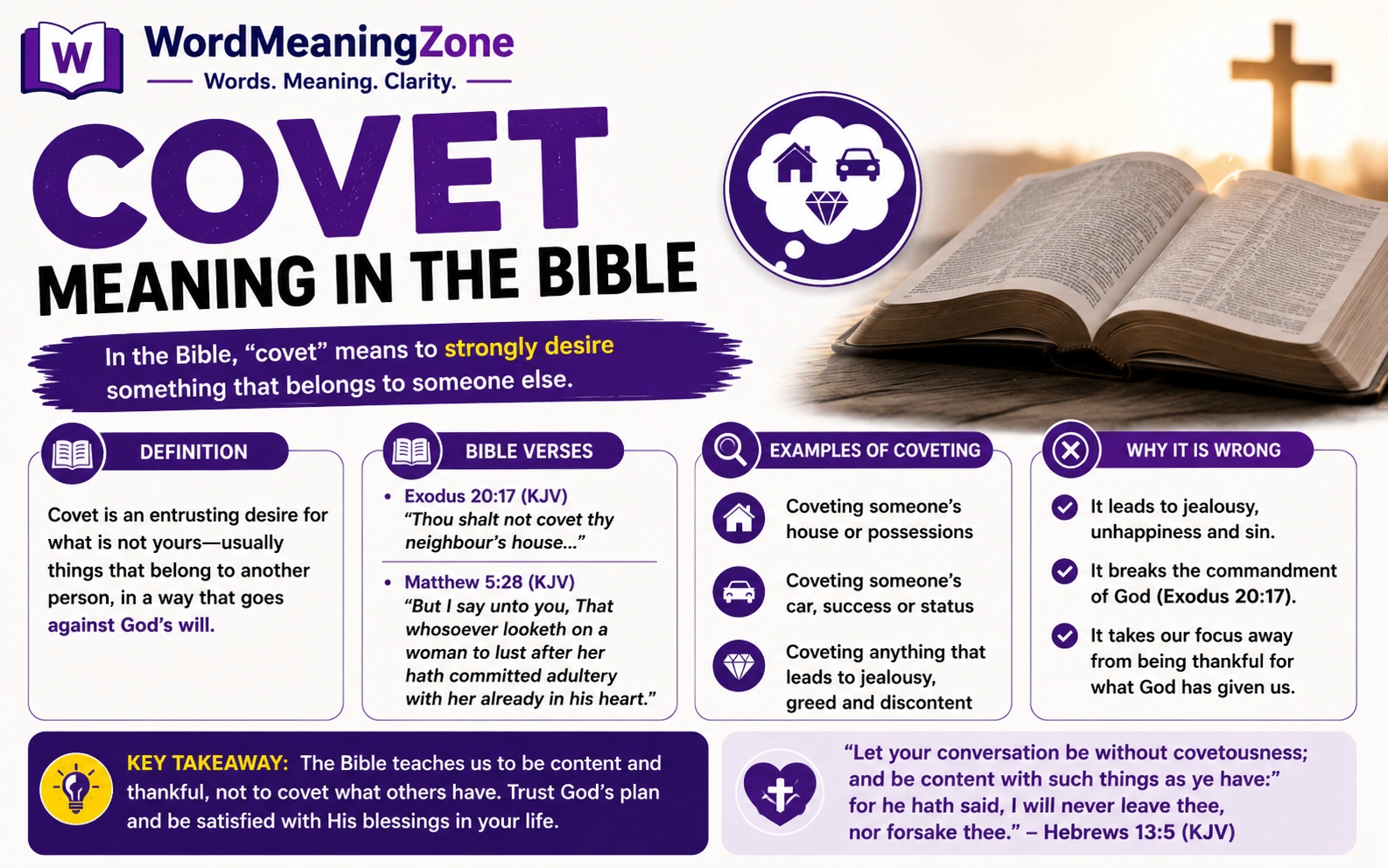
One-line answer: To covet, in biblical terms, means to selfishly and obsessively crave something that belongs to somebody else — your neighbor’s house, spouse, job, or bank account — and it’s such a serious heart-issue that God gave it its own dedicated spot in the Ten Commandments.
Okay, let’s be honest for a second. You’ve probably scrolled past the word “covet” a hundred times in church, in a wedding reading, or in that one Sunday school flannelgraph lesson, and just nodded along like you totally got it. But here’s the twist: Covet Meaning in the Bible is way juicier, weirder, and more relevant to your 2am Instagram-scrolling habit than you’d think. This isn’t some dusty commandment about not stealing your neighbor’s donkey (though, yes, donkeys are literally mentioned). It’s about the sneaky, invisible sin that starts in your head long before it ever shows up in your hands.
Grab your coffee. We’re about to unpack this properly — no boring theology-lecture vibes, promise.
Quick Facts: Covet in the Bible at a Glance
| Fact | Detail |
|---|---|
| Original Hebrew word | Chamad (חָמַד) — “to desire strongly, delight in, lust after” |
| Original Greek word (New Testament) | Epithymia (ἐπιθυμία) — “strong desire, craving, lust” |
| Where it’s officially banned | The 10th Commandment |
| First appears in | Exodus 20:17 |
| Also repeated in | Deuteronomy 5:21 |
| Most quoted verse about it | “You shall not covet” |
| Famous biblical example | Achan, Ahab, King David |
| Opposite virtue | Contentment |
| New Testament equivalent | Idolatry (per Colossians 3:5) |
What Is the Meaning of Covet in the Bible?
So, What is Covet Meaning in the Bible? In plain English: coveting is wanting something so badly — something that belongs to someone else — that it starts to control your thoughts, your choices, and eventually your actions. It’s not the same as admiring your friend’s new car and thinking “nice, I’d like one someday.” It’s the obsessive, entitled, “that should be mine” kind of wanting that eats away at gratitude.
The Hebrew word chamad pops up way before the Ten Commandments too — it’s the same root word used in Genesis 3:6, describing how Eve saw that the forbidden fruit was “desirable” (chamad again) to the eyes. Coincidence? Bible scholars don’t think so. The very first sin in the Bible and the last of the Ten Commandments are linked by the exact same word. That’s not just clever writing — it’s a pattern. Desire, unchecked, is where sin so often begins.
The Tenth Commandment: Where It All Started
Here’s where Covet Meaning in the Bible gets its official legal status, so to speak. The commandment shows up twice, worded almost identically both times.
| Version | Reference | What It Bans |
|---|---|---|
| Exodus version | Exodus 20:17 | Neighbor’s house, wife, servant, ox, donkey, “anything that belongs to your neighbor” |
| Deuteronomy version | Deuteronomy 5:21 | Neighbor’s wife, house, field, servant, ox, donkey, “anything that belongs to your neighbor” |
Notice the small difference? In Exodus, “house” comes first; in Deuteronomy, “wife” gets top billing and even gets her own separate clause. Scholars generally agree this reflects a slightly different emphasis rather than a contradiction — both versions are pointing at the same core idea: don’t let your heart start planning how to acquire what God gave to someone else.
Expert insight: Bible teachers often point out that nine of the Ten Commandments deal with actions — don’t murder, don’t steal, don’t lie. The tenth is the odd one out because it targets a feeling. You can’t arrest someone for coveting. But God clearly cared enough about internal motive to make it a top-ten offense.
You Shall Not Covet Meaning in the Bible: Why a Feeling Got Its Own Commandment
This is the part that trips people up. You Shall Not Covet Meaning in the Bible isn’t really about the object at all — the ox, the donkey, the house. It’s about the direction of your heart. Theologians frequently describe the Tenth Commandment as the “guardrail” commandment — the one that catches sin before it becomes an action. Coveting is the launchpad. Envy leads to scheming. Scheming leads to theft, adultery, slander, or worse.
The apostle Paul actually gets personal about this in Romans 7:7, admitting he might never have understood what sin really was if the law hadn’t specifically said, in short, don’t covet. For Paul, this commandment wasn’t abstract — it was the one that exposed his own heart.
Old Testament Stories Where Coveting Went Horribly Wrong
Nothing makes a concept click like a good story, and the Old Testament is basically a highlight reel of “here’s what happens when you covet.”
| Person | What They Coveted | Reference | Outcome |
|---|---|---|---|
| Achan | Silver, gold, and a fine robe from conquered Jericho | Joshua 7 | Israel’s army defeated in battle; Achan and his family faced severe judgment |
| King Ahab | Naboth’s vineyard, simply because it was next door | 1 Kings 21 | Naboth was killed on false charges; Ahab’s dynasty was later judged |
| King David | Bathsheba, another man’s wife | 2 Samuel 11 | Adultery, a cover-up, and the death of Uriah |
| Judas Iscariot | Money/silver | Matthew 26:14–16 | Betrayal of Jesus for thirty pieces of silver |
Notice the pattern? In every single case, coveting didn’t stay a private thought. It escalated. Achan’s secret desire led to a buried stash and national defeat. Ahab’s jealousy over a vineyard led to a fabricated murder plot. David’s glance at Bathsheba spiraled into one of the most infamous cover-ups in Scripture. The Bible isn’t shy about showing coveting as a gateway sin, not a harmless daydream.
What the New Testament Adds to the Conversation
The New Testament doesn’t drop the topic — it actually turns up the volume.
| Verse | Core Teaching |
|---|---|
| Romans 7:7 | The law’s command against coveting revealed Paul’s own sinfulness |
| Colossians 3:5 | Covetousness is directly called a form of idolatry |
| 1 Timothy 6:10 | The love of money is described as a root of many kinds of evil |
| James 4:2 | Unfulfilled desires and cravings are linked to conflict and quarrels |
| Luke 12:15 | Jesus warns that a person’s life isn’t measured by their possessions |
| Ephesians 5:5 | A greedy or covetous person is described as an idolater, excluded from inheriting God’s kingdom |
That Colossians 3:5 reference is a big one for understanding Do Not Covet Meaning in the Bible on a deeper level. Calling covetousness “idolatry” is a heavy statement — it means that when you covet, you’re essentially placing a created thing (money, status, someone else’s spouse, someone else’s life) on the throne that God is supposed to occupy. It’s worship, just aimed at the wrong target.
Covet vs. Desire vs. Envy vs. Lust: What’s the Actual Difference?
People throw these words around like synonyms, but the Bible treats them with more nuance than you’d expect.
| Term | Definition | Is It Always Sinful? |
|---|---|---|
| Desire | Wanting something, neutral in itself | No — desire for good things (a healthy marriage, honest work) is normal |
| Covet | Desiring something that specifically belongs to another person, often obsessively | Yes — explicitly forbidden in the 10th Commandment |
| Envy | Resentment toward someone because of what they have | Yes — listed among the “works of the flesh” in Galatians 5:19–21 |
| Lust | Intense, often sexualized craving, frequently tied to epithymia | Yes — condemned repeatedly, notably in Matthew 5:28 |
So while wanting a promotion or a nice home isn’t inherently wrong, Covet Meaning in the Bible specifically kicks in when that desire is fixated on something that already belongs to someone else, paired with a willingness to disregard their claim to it.
Covet Meaning in the Bible Tagalog
For Filipino readers searching Covet Meaning in the Bible Tagalog, the concept translates closely to the word “imbot” or the phrase “huwag mong iimbutin” — meaning “do not covet” or “do not greedily desire.” Tagalog Bible translations of Exodus 20:17 typically render the command along the lines of not desiring or coveting the neighbor’s house, wife, or belongings, preserving the same core warning found in the Hebrew original: don’t let your heart fixate on what God gave to someone else.
Why This Still Matters in a Scroll-and-Compare World
Here’s the uncomfortable modern twist: the Ten Commandments were written for shepherds and farmers, but the Tenth Commandment might be the most relevant one for people glued to social media. Coveting today doesn’t usually look like sneaking into your neighbor’s tent to steal an ox. It looks like:
- Comparing your salary to a coworker’s and stewing about it for days
- Scrolling a friend’s vacation photos and feeling a weird, sour resentment
- Wanting someone else’s relationship, house, body, or “glow-up” so badly it steals your peace
- Making financial or relational decisions purely to “keep up” with someone else’s life
Expert insight: Many pastors describe modern social media as a “coveting accelerant” — a 24/7 highlight reel that supercharges the same ancient temptation Moses warned about 3,000 years ago. The tool changed. The heart problem didn’t.
The Antidote: What the Bible Says to Do Instead
Scripture doesn’t just diagnose the problem — it offers a cure, and it shows up more than once.
| Cure | Reference | Core Idea |
|---|---|---|
| Contentment | Philippians 4:11–12 | Learning to be satisfied in any circumstance |
| Gratitude | 1 Thessalonians 5:18 | Giving thanks in all situations |
| Trust in God’s provision | Matthew 6:31–33 | Seeking God’s kingdom first instead of chasing more |
| Generosity | Acts 20:35 | Giving is framed as more blessed than receiving |
| Guarding the heart | Proverbs 4:23 | Watching over your heart, since it shapes everything else |
Contentment is really the Bible’s proposed vaccine against covetousness. It’s not about pretending you don’t want nice things — it’s about refusing to let those wants dictate your peace, your integrity, or your relationships.
Conclusion On Covet Meaning in the Bible
So, at the end of the day, Covet Meaning in the Bible boils down to this: it’s the quiet, heart-level obsession with what belongs to someone else — and Scripture treats it seriously enough to rank it right alongside murder and theft in the Ten Commandments. From Achan’s buried treasure to Ahab’s stolen vineyard to King David’s tragic choices, the Bible consistently shows that unchecked desire rarely stays contained. It grows, it spreads, and it damages relationships. The good news? The same Bible that names the problem also hands us the fix: gratitude, contentment, and a heart anchored in something bigger than the next thing we think we need.
FAQs About Covet Meaning in the Bible
1. What is the simplest definition of covet in the Bible?
To covet means to selfishly and excessively desire something — usually a possession, position, or person — that rightfully belongs to someone else.
2. Which commandment forbids coveting?
The Tenth Commandment, found in both Exodus 20:17 and Deuteronomy 5:21, directly forbids coveting a neighbor’s house, spouse, servants, animals, or anything else that belongs to them.
3. Is coveting the same as jealousy?
Not exactly. Jealousy is a broader emotional response that can include protectiveness (even good jealousy, like guarding a marriage), while coveting is specifically about craving something that belongs to another person.
4. Why is coveting called idolatry in the New Testament?
Because Colossians 3:5 groups covetousness with idolatry, since an obsessive desire for something effectively puts that thing in the position that should be reserved for God alone.
5. What is the Do Not Covet Meaning in the Bible in practical, everyday terms?
Practically, it means guarding your heart from comparison — resisting the urge to resent, scheme, or chase after what someone else has, whether that’s their job, relationship, appearance, or lifestyle.
6. Can wanting something nice ever be considered coveting?
Not automatically. Wanting a good job, a stable home, or a loving relationship is a normal, God-given desire. It crosses into coveting when that desire fixates specifically on someone else’s version of it, paired with resentment or a willingness to act wrongly to get it.
Disclaimer: This article is written for general educational and informational purposes only and reflects a plain-language overview of biblical teaching on coveting. It is not a substitute for formal theological training, pastoral counsel, or guidance from a qualified religious leader. Bible translations and interpretations can vary between denominations and scholars; readers are encouraged to study the referenced passages directly in their preferred translation and consult a pastor, priest, or biblical scholar for deeper study.
Thank you so much for reading Covet Meaning in the Bible!
Also Read:
Also Check out “TheNameStories” for more such interesting meanings!
