
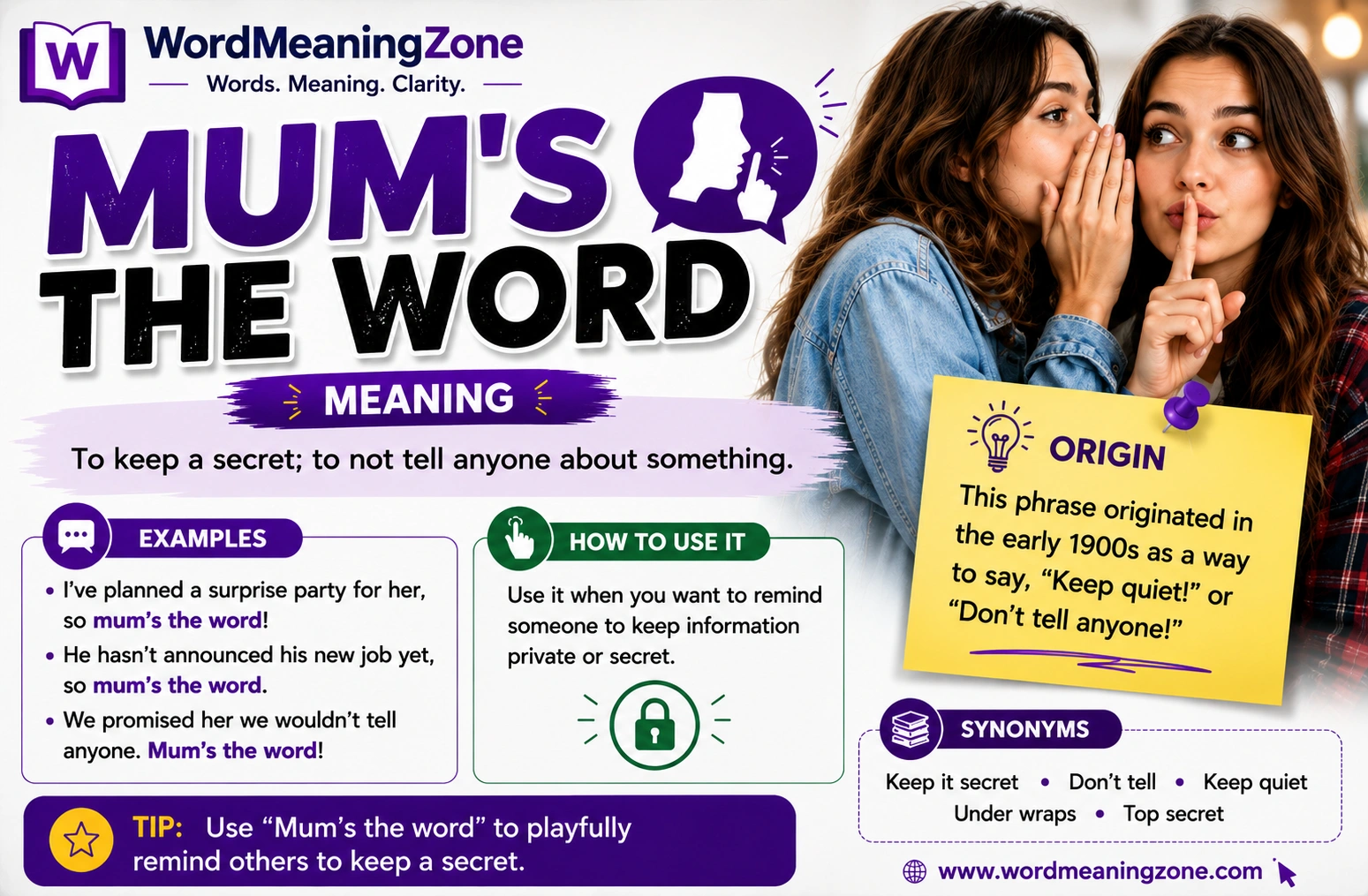
Mum’s the word means: stay quiet, keep the secret, and don’t breathe a word to anyone.
If you’ve ever typed “mum’s the word meaning” into a search bar at 11 p.m. because your coworker whispered it after a meeting and you nodded like you understood, welcome. You’re in good company. This phrase has been confusing people for over 300 years, and by the end of this guide, you’ll not only know the mum’s the word meaning cold — you’ll know exactly where it came from, how to use it without sounding stiff, and where most people trip up.
Let’s get into it.
Mum’s the Word Meaning — The Quick Definition
“Mum’s the word” is an idiom used to tell someone (or promise someone) that a piece of information will stay secret. It’s the verbal equivalent of a zipped lip.
- Part of speech: idiomatic expression (functions as a short declarative phrase)
- Register: informal to neutral — fine for texts, awkward in a legal brief
- Closest one-word synonym: “silence,” “confidentiality,” or “discretion”
- Typical use: right after someone asks you to keep a secret, or when you’re the one asking
Here’s the twist that trips up almost everyone: the “mum” in this phrase has zero connection to “mom.” It’s not about mothers, motherhood, or maternal wisdom. It comes from a sound — the closed-mouth “mmm” you make when you physically cannot speak. That single fact is the key to the whole idiom, so hang onto it.
Where Did “Mum’s the Word” Come From? A 650-Year Paper Trail
This is the part most articles gloss over, and it’s the most interesting part.
The word “mum” meaning “silent” shows up in English writing as early as 1376, in William Langland’s poem Piers Plowman. It comes from Middle English mommen, an imitative word built from the sound of a person trying to talk with their mouth shut — literally “mmm.” Some etymologists also connect it to mummer, the old term for costumed performers who acted out stories without speaking a word, relying on gesture alone.
Shakespeare Got There First
By the 16th century, English speakers were saying “mum is counsel” — meaning silence is the wisest advice. Then William Shakespeare cemented the word in the cultural memory in Henry VI, Part 2, with the line:
“Seal up your lips, and give no words but mum.”
That’s roughly 1591. It took another century or so for the exact phrase we use today to solidify. According to the Online Etymology Dictionary, “mum’s the word” as a fixed phrase is recorded by 1704, appearing in a London travel guide with the line “mum’s the word — for who would speak their mind amongst tarrs and commissioners.”
Not Your Mom’s Idiom: Debunking the Myth
Here’s the myth-busting bit worth repeating: “mum” is not short for “mother.” It’s a total coincidence that English also uses “mum” as a British nickname for mom. Two completely different word histories collided in one four-letter word, and generations of English speakers have been quietly mixing them up ever since.
| Origin Milestone | Approximate Date | Source |
|---|---|---|
| “Mum” (silence) first appears in print | 1376 | Piers Plowman, William Langland |
| “Mum is counsel” phrase in use | 1500s | Oxford English Dictionary citations |
| Shakespeare’s “give no words but mum” | c. 1591 | Henry VI, Part 2 |
| Fixed phrase “mum’s the word” recorded | 1704 | Online Etymology Dictionary |
How to Use “Mum’s the Word” in a Sentence
It’s almost always a short, standalone reassurance or instruction. Here’s how it plays out in real conversation:
| Situation | Example Sentence |
|---|---|
| Keeping a surprise party secret | “She has no idea what’s coming — mum’s the word until Saturday.” |
| Workplace confidentiality | “The layoffs aren’t public yet, so mum’s the word around the office.” |
| Reassuring a friend | “Don’t worry, I won’t tell your parents. Mum’s the word.” |
| Playful sibling secret | “I saw you sneak out last night, but mum’s the word — you owe me one.” |
Notice it almost never needs extra explanation. It’s a complete thought on its own, which is exactly why it’s survived 300+ years of casual English.
“Mum’s the Word” vs. Other Secrecy Idioms
English has a whole toolbox of ways to say “keep quiet.” Here’s how “mum’s the word” stacks up against its closest cousins:
| Idiom | Tone | Best Used When |
|---|---|---|
| Mum’s the word | Warm, casual, almost playful | Everyday secrets among friends/family |
| Keep it under wraps | Slightly more formal | Business or project confidentiality |
| Zip it / button it | Blunt, sometimes teasing | Telling someone to physically stop talking |
| My lips are sealed | Personal promise | Reassuring someone you’ll say nothing |
| Loose lips sink ships | Cautionary, high-stakes | Warning about consequences of gossip |
If you’re writing dialogue, marketing copy, or a text message, “mum’s the word” reads as the friendliest, least corporate option of the bunch — which is exactly why it still shows up constantly in casual American English despite “mum” not being the everyday US word for mother.
Why Idioms Like Mum’s the Word Meaning Trip People Up
This isn’t just a fun fact — it’s backed by research on how idioms actually function in language.
- Linguistic research by psychologist Howard Pollio and colleagues found that idiomatic expressions occur roughly once every 3 to 4 minutes in ordinary conversation — meaning phrases like this one aren’t rare quirks, they’re structural to how English speakers actually talk.
- Researchers Kreuz and Roberts found idioms make up close to 20% of the figurative language used in contemporary American literature.
- In studies of English language learners, a majority of instructors — around 70% in one ESL teacher survey — agreed idioms are one of the hardest parts of English to teach, precisely because the literal words never match the intended meaning.
- Academic work out of the University of Birmingham has shown that even fluent, university-level English learners regularly misinterpret idioms in real time, even when the surrounding sentence gives clear context clues.
The takeaway: if “mum’s the word” ever confused you, you’re not behind — you’re statistically normal. Idioms are memorized as whole units, not decoded word by word, which is exactly why “mum” never triggers a mental image of your mother once you know the phrase.
The S.E.A.L. Framework: How I Decide Whether an Idiom Will Land
After years of editing conversational copy for brands trying to sound human instead of robotic, I built a quick mental checklist for any idiom before I use it in writing. I call it the S.E.A.L. framework — a nod to Shakespeare’s own line about sealing your lips.
- Setting — Is this formal (legal, medical, technical) or casual (chat, social, blog)? “Mum’s the word” belongs firmly in casual territory.
- Exact meaning — Confirm the figurative meaning matches your intent. Here, it’s “stay silent,” not “ask your mom.”
- Audience — Will your reader recognize the phrase? It’s common in US and UK English, but can confuse non-native speakers without context.
- Line ready — Have a natural sentence prepped so it doesn’t feel forced or dropped in for effect.
Run any idiom through those four checkpoints before you publish, and you’ll rarely misfire.
Case Study: The Product Launch Almost Sunk by Three Words
A mid-sized software company I consulted with was prepping a surprise product reveal. The internal Slack message read: “Mum’s the word on the launch — don’t tell clients yet.” One newer team member, unfamiliar with the idiom, read it literally and asked in the channel, “Wait, why are we talking about moms?”
It was harmless — but it delayed a sensitive announcement by nearly an hour while people clarified the instruction. The fix was simple: the team added a one-line internal glossary of common company idioms, including “mum’s the word,” right in their onboarding doc. Small change, zero repeat confusion since.
Lesson: idioms are efficient for insiders and confusing for newcomers. Know your audience before you lean on one.
Common Mistakes With “Mum’s the Word Meaning”
- Writing “mum is the word.” It’s a contraction — “mum’s,” not “mum is.” Both are technically understood, but “mum’s the word” is the standard, more natural form.
- Assuming it’s about mothers. It isn’t. Don’t build jokes or wordplay around “mom” using this idiom — it misses the actual etymology.
- Using it in formal writing. A contract, press release, or medical form is the wrong home for this phrase — it reads as too casual.
- Overusing it as a punchline. One clean use lands. Three in one paragraph feels gimmicky.
Before and After: Making It Sound Natural
Before (stiff, overexplained): “I would like to inform you that this information is confidential, and as the popular idiom goes, mum’s the word is applicable in this situation, meaning silence.”
After (natural, confident): “Keep this between us — mum’s the word until the announcement goes live.”
Same content. One sounds like a textbook; the other sounds like a person talking.
FAQs About Mum’s the Word Meaning
1. What is the exact mum’s the word meaning?
It means to stay silent or keep a secret — a promise or instruction not to reveal information.
2. Does “mum’s the word” have anything to do with “mom”?
No. “Mum” here comes from an old word for silence (Middle English mommen), unrelated to the British word for mother.
3. Where did “mum’s the word” originate?
The underlying word “mum” dates to the 1370s; the fixed phrase “mum’s the word” is recorded by 1704, with Shakespeare using a close variant in Henry VI, Part 2 around 1591.
4. Is “mum’s the word” still used in American English in 2026?
Yes. It remains common in casual US speech, texting, and workplace chat, even though Americans more often say “mom” for mother.
5. What’s a good synonym for “mum’s the word”?
“My lips are sealed,” “keep it under wraps,” or simply “keep quiet” all carry a similar meaning, with slightly different tones of formality.
Key Takeaways On Mum’s the Word Meaning
- “Mum’s the word” means keep quiet, keep a secret — full stop.
- “Mum” comes from an old silence-word, not from “mother.”
- The phrase has roots going back to 1376, with Shakespeare using a close variant and the fixed phrase recorded by 1704.
- It’s casual — save it for conversation, chat, and informal writing, not contracts.
- Idioms like this trip up even fluent speakers, so a quick context clue never hurts.
The Bottom Line On Mum’s the Word Meaning
The mum’s the word meaning is simple once you strip away the myth: it’s a centuries-old way of promising silence, born from a sound rather than a name. Next time you hear it — or use it yourself — you’ll know it’s got more in common with Shakespeare than with anyone’s mother.
Thank you so much for reading Mum’s the Word Meaning—we really appreciate it!
Also Read:
Also Check out “TheNameStories” for more such interesting meanings!
