
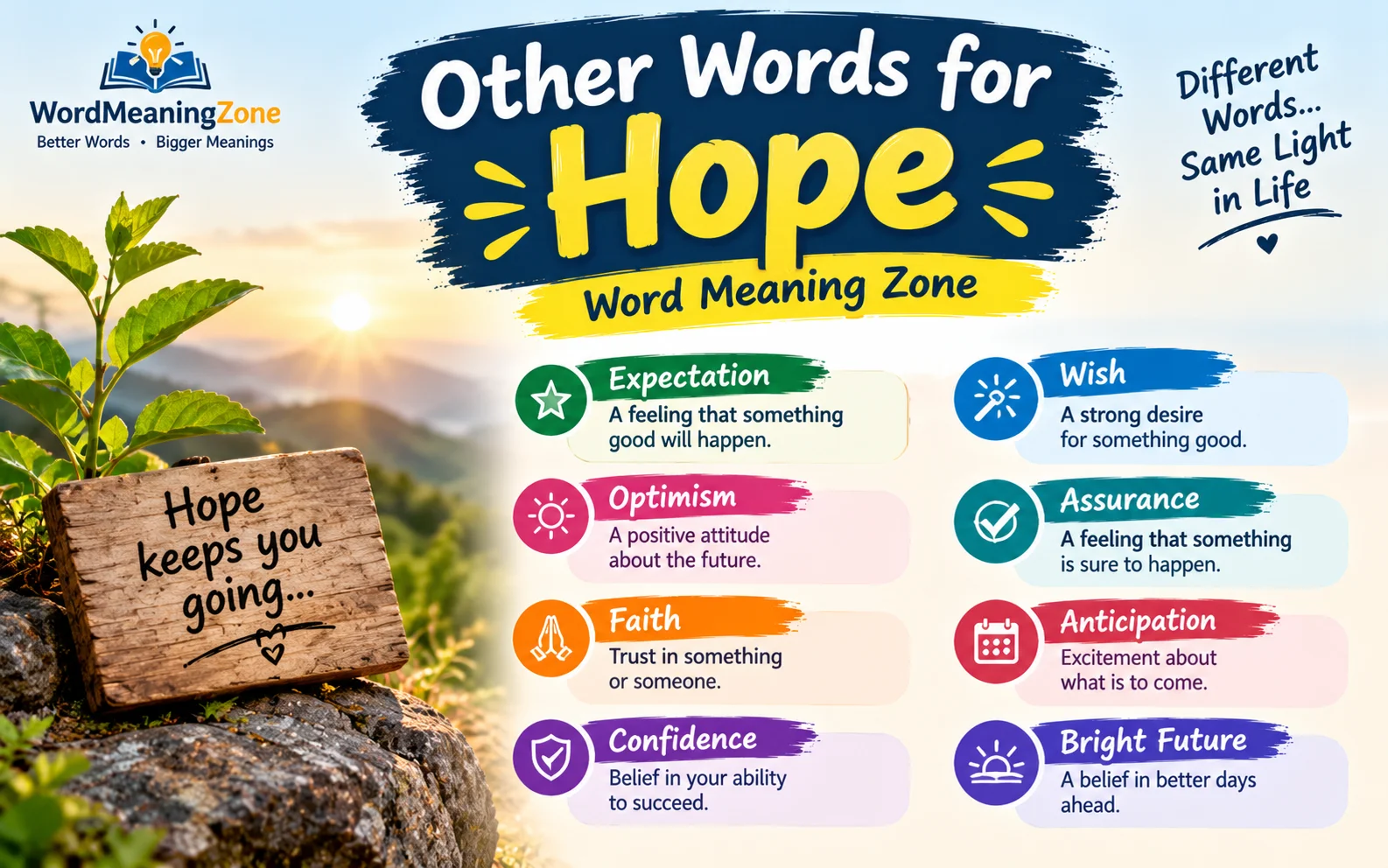
Quick answer: The best other words for hope depend on what you mean.
- To want something to happen: wish, long for, yearn for, aspire to
- To believe it will happen: expect, anticipate, trust, count on
- For the feeling itself: optimism, confidence, hopefulness, faith
- For a reason to feel positive: promise, prospect, outlook, glimmer
- For a goal: aspiration, ambition, dream
“Hope” does several jobs. It is a verb (“I hope it works”), a noun (“There is still hope”), and the opening word of countless emails (“Hope you are doing well”). This guide sorts the alternatives by job, shows how much certainty each word carries, and covers the email phrases people search for most, so you can pick the right word the first time.
Quick-Reference Table: Other Words for Hope by Meaning
| If you mean… | Best alternatives | Example |
|---|---|---|
| To want something to happen (verb) | wish, long for, yearn for, desire | “I wish the project would finish early.” |
| To expect it will happen (verb) | expect, anticipate, look forward to, count on | “We anticipate a reply by Friday.” |
| To aim for something (verb) | aspire to, aim to, plan to, intend to | “She aspires to lead the team.” |
| The feeling of optimism (noun) | optimism, hopefulness, confidence, faith | “Optimism ran high after the first results.” |
| A goal or dream (noun) | aspiration, ambition, dream | “His aspiration is to teach.” |
| A reason to feel positive (noun) | promise, prospect, outlook, glimmer | “The trial shows real promise.” |
| A person or thing you rely on (noun) | best chance, lifeline, saving grace | “The grant was their lifeline.” |
| A friendly email opener | I trust you are well, I hope you’re having a good week | See the email section |
What Does “Hope” Mean?
As a verb, Merriam-Webster defines hope as wanting something to happen or be true while thinking it could. As a noun, Dictionary.com describes it as the feeling that what you want can be had, or that events will turn out for the best. The word traces back to Old English hopa.
Merriam-Webster also groups hope with expect and look, all meaning to await an outcome. Of the three, hope implies the least certainty, yet it still leans toward confidence that the thing is possible. That detail explains most synonym choices: the words differ mainly in how sure the speaker is.
The Certainty Ladder
Use this framework to compare options. Moving up the ladder means more certainty, and moving down means less.
| Level | Other Words for Hope | What it signals |
|---|---|---|
| 6 (highest) | know / be certain | No real doubt |
| 5 | trust, be confident | Strong belief, usually based on past reliability |
| 4 | expect | It should happen; often carries an assumption of right |
| 3 | anticipate, look forward to | You are preparing for it, usually with positive feeling |
| 2 | hope | Wanted and possible, but uncertain |
| 1 (lowest) | wish | Wanted, but possibly unlikely or impossible |
Two quick tests show the ladder at work:
- “I wish you were here” implies you are not. “I hope you are here” implies you might be.
- “I expect a reply by Friday” is a demand. “I hope for a reply by Friday” is a polite request.
What Are Some Other Words for Hope? (By Meaning)
To Want Something to Happen
| Other Words for Hope | Nuance | Example |
|---|---|---|
| Wish | Mild desire; can be unlikely | “I wish it would stop raining.” |
| Long for | Deep, patient desire | “He longs for a quiet life.” |
| Yearn for | Intense, emotional longing | “They yearned for news from home.” |
| Desire | Formal, strong wanting | “The board desires a swift resolution.” |
| Pray | Hope directed to a higher power or spoken as a heartfelt plea | “We are praying for good weather.” |
| Dream of | Hope for something big or distant | “She dreams of opening a bakery.” |
| Set your heart on | Hope tied to strong personal commitment | “He set his heart on that job.” |
To Believe It Will Happen
| Other Words for Hope | Nuance | Example |
|---|---|---|
| Expect | Reasonable certainty | “I expect the order to arrive Monday.” |
| Anticipate | Expect and prepare | “We anticipate high demand.” |
| Look forward to | Expect with pleasure | “I look forward to meeting you.” |
| Count on / bank on | Rely on it happening | “Don’t count on a refund.” |
| Trust | Confidence grounded in reliability | “I trust the results will hold.” |
| Await | Formal waiting | “We await your decision.” |
Other Words for Hope To
When “hope” is followed by to plus a verb, the alternatives depend on how much control you have:
- Aim to / plan to / intend to: you control the outcome. “We intend to launch in March.”
- Aspire to: a high, long-term goal. “She aspires to become a surgeon.”
- Expect to: you are fairly sure. “I expect to finish by noon.”
- Would like to / am keen to: polite, softer wanting. “I would like to join the call.”
If the result depends on luck or other people, hope is usually the more honest word. “I hope to win the lottery” cannot be swapped for “I intend to.”
The Noun: Hope as a Feeling
Optimism
a general habit of expecting good outcomes
Hopefulness
hope about a specific situation
Confidence
well-founded belief that things will go right
Faith
trust without needing proof
Anticipation
excited expectation
Buoyancy / good cheer
lighthearted positivity
The Noun: A Goal or a Reason for Hope
- Aspiration, ambition, dream: what you aim for
- Promise, prospect, outlook: signs that things may go well (“a promising outlook”)
- Glimmer, ray, spark, flicker: small signs of hope (“a glimmer of hope”)
- Silver lining, light at the end of the tunnel: idioms for hope found in a bad situation
- Lifeline, last resort, saving grace, best chance: the person or thing a situation depends on
Other Words for Hope and Faith
The two overlap but are not twins. Hope looks ahead and wants a particular outcome. Faith is trust or belief, often held without proof and not always about the future. In Christian tradition the two sit side by side as separate virtues alongside love (charity). In everyday writing, use faith when the idea is trust (“I have faith in the team”) and hope when it is desire for an outcome (“I hope the team wins”). Words that blend both include confidence, belief, trust, conviction and optimism.
Other Words for Hope in Different Languages
| Language | Other Words for Hope | Pronunciation or note |
|---|---|---|
| Spanish | esperanza | The verb esperar means both “to hope” and “to wait” |
| French | espoir | Also espérance in literary or religious use |
| German | Hoffnung | |
| Italian | speranza | |
| Portuguese | esperança | |
| Latin | spes | |
| Hindi | आशा (aasha), उम्मीद (ummeed) | Both are common in everyday speech |
| Arabic | أمل (amal) | |
| Russian | надежда (nadezhda) | |
| Japanese | 希望 (kibō) | |
| Chinese | 希望 (xīwàng) | |
| Korean | 희망 (huimang) |
Other Words for Hope in Emails and Messages
Many people searching for other words for hope want a fresher way to open or close a message. The same rule applies here: match your tone to the relationship.
| Phrase you want to replace | Formal / professional | Friendly / casual |
|---|---|---|
| Hope you are doing well | I trust you are well. / I hope you are keeping well. | Hope you’re having a good week! / How have you been? |
| Hope you are well | I trust all is well on your end. | Hope all’s good with you! |
| Hope all is well | I trust everything is going smoothly. | Hope things are going great! |
| Hope this email finds you well | I hope you are well. / I trust you are having a productive week. | Hope your week’s off to a good start. |
| Hope you have a good day | I wish you a productive day. / Enjoy the rest of your day. | Have a great one! / Make it a good one! |
| Hope you feel better | Wishing you a speedy recovery. / Please take the time you need to recover. | Get well soon! / Take care of yourself. |
| Hope to hear from you soon | I look forward to your reply. / I would appreciate your thoughts at your convenience. | Let me know what you think! |
| Hope to see you soon | I look forward to seeing you. / I hope our paths cross again soon. | Can’t wait to catch up! |
Is “Hope You Are Doing Well” Still Acceptable?
Yes. Grammarly notes there is nothing wrong with “I hope this email finds you well” as a formal greeting, though it can feel overused. Scribbr points out that the clipped form “Hope you’re doing well” lacks a subject, so it is technically incomplete. That is fine in casual messages, but add “I” in formal writing.
Before and After: A Worked Example
Before (generic):
Hope you are doing well. Hope to hear from you soon.
After (specific and tone-matched):
I hope your week is going well. I’d appreciate your feedback on the draft by Thursday if possible.
The second version does two things the first does not. It anchors the greeting in something real (the week), and it replaces a vague wish with a clear request and deadline. “Hope to hear from you soon” gives the reader no timeframe, so it is easy to ignore.
Tips for Better Email Openers
- Reference something real: a recent meeting, the weekend, a project milestone.
- Match the relationship: “I trust you are well” suits a senior client, while “Hope you had a good weekend” suits a colleague.
- Be careful with “I wish you well.” It can sound like a goodbye rather than a greeting.
- Skip the opener when the message is urgent and you already talk daily. A direct first line is fine.
Formal, Informal and Slang Alternatives
| Register | Words and phrases |
|---|---|
| Formal | anticipate, aspire to, trust, desire, it is my hope that, prospect, confidence |
| Neutral | hope, wish, expect, look forward to, optimism, dream |
| Informal | fingers crossed, here’s hoping, counting on it, banking on it, rooting for you, pinning my hopes on |
| Slang / internet | hopium (wishful, often unrealistic optimism, usually said with irony), manifesting (hoping combined with positive intention), praying for (used casually) |
| Idiomatic | knock on wood / touch wood, light at the end of the tunnel, silver lining, hope against hope (to keep hoping despite poor odds) |
Antonyms of Hope
| Antonym | Meaning | Example |
|---|---|---|
| Despair | Complete loss of hope | “She sank into despair after the news.” |
| Hopelessness | A sense that nothing will improve | “A mood of hopelessness filled the room.” |
| Despondency | Low spirits from lost hope | “His despondency lasted for weeks.” |
| Pessimism | A habit of expecting the worst | “Her pessimism is hard to shake.” |
| Dejection | Sadness after disappointment | “The loss left the team in dejection.” |
| Doubt | Uncertainty about the outcome | “There is little doubt it will pass.” |
| Dread (verb or noun) | Fearing the outcome | “I dread the results.” |
| Resignation | Accepting a bad outcome without expecting change | “He accepted the decision with resignation.” |
For the verb, common opposites are fear, dread, doubt and despair.
How to Choose the Right Other Words for Hope
Follow this four-step workflow:
- Decide the job. Is “hope” a verb, a noun, or an email opener? Verbs and nouns have separate synonym sets.
- Check the certainty. Use the ladder above. Do you want something (wish), expect it (anticipate), or rely on it (trust)?
- Match the register. Aspire and anticipate fit reports. Fingers crossed fits a text to a friend.
- Test the swap. Substitute the word and read the sentence aloud. Check that the grammar still works, since aspire needs to, long needs for, and expect can take that.
Common Mistakes to Avoid While Choosing Other Words for Hope
- Using “expect” where you mean “hope.” “I expect you are well” can sound presumptuous. “I expect your reply by Monday” sounds like an order.
- Writing “I wish you are well.” Wish takes the past subjunctive for unreal situations (“I wish you were here”). For a real possibility, use “I hope you are well.”
- Treating faith and hope as identical. Faith is trust. Hope is desire plus possibility.
- Over-formalizing. “I aspire to receive your reply” sounds stiff. A plain “I look forward to your reply” works better.
- Replacing “hope to” with “intend to” when luck is involved. “Intend” claims control you may not have.
- Using the same opener in every email. Even a good phrase becomes background noise when repeated.
- Overusing “trust.” “I trust you are well” is polite once, but it can read as assuming the answer.
FAQs About Other Words for Hope
What is a poetic word for hope?
Beacon, glimmer, dawn, lodestar and silver lining all carry a poetic tone. “A beacon of hope” is the most familiar phrase.
What is the difference between “hopeful” and “optimistic”?
Hopeful usually refers to a specific situation (“hopeful about the interview”). Optimistic describes a general habit of expecting good outcomes.
Is “hopefully” the same as “I hope”?
In everyday English, “Hopefully, the report arrives today” is widely used to mean “I hope the report arrives today.” Some editors still prefer the “I hope” version in very formal writing.
How do I reply to “I hope you are doing well”?
Answer briefly, then return the courtesy: “I’m doing well, thank you. I hope you are too.” Then move on to the topic of the email.
What is a stronger word than hope?
It depends on direction. For intensity of desire, use yearn or long for. For more certainty, use expect, trust or be confident.
Final Takeaway On Other Words for Hope
Choosing among the other words for hope comes down to two questions: how sure are you, and who are you talking to? Pick wish for the uncertain, expect or trust for the confident, aspire for long-term goals, and a specific, personal phrase when you are writing an email. A well-chosen synonym makes your meaning more precise, and it often makes your tone warmer too.
