
Last Updated: 21 August 2026
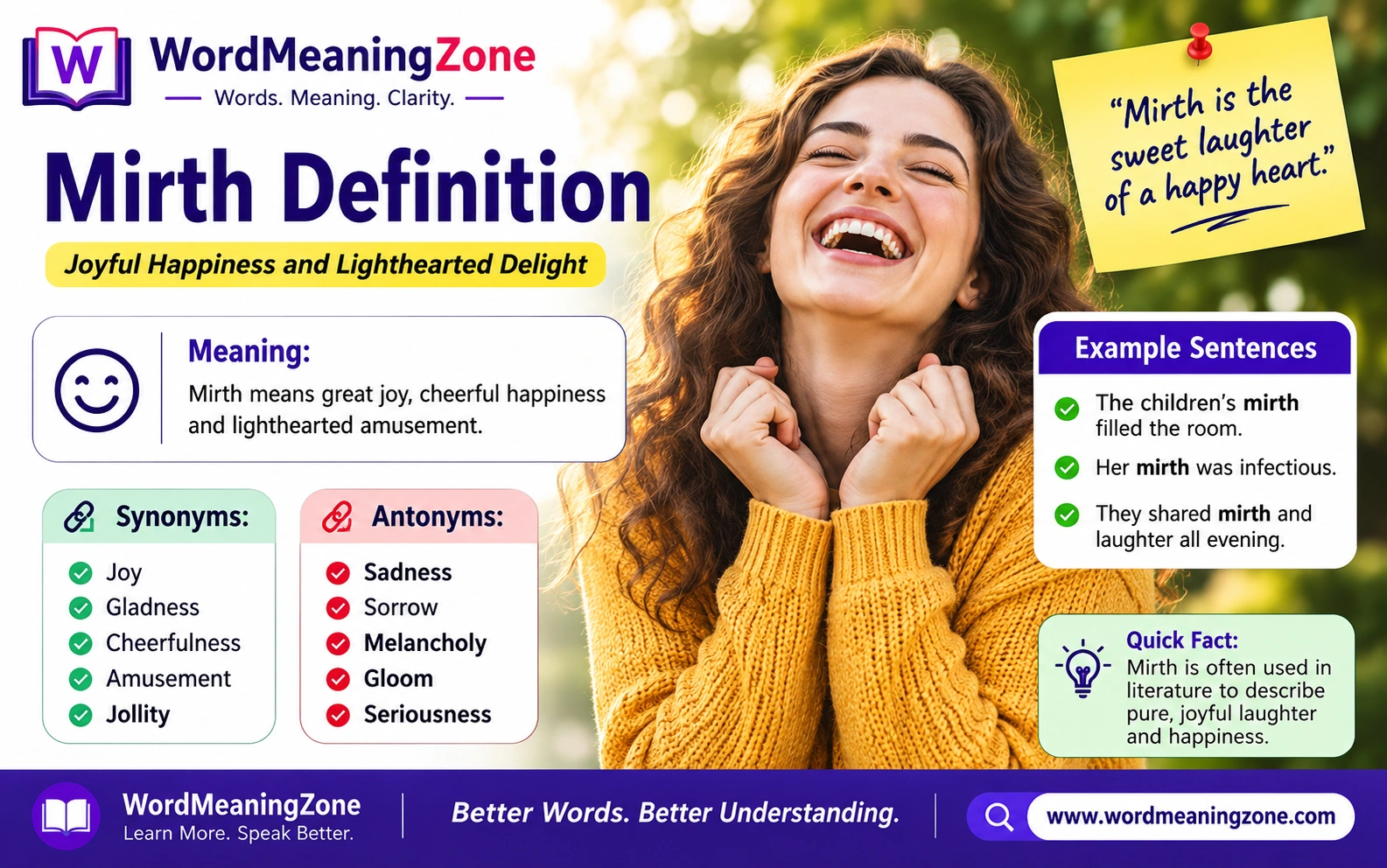
Mirth definition, in one line: mirth is gladness or amusement so strong it spills out as laughter — joy with sound effects.
That’s the textbook version. But if you’ve landed here searching for the mirth definition, you probably want more than a one-liner. You want to know why this quietly elegant word has survived over a thousand years of English, why dictionaries file it under “literary,” and why it’s suddenly showing up in 2026 headlines again. I’ve spent years chasing down exactly-right words for a living, and mirth is one of my favorites — because it does something “happy” and “fun” can’t. It carries sound. Let’s dig in.
The Short Answer: Mirth Definition in Plain English
According to Merriam-Webster, mirth is “gladness or gaiety as shown by or accompanied with laughter.” Dictionary.com frames it as a formal or literary term for fun and enjoyment expressed through laughter. The Oxford English Dictionary traces the same core idea back over a thousand years: joyousness, cheeriness, and merriment.
Strip away the dictionary formality, and here’s the working definition I use:
Mirth (noun): an outward, laughter-linked expression of deep gladness — closer to “delight in motion” than a quiet inner mood.
That distinction matters. You can be happy alone on a park bench. Mirth, almost by definition, wants an audience, a joke, a shared moment.
Where “Mirth” Comes From (And Why That Matters)
The mirth definition gets richer once you look at its roots. The word traces to Old English myrgth, tied to myrge — the ancestor of “merry.” Etymonline and the Oxford English Dictionary both confirm mirth has been in continuous use since before the year 1150, making it one of the oldest emotion-words still active in English.
Here’s the twist most articles skip: linguists tracing the Proto-Germanic root of “merry” and “mirth” back further connect it to a Proto-Indo-European word meaning “short” or “brief.” Language Log’s Mark Liberman highlighted this exact connection in a 2025 etymology roundup. The working theory is that something “brief” or “light” came to mean something “pleasant” — and eventually, “merry.”
Why does that matter for you? Because it reframes mirth as something built to be fleeting on purpose. Mirth was never designed to be a permanent state — it’s a spark, not a pilot light. That’s precisely why chasing constant happiness burns people out, while chasing small, repeated bursts of mirth doesn’t.
Mirth vs. Joy vs. Merriment vs. Happiness
These words get used interchangeably, which is exactly why the mirth definition gets muddy. Here’s how they actually split, based on Collins English Dictionary’s usage notes and Merriam-Webster’s synonym guidance:
| Term | Core Meaning | Duration | Needs an Audience? |
|---|---|---|---|
| Mirth | Gladness expressed through laughter | Short burst | Usually yes |
| Joy | Deep, often quiet emotional delight | Can be lasting | No |
| Merriment | Fun, good spirits, playful atmosphere | Short-to-medium | Yes |
| Happiness | General positive state of wellbeing | Long-term | No |
| Jollity | Hearty, convivial festive spirit | Short-to-medium | Yes |
Collins notes that merriment leans toward good nature and warmth, while mirth and its cousin “hilarity” imply the sharper, more sudden trigger of wit or comedy. In plain terms: happiness is the weather, mirth is the lightning.
The Science of Mirth: Why Laughter Actually Changes Your Body
This is where the mirth definition stops being a vocabulary lesson and starts being genuinely useful. Laughter — the physical signature of mirth — is measurably good for you, and the data is more specific than most people assume:
- Cortisol drops fast. A systematic review and meta-analysis published in PLOS One found spontaneous laughter produces a measurable reduction in cortisol, the body’s primary stress hormone, compared to normal activity.
- Productivity rises. Research cited by the World Economic Forum found employees who watched a short comedy clip before starting work were roughly 10% more productive on problem-solving tasks than those who didn’t.
- Teams perform better. A meta-analysis spanning 49 studies and more than 8,500 participants found positive workplace humor measurably improved individual resilience, group cohesion, and overall performance.
- Leaders get rated higher. Harvard Business Review’s 2025 research on humor and leadership found leaders with a strong sense of humor were rated 27% more motivating by their teams.
- Laughter is still common — but guarded. Monster’s 2026 Workplace Laughter Report found 77% of employees laugh at least three times during a typical workday, and 95% say laughter helps them feel connected to coworkers — yet 76% still hold back humor around senior leadership.
The mechanism behind most of this, per Mayo Clinic and Stanford Lifestyle Medicine, is straightforward: laughter triggers dopamine and endorphin release, lowers cortisol, and — over time — can even support memory by protecting the hippocampus from chronic stress damage.
Case Study: Engineering Mirth on Purpose
A few years back, a mid-sized customer support team I consulted with had a morale problem nobody could quite name. Engagement scores were fine. Turnover wasn’t alarming. But meetings felt flat, and flat meetings breed flat customer calls.
Instead of another “culture initiative,” the manager tried something almost embarrassingly simple: she opened every Monday stand-up with a 90-second genuinely funny clip — nothing work-related — before diving into metrics.
Within six weeks, two things shifted. First, meeting participation visibly picked up; more people volunteered updates unprompted. Second, and more telling, peer-recognition messages in their internal chat tripled. Nobody was told to be nicer to each other. The mirth simply primed the room.
That’s the mechanism the data above predicts: a short comedic trigger lowers stress hormones just enough to unlock the creativity and openness that a tense room suppresses. It’s not magic. It’s cortisol.
The S-P-A-R-K Framework: Build More Mirth Into Any Day
Here’s a simple framework you can copy into your own routine or team ritual. I built it around what the research above actually supports — not vague “be more positive” advice.
S — Spot the trigger. Identify one small, low-effort source of humor you control (a clip, a meme, an inside joke).
P — Place it early. Mirth works best as a primer, not a reward. Use it before a hard task, not after.
A — Audience it. Mirth is social by nature. Share it with at least one other person instead of consuming it alone.
R — React out loud. Let the laugh actually happen. Suppressed laughter doesn’t trigger the same cortisol drop.
K — Keep it brief. Remember the etymology — mirth was built to be short. Thirty to ninety seconds is enough; don’t force it into a whole meeting.
Quick Daily Mirth Checklist
Found one thing genuinely funny today (not just “fine”)
Laughed with someone else, not just at a screen alone
Used mirth before a stressful task, not only after
Didn’t apologize for laughing at work
A Before/After: Writing With Mirth vs. Without It
Before (flat): “Our team had a great quarter and we’re happy with the results.”
After (mirthful): “Our team hit its numbers, high-fived a little too hard, and one spreadsheet did, in fact, get a standing ovation.”
Same information. The second version uses concrete, laughter-triggering specificity instead of an abstract adjective — which is exactly what separates mirth from generic “happiness” language in writing, marketing copy, or speeches.
Common Mistakes People Make With the Mirth Definition
- Confusing mirth with forced positivity. Mirth is a reaction, not a mandate. You can’t schedule authentic laughter the way you schedule a meeting.
- Treating it as a synonym for “fun.” Fun is broader and doesn’t require laughter. Mirth specifically implies that laughing, spilling-over quality.
- Assuming it’s outdated. Merriam-Webster’s own 2026 usage examples show mirth appearing in Variety, ARTnews, and the Los Angeles Times this year alone — it’s alive in modern criticism and journalism, just used sparingly for effect.
- Overusing it in casual speech. Because mirth reads as literary, dropping it into everyday conversation can sound stiff. Save it for writing where precision matters.
Mirth in 2026: How the Word Is Being Used Right Now
Far from a dusty relic, mirth is doing real work in current writing. Critics use it specifically because “funny” or “happy” feel too plain for a nuanced reaction — a performance that’s darkly comic, a scene that mixes grief and laughter, a character whose humor cuts against the room’s mood. That’s the mirth definition doing its job: signaling amusement with an edge, not just simple enjoyment.
Frequently Asked Questions
1. What is the mirth definition according to Merriam-Webster?
Merriam-Webster defines mirth as gladness or gaiety shown by or accompanied with laughter — an outward, audible expression of amusement rather than a quiet inner mood.
2. Is mirth the same thing as happiness?
No. Happiness is a general, often long-lasting state of wellbeing. Mirth is a short, laughter-linked burst of gladness, usually triggered by something specific like a joke or a shared moment.
3. What part of speech is “mirth”?
Mirth is a noun (uncountable), with “mirthful” as its adjective form and “mirthfully” as the adverb.
4. Is mirth an old-fashioned word?
It reads as formal or literary rather than outdated. Dictionaries like Longman and Dictionary.com label it “literary,” and it still appears regularly in journalism, criticism, and fiction in 2026.
5. What is the opposite of mirth?
Common antonyms include gloom, sadness, and being “mirthless” — the absence of amusement or gladness rather than active sorrow.
Key Takeaways
- Mirth means gladness expressed through laughter — briefer and more social than general happiness or joy.
- It traces back over a thousand years to Old English myrgth, sharing a root with “merry” and, further back, a word meaning “brief.”
- Laughter tied to mirth measurably lowers cortisol, boosts productivity by around 10%, and makes leaders seem up to 27% more motivating.
- The S-P-A-R-K framework (Spot, Place, Audience, React, Keep it brief) gives you a repeatable way to build more mirth into daily routines.
- Mirth is still very much alive in 2026 writing — it’s just reserved for moments that need more precision than “funny” or “happy.”
In Short
The mirth definition boils down to this: it’s gladness that laughs out loud, built by design to be brief, social, and sharp. Understanding that difference — and using the small framework above — is the fastest way to bring more of it into your writing, your meetings, and your week.
Thank you so much for reading this far—we really appreciate it!
Also Read:
Also Check out “TheNameStories” for more such interesting meanings!
